As Cardinal Mercier said : "When prudence is everywhere, courage is nowhere."                                                                                  From Cardinal Sarah : "In order to avoid hearing God's music, we have chosen to use all the devices of this world. But heaven's instruments will not stop playing just because some people are deaf."                                                                                              Saint John-Paul II wrote: "The fact that one can die for the faith shows that other demands of the faith can also be met."                                                 Cardinal Müller says, “For the real danger to today’s humanity is the greenhouse gases of sin and the global warming of unbelief and the decay of morality when no one knows and teaches the difference between good and evil.”                                                  St Catherine of Siena said, “We've had enough exhortations to be silent. Cry out with a thousand tongues - I see the world is rotten because of silence.”                                                  Chesterton said, “The Christian ideal has not been tried and found wanting. It has been found difficult; and left untried.”                                                Brethren, Wake up!
Showing posts with label Faith. Show all posts

RIGHT TO LIFE - NORTHERN IRELAND

The campaign Right to Life is coordinating responses to the Northern Ireland Public Consultation on sex-education in schools, particularly in relation to mandatory teaching about abortion to the very young, the policy proposed by the Department of Education. 79% of Irish respondents to the earlier consultation did not want abortion laws imposed by Westminster.

It takes a minute to respond to the consultation on the link below.  The deadline is this Friday at one minute to midnight. Please consider adding your voice for Life.


Our Lady of the Presentation, pray for all children.

SAINT JOSEPH - A MEDITATION

This wonderful meditation upon Saint Joseph was preached at the August day of Recollection by Fr Paul Keane, Chaplain of the University of Cambridge, priest of Brentwood Diocese, and recently a Magistral Chaplain of our Order. We are very grateful to him for these spiritual insights.

From the Holy Family and St Catherine by Bordoni

Devotion to St Joseph 

AMDG

I was not meant to be here. Nor were the professed knights. This weekend we were to be on retreat at Farnborough Abbey. But the abbey became unavailable and, instead, we shall make the retreat in October. But with every loss there is a gain. We can be here. However, let me bring something of Farnborough to Golden Square. Not its beautiful chapel or the tomb of Emperor Napoleon III but St Joseph.

Even if we know Farnborough, we may not immediately associate it with the spouse of Our Lady, but the national shrine of St Joseph is at the abbey. If any of us did not know there was a national shrine of St Joseph, you have not failed your English Catholic proficiency test. Its existence has been a well-kept secret since it was originally established at Mill Hill in 1866 by Fr Herbert Vaughan, the future Cardinal Archbishop of Westminster. He sought and received from Blessed Pope Pius IX permission for a canonical coronation of a statue of St Joseph.

Receiving the pope’s specific blessing for the crowning of images of Our Lady began in the early seventeenth century. Such coronations were extended to only one other saint - St Joseph - in the late eighteen century. It began with the crowing of his image at Kalisz, in central Poland, in 1796. Sadly, Mill Hill was closed and sold in 2006 but, thankfully, it was arranged that the crowned statue of St Joseph and its surrounding shrine should go to Farnborough. This was apt because the foundress of the abbey, Empress Eugene, the wife of Napoleon III, gave a donation to help found the St Joseph’s Society for Foreign Missions, for which Mill Hill was built. In brief, we have had a national shrine to St Joseph since 1866. Its crowned statue is now at Farnborough. We may not be at the abbey but for this first talk, in Golden Square, let us spend time with St Joseph.

To go to Joseph is something St Teresa of Avila would heartily support. In her autobiography she wrote of him: ‘I am quite amazed when I consider the great favours our Lord has shown me through the intercession of [St Joseph], and the many dangers both of body and soul from which he has delivered me. It seems that to other saints our Lord has given power to succour us in only one kind of necessity; but this glorious saint, I know by my experience, assists us in all kinds of necessities; hence our Lord, it appears, wishes us to understand that as He was obedient to him when on earth, so now in Heaven He grants him whatever he asks’ (Chapter 5).

As Catholics, we have customs and expressions that others may find odd. For example, if you feel crowded in a restaurant just say Grace before you eat and make the sign of the cross. You will find that your neighbouring diners will promptly edge away. And whilst on that, experience teaches that however sure you are that the waiter or waitress has brought everything to the table, the moment you begin Grace, they will bring over a forgotten condiment or begin pouring your wine. Either way, they freeze in shock or are blithely unaware of your muttered prayer, while we end up feeling embarrassed as if caught out. But say Grace we should because we should never eat the fruits of the earth and sea causally and ungratefully.

A Catholic phrase that we use is ‘I have a devotion to’ followed by some saint’s name or prayer, such as the rosary. No one else uses the word ‘devotion’ so casually. And devotion is a strong word. It implies a wholehearted adherence to a person or thing. It makes me think of Helena’s passion for Demetrius in A Midsummer’s Night Dream. Helena says to him:

‘I am your spaniel, and, Demetrius,
The more you beat me, I will fawn on you.
Use me but as your spaniel—spurn me, strike me, 
Neglect me, lose me. 
Only give me leave, 
Unworthy as I am, to follow you.’ (Act II, Sc. I).

Now, such sentiments we could judge as a little over the top. And the thing about devotion, within Catholic theology, is that it is not first a matter of our emotions but a choice of our will. To be exact, devotion is a virtue of religion when we choose to give God what is His by right – such as giving thanks before we eat. Devotion is an act of the will, a choice to serve our Creator. In fact, any real act of prayer or service comes from devotion.

Now, at the same time, ‘devotions’ has become the word we use for pious practices or certain prayers which can be ways of focusing our hearts, our minds, our wills that they bring us closer to God. Some devotions will work for some, others for others. I love the Stations of the Cross. I know clergy who do not. Some cling to the rosary; others are left cold.

St Teresa, however, would have us all become devoted to St Joseph. She says in her autobiography: ‘I have never known anyone who was truly devoted to [St Joseph], who performed particular devotions in his honour that did not advance more in virtue, for he assists in a special manner those souls who recommend themselves to him.

St Teresa was ahead of the field. Popular devotion to St Joseph had been slow to develop. It was only from 1479 that a feast day was kept for him in Rome. Perhaps certain apocryphal texts were to blame for this. In the first centuries of the Church, there was a desire to know more about Jesus’ childhood years than the Gospels recalled. What was His life like as he grew up as he grew up in Nazareth? So fictional accounts appeared, which though the Church taught were untrue, became popular. Perhaps, the most famous is the Gospel of Thomas where, for example, the child Jesus struck dead a fellow child who accidentally hit Him. In this apocryphal Gospel St Joseph is depicted as a bad carpenter – after all, who was St Joseph to teach the Son of God? - and Jesus must intervene. For example, when Joseph cuts a plank too short for furniture, Our Lord stretches it to the right length. In many ways, for a long time, Joseph was reduced in the popular imagination to a pretend husband, and even more pretend father.

Yes, many who have gone before us, thought he was not a real man because his marriage was not consummated and he was not the biological father of Jesus. Yet, St Augustine, in one of his sermons, says of St Joseph, ‘He was so much more truly the father as he was virginally the father’ (51.26). How is this so? Augustine thinks of Joseph as having adopted Jesus and when we adopt, we are saying ‘Yes’ to a child, who, in some way, we have come to know unlike most other parents who when they become parents – that is, create a new life – have not chosen a particular child who they have come to know. They must wait nine months and more to see what sort of child they have conceived. Therefore, Augustine says, the father who adopts has chosen the child with his heart not simply created him from his loins.

It is perhaps easy for us to see Our Lady as a two-dimensional figure. a character in salvation history whose lines were written for her. We forget that she did not have to say, ‘Thy will be done.’ She was free to say, ‘No,’ however much that would have violated her devotion to God. If we reduce Mary, how much more so can we do it to the one to whom she was espoused. If we do that, however, we lose St Joseph’s own example of devotion. He chose Jesus.

Having discovered his espoused was pregnant and knowing that he was not the father, Joseph planned to divorce Mary quietly. But, in a dream, an angel appears to him and says, ‘Joseph, Son of David, do not be afraid to take Mary your wife, for that which is conceived in her is of the Holy Spirit; she will bear a son, and you shall call his name Jesus, for he will save his people from their sins’ (Matthew 1.20b-21).

What is most important here is that Joseph will be the one who names him. Not think of the name. A name that means the one who saves us from our sins was beyond the expectations of any Jew. They knew God as one who saved Israel by removing sinners. Now, however, sinners themselves will be saved. No, coming up with the name would be beyond any Jew, however faithful. But Joseph’s role is to declare what the name is. This is the action of a father and, in law, one who adopts is no less of a father than one who creates. The immediate significance of this is that, through Joseph, by adoption, Jesus is of the House of David.

Being Irish, I tend to say a person’s name quite often in conversation. A Celtic way of connection. But any of us, when we love someone, delight in saying the person’s name frequently. As God says in Isaiah: ‘I have called you by your name; you are mine’ (43.1). My parents knew who my best friend of the time was because their name would appear frequently in my conversation. And when we fall in love, but have not shared that love, we can find ourselves pausing after we have said the beloved’s name, fearful that we have given ourselves away. Timothy Radcliffe recalls that a child of four once said, ‘You can tell someone loves you by the way they say your name, because if they love you, your name is safe in their mouth.’

However, too frequently, we are a child in love with the sound of our own name. But Joseph taught us a name we can rely on. Only because of Joseph, can I call out to my saviour. Only because of him, can I say, ‘Jesus.’ It is why the thief could even ask on the cross, ‘Jesus, remember me’ (Luke 23.42). When we know someone’s name, we can draw them to us,make a claim on them. And Joseph can rightly claim that he helped to save us. This is why St Bernadine of Siena, the fifteen-century Franciscan wrote: ‘It is beyond doubt that Christ did not deny to Joseph in heaven that intimacy, respect, and high honour which he showed him as to a father during his own human life, but rather completed and perfected it.’ No wonder we can crown St Joseph.

When the English martyr, St Ralph Sherwin, was executed at Tyburn, his final words were, ‘Jesu, Jesu, Jesu, esto mihi Jesus!’ That is ‘Jesus, Jesus, Jesus, be for me Jesus.’ In the porch of the church of my home parish, there is a framed document from about a hundred years ago, promising every parishioner a plenary indulgence should they, in their final hours, have the name of the Lord on their dying lips.
page4image20743808.png
Every year, on 3 January, we celebrate the Feast of the Most Holy Name of Jesus. As the Collect or Opening Prayer for the Mass of that day says: ‘Give your people the mercy they implore, so that all may know that there is no other name to be invoked but the Name of your Only Begotten Son.’ There is no other name to be invoked because as the angel said to Joseph: ‘You must name Him Jesus, because He is the one who is to save His people from their sins.’

We do not want to say the Lord’s name casually, which is why we often refer to Him as ‘the Lord.’ And we certainly do not want to say His name as an expletive. But I, quite purposefully, say the Lord’s name in my preaching and when talking about Him. Because saying the name of Jesus makes Him present among us: ‘For where two or three are gathered in my name, there am I in the midst of them’ (Matthew 18:20). You and I will transform moments and spaces should we allow ourselves to bring the name of Jesus into conversation. His name is not one to be kept hidden – the name of Jesus saves. In the earliest days of the Church, when a lame man asked St Peter for some money, the Apostle replied: ‘I have no silver and gold, but I give you what I have; in the name of Jesus Christ of Nazareth, walk’ (Acts 3.6). We need that freshness, that excitement at the name of Jesus.

Perhaps the most moving words concerning Joseph as the father of Jesus are said by Mary in Luke’s Gospel. On finding the missing twelve-year-old in the Temple, His mother says, ‘Son, why have you treated us so? Behold, your father and I have been looking for you anxiously’ (2.48b). At one level, Jesus distances Himself from Joseph. Mary has placed Joseph at the head of her statement but her son responds, ‘How is it that you sought me? Did you not know that I must be in my father’s house?’ (2.49). This is understandable. Jesus’ mission is to do God the Father, his Father in Heaven’s will. At the same time, however, Mary reveals the significance of Joseph in Jesus’ life and, as Luke recounts, after this incident Jesus returns to Nazareth and is obedient to both. Joseph is fathering Jesus, helping to raise the child into the man.

For each one of us, in Joseph’s devotion to God, we have a model for ourselves – men and women. However, for us men, whatever our state of life, Joseph can be a particular example. I have just returned from Ireland after a two-week holiday on the west coast. I was there during the Feast of Our Lady of Knock, that silent apparition, which included the appearance of St Joseph. On the day, I concelebrated Mass in the parish church of Lisdoonvarna in Co Clare. The priest considered each aspect of the apparition and told us men that in a time where the qualities of masculinity were questioned St Joseph was an example to us and that we should ‘man up.’ I am not sure if that language would work in Cambridge but, of course, he was right in this way: Jesus needed Joseph as a father not first because He lived in a socially conservative time – Christ was happy to eschew social conventions – but because He needed a man in his life as He grew up. Joseph reminds us that fatherhood is something essential, which each man can exercise as a father, a professed knight, or a priest. We should look to Joseph and seek his prayers. May men may be able to flourish as men.

In Room 30 of the National Gallery is a marvellous Counter-Reformation picture by the seventeenth-century Spaniard Murillo. He painted it at the very end of his life while working for the Capuchins in Cadiz, where, it is said, a fall from scaffolding led to his death some months later. This painting, therefore, is a consummation of his career. Known as the Pedroso Murillo it depicts at the top God the Father, holding a globe and blessing. He is surrounded by angels. Below Him is the Holy Spirit in the form of a dove. Then we meet Christ - perhaps as a four-year old child. His face forms the centre point of the picture. He stands on a carved stone. It looks a bit like an altar. His right hand is held by Mary, who kneels on one knee looking adoringly at Him. His left hand is placed on the palm of a kneeling Joseph. Together Mary and Joseph steady ‘their’ child. St Joseph looks at us, inviting us to approach. The painting’s title is ‘The Heavenly and Earthly Trinities.’

Balthasar Boehm, an Augustinian preacher of Eichstadt in the sixteenth century wrote: ‘Three persons possess the one Jesus as their son: God the Father sent the Divinity of the Son from Heaven; the virgin mother Mary contributed His holy body; and venerable Joseph supported his noble humanity by the work of his hands. That is, so to speak, the all-blessed new trinity which has appeared on this earth – Jesus as son, Mary as mother, and Joseph as father.’ I was in the Vendee at the beginning of the summer holiday, staying with friends whose first born, Ambroise, is my godson. We often went to the beach and he liked nothing better than to have his hands held above his head so that he could stand among the waves as they landed on the shore. If it was not his father holding him, he was very happy for me to do so. Joseph was not Jesus’ father and yet Jesus was fathered by him. We can do the same. Hold Jesus steady in our lives and the lives of others.

As the Holy Spirit of the Heavenly Trinity is more likely to be forgotten, so St Joseph can be overlooked. However, we can let him help us to approach the Lord. If we choose to be devoted to God as he was, we who, in faith and virtue, can be just like Joseph, we can be as close to Jesus as he is. In the earthly Holy Trinity, Joseph is us.

I mentioned that the first image of St Joseph to be canonically crowned was at Kalisz in Poland. Well, before and during the Second World War, the concentration camp at Dachau, was where the Nazis tended to imprison ministers of religion – both Protestant and Catholic. Among them it is estimated that 1,773 Polish priests and several bishops were imprisoned there. 868 of them were murdered.

As the impending defeat of Germany became more and more apparent in April 1945, the head of the camp ordered its destruction by fire and the killing of all its prisoners. Suspecting the intentions of the Nazi officer, the priests of the camp, many of whom were from the regions around Kalisz, began a novena imploring the protection of St Joseph. The novena ended just a few days before 29 April, the day on which the massacre was to take place. The American army planned to take control of the camp on 30 April – one day too late.

But as Providence would have it, without knowing the orders of the Nazi camp commander, a small group of American soldiers was sent out to scout the camp a day earlier than planned, exactly three hours before the planned destruction of the camp. One of the Polish priests later recounted: ‘The SS officers quickly surrendered when they saw the American soldiers because they thought it was a larger force from the U.S. Army. After the camp was liberated, everyone was convinced it was St. Joseph of Kalisz who saved us. We promised then that we would spread the devotion to St. Joseph of Kalisz. We had discovered that St. Joseph could save us just as he saved Baby Jesus while running away from King Herod to Egypt.’

After the war, the Polish Bishops’ Conference proclaimed April 29 as the National Day of Martyrdom for Polish Clergy under the Nazi and communist regimes. The hundreds of priests who survived Dachau continued to make pilgrimages to the shrine each year on this date to give thanks until their deaths. The last priest died in 2013. He was a hundred years old.

In our world of great difficulties, where God is often forgotten or dismissed, we need Joseph – for his example, his guidance, his prayers. As Pharoah said many thousands of years ago to the sons of the Patriarch Isaac: ‘Go to Joseph’ (Genesis 41.55).

Saint Joseph, pray for us
Our Lady of Philermo, pray for us
Blessed Gerard, pray for us

BELATED NOTICE! - PORTIUNCULA INDULGENCE

 With apologies for not posting yesterday, but you have until Midnight tonight!

Today is the day upon which every year we may gain the Portiuncula Indulgencefrom the afternoon on the 1st August to sunset on the 2nd.  This plenary indulgence may only be applied to the Souls in Purgatory, by the act of visiting a church following Confession and receiving Holy Communion. It is thus one of the greatest Acts of Charity we can perform, to release a soul from Purgatory. Why would one not do this?

The Indulgence was granted miraculously to Saint Francis on a night of great temptation, in which he is said to have rolled as mortification in a briar-bush which became a bush of sweet thornless roses.  Originally it required a visit to the cell where he died, now in the basilica at Portiuncula (see photo above) about a mile from Assisi, but by successive Popes, in their great mercy, has been granted more and more liberally until today any church may be visited to gain this indulgence. (This privilege has been finally established for an indefinite time by a decree of the S. Cong. of Indul., 26 March, 1911 (Acta Apostolicae Sedis, III, 1911, 233-4), and reformed and confirmed by Pope Paul VI in "Indulgentiarum Doctrina" (1967). This Apostolic Constitution established that a Plenary Indulgence may be gained only once a day.)

The obligations are the usual ones of Confession and Holy Communion, ideally on the day, and recitation of the Lord's Prayer and the Creed, and prayer for the Holy Father's intentions, carried out with the will to gain the indulgence, and a detachment from sin. That is all. The indulgence may be gained on each of the two days, thus twice, assisting two souls.

Please make the effort to do this wonderful charitable work today! This is gift to a soul in need!

For more information see HERE.

VICTORY OVER THE TURKS - RHODES 1480AD

On this day in 1659, the feast of S Pantaleon, was achieved a great victory over the naval forces of the Turks by Cardinal Grand Master Pierre d'Aubusson. The day is traditionally commemorated in the Order as a first class Feast, with the following prayers added to the Mass.
DIE XXVII JULII.

Festum duplex Iæ. Classis

OB INSIGNEM VICTORIAM PER
EMIN. DOMINUM PETRUM D’AUBUSSON
Cardinalem &c. Magnum Magistrum Rhodiorum : contra Turcas obtentam. 
As quod Officium Innocentius Octavus Pont. 

ORATIO
Deus in te sperántium fortitudo, adesto precibus nostris : quas tibi cum gratiarum offerimus actione : pro Victoria Magistro nostro, ac ejus exercitui, contra hostes Fidei Christianæ Turcos, per te mirabiliter Rhodi concessa : supliciter deprecantes: ut solitá tuæ pietatis clementiá muniti, dextráque tuæ potentiæ defensi : ab hostium insidiis, omníque adversitate protegámur.  Per Dominum nostrum Jesum Filium tuum. Qui tecum vivit et regnat in unitate Spiritus Sancti Deus, per omnia sæcula sæculorum.

SECRETA
Hostias tibi Domine placationis et laudis offerimus, suppliciter exorantes : ut qui nos de Fidei tuæ hostibus triumphare fecisti : clementer ab inimicorum insidiis, et omni periculo salves et munias.  Per Dominum nostrum Jesum Filium tuum. Qui vivit et regnat in unitate Spiritus Sancti Deus, per omnia sæcula sæculorum.

POSTCOMMUNIO
Sumptis redemptionis nostræ muneribus, quæsumus Omnipotens Deus : eorum celebratione tuæ protectionis auxilium : et famuli tui N. Hospitalis Hiersolomitani Magistrum, cum suo Exercitu, gratias de Triumphis Turcarum hostium fidei, nomini tuo sancto referentem : ab omni inimicorum incursu, cunctisque adversitatibus liberes semper et protegas.  Per Dominum nostrum Jesum Filium tuum. Qui tecum vivit et regnat in unitate Spiritus Sancti Deus, per omnia sæcula sæculorum.

Ex Officia Propria Sanctorum Ordinis S. Joannis Hierosolimitani Melitensis in usum Domus Coloniensis SS. Joannis et Cordulæ.  Typis Antonii Metternich MDCLIX.

BL. DAVID GUNSON PILGRIMAGE - SERMON

The annual Pilgrimage in honour of Blessed David Gonson, one of our three English Martyrs, took place on his feast day last Wednesday.

The Mass was celebrated at the church of Our Lady of la Salette, Bermondsey, with the 7th annual Martyr Sermon, preached by Father Gwilym Evans FSSP, former Director of Music of the Order in England, and ordained to the sacred priesthood last year. It was also the first time the chasuble newly adorned with Blessed David's arms has been worn for this Pilgrimage.
There followed the silent walk to the site of martyrdom, at St Thomas Waterings in the Old Kent Road, where we were joined by those who cannot walk the route. The evening ended with supper, with a conviviality worthy of Chaucer's characters.

It was good to see so many younger members of the Order and Companions, and many participating for the first time. It is fitting thus to honour and invoke our Martyr.

The text of Fr Evans' sermon is given below. We are extremely grateful to him.

The Vocation of Martyrdom


What would you have done…? That’s the question that I always end up asking myself, whenever I read about this country in the 1530s. What would I have done…?


Of course, we’d all like to think that we’d have been among the three percent of this country’s population who remained faithful, so as to give up their lives for the Faith. But, if we were faced with losing everything (friends, family, house, income — even the Sacraments, and ultimately our lives), what would have stopped us being like all the other Catholics (all the other bishops, priests, religious, and pious faithful) who ended up abandoning the Church that they had presumably loved and cherished…?


Why was it that only three of the English Knights of Malta—at the time of the Order’s suppression in this country—were crowned with the glory of martyrdom…? Three times the number of bishops, it has to be said; and three times the number of government ministers: Saints John Fisher and Thomas More being the only representatives of their class… And the Order is rightly proud of this supreme witness to the faith, when so many—who should have known better, who should have been leading their lambs to the slaughter—preferred convenience and comfort. But what would we have done…?


It’s true to say that there were others who suffered a ‘white’ martyrdom: Knights of Malta who suffered exile; those who died in prison; and the heartbreaking account of the then Grand Prior, William Weston, who was spared the gallows, but collapsed and died, on hearing the news of his beloved Order’s suppression. But what of all those other knights? What of those knights and professed chaplains who were later to be found in England, collecting their royal pension, and even in personal service to King Henry VIII? What about Fra’ Edward Bellingham, now Gentleman of the Privy Chamber, or Fra’ Ambrose Cave, soon to be Chancellor of the Duchy of Lancaster?


Or, to be more blatant, what about Fra’ Philip Babington, the former Knight of Justice who brought the accusation against the blessed martyr that we celebrate today — against his confrère in the Grand Priory? What made a Babington a Babington, and a Gunson a Gunson…?


It’s not as if one of them got lucky — as if one of them managed the ‘shortcut’ to Heaven — as if, had circumstances been different, it could have been otherwise… Gunson arrived in England after the Order’s suppression — and, indeed, after the double martyrdom of Fortescue and Dingley. He knew what was coming.


Martyrs are not martyrs because of the ‘incidental blood’ that was shed. The cause of their martyrdom—the cause of their blessedness, their sanctity—is not their death, but their life: the life that leads them to martyrdom. Martyrdom is an expression of a relationship that already exists; it is a fulfilment of a love for Christ and for His Church. Of course, it is only grace that can bring us to love to such an extent as to offer our lives for that love — to prove that fullness of love which is martyrdom. But that grace is there for us all.


We may not all be called to a martyrdom of blood, but we are all called to be martyrs (to be witnesses) of truth — to make that truth known, through our sufferings, through our sacrifices, but—most of all—through our love: through being holy.


To be holy is to live out one’s vocation — to answer God’s call to our own personal holiness. The vocation of the Knight of Malta is summed up by its famous twin charism; it’s enunciated in that well-known Prayer of the Order that we’ll all recite at the end of our pilgrimage this evening, at the very place where our martyr lived out his vocation to the full: first, “to practise and defend the Catholic, the Apostolic, the Roman Faith against the enemies of religion” (tuitio fidei); and thereby “to practise charity towards my neighbours, especially the poor and the sick” (obsequium pauperum).


Like all vocations, it’s a vocation of love: it’s a fulfilment of Christ’s double commandment of love — love of God (tuitio fidei) and love of neighbour (obsequium pauperum). And, in the words of Christ’s vicar on earth—our current Holy Father—to be holy is “to love as Christ loves”. To be holy is not to know something, nor to do something, not even to be something — but it’s to be some-one: to be Christ.


At Saint Thomas Waterings, 482 years ago today, Blessed David Gunson (the ‘Good Knight’, as he became known) loved as Christ loves. He consummated his vocation; he carried out the real work of the Order — which, as the late Pope once put it, is “not mere philanthropy, but an effective expression and a living testimony of evangelical love”. That is a love that turns a life of ‘tuitio fidei’ into a death ‘in odium fidei’. It’s a love that turns ‘obsequium pauperum’ into an ‘obsequium mortis’, an ‘obsequium crucis’ — an ‘obedience unto death’, an ‘allegiance to the Cross’. It’s a love that tells us what to do, and how to ‘be Christ’.


Blessed David Gunson, pray for us.

ADVENT EVENING OF RECOLLECTION - THE FOUR LAST THINGS

The Four Last Things
Maarten van Heemskerck - The Four last Things, 1565. Royal Collection Trust, Windsor. 

The Evening Recollection was held at the Assumption Warwick Street on Tuesday 29th November.  The evening began with sung Vespers of the Little Office Our Lady, followed by a most excellent talk by the Rector, Fr Mark Elliott-Smith, then Holy Hour, two priest were on hand to hear confessions, and ending with a fraternal party in the Chapter Room.

The text of the talk is given below. We are greatly indebted to Fr Elliott-Smith, a good friend of the Order, for his generous time and hospitality at the altar.

"DEATH, JUDGEMENT, HEAVEN AND HELL"

A rottweiler, a chihuahua, and a cat all die and appear before the Judgment Seat of Heaven. God asks the rottweiler, "Why should you get into Heaven?" 

The rottweiler says, "I protected my family for years, and died saving them from a crazed killer." 

God says, "Well done, boy. Come sit at my right hand. How about you, Mr. Snuffles?"

The chihuahua says "I didn't die heroically, but I did provide love and comfort to an elderly lady in her last years." 

"Good enough. Come sit on my left." God turns to the cat. "How about you? Why should you get into Heaven?" 

The cat looks up and calmly says, "because you're in my chair."

Well, it’s Advent, it’s an Evening of Recollection, it’s dark outside, and cold to boot. What better way to cheer you up than by thinking about death?

Or rather, what we have traditionally called “The Four Last Things”, Death, Judgement, Heaven, and Hell.

WARDOUR - FR MONTGOMERY'S SECOND PAPER


The first paper in this two-part meditation is given HERE.  We are grateful to Fr Edmund Montgomery for his insights into our Faith, an to the Faith of the Martyrs in this land.

In the Name of the Father and of the Son and of the Holy Spirit. Amen.

In our First Conference we heard how the true understanding of martyrdom is to ‘bear witness’ and we explored both martyrdom in this sense in Scripture, in tradition, and in our lives, too.

A witness in Court, as we know, is required to affirm: ‘I swear by almighty God, that the evidence I shall give will be the truth, the whole truth, and nothing but the truth.’ They are on oath before God that their testimony is true.

To be a martyr is to be a witness. To be a witness is to be obliged to tell the truth. So that our lives may tell the truth, we must live lives of integrity: faithful to the Lord’s commands, the teaching of His Church, and the obligations we have taken on as members of the Order. It all has to be, as it were, a seamless garment: we claim to be Catholics, good, then we must show that by the conduct of our lives, otherwise our witness testimony will be seen to be unreliable; we claim to be members of the Order, good, then we must show that by the conduct of our lives, otherwise our witness testimony will be seen to be unreliable.

But we also witness to each other. St Paul put it like this, ‘Therefore, since we are surrounded by such a great cloud of witnesses, let us throw off everything that hinders and the sin that so easily entangles. And let us run with perseverance the race marked out for us, fixing our eyes on Jesus, the pioneer and perfecter of faith. For the joy set before him he endured the cross, scorning its shame, and sat down at the right hand of the throne of God. Consider him who endured such opposition from sinners, so that you will not grow weary and lose heart.’11 St Paul literally writes, ‘Therefore, since we are surrounded by such a great cloud of martyrs...’

Our testimony, our witness to each other than encourage or discourage each other. To be absent from Mass, to not support our parish priests, to be never amongst those who volunteer that can be a real counter-sign to our witness as Catholics; to be absence from Order events, to not support our confreres, to not be involved in the works of the Order unless it fits with our social lives or plans for recreation that can be a real counter-sign to our witness as members of the Order.

St John, writing in the last book of the Bible, Revelation, sees a vision of heaven, ‘After this I looked, and there before me was a great multitude that no one could count, from every nation, tribe, people, and language, standing before the throne and before the Lamb. They were wearing white robes and were holding palm branches in their hands.’12 The multitude in heaven, that is – everyone in heaven – are dressed in white and holding palm branches. The palm branch, as you know from Christian iconography and symbology is the attribute of the martyr. St John foresees that everyone in heaven is a martyr. We get to heaven if we bear witness. The testimony of our lives is written by our deeds and our testimony bears witness to what we truly believe is important, our real priorities, where we consider our true energies should be directed. Please God these all align with our duties as Catholics and our obligations in marriage and family life, religious profession, ordination, and to the Order.

Let me share with you an episode from Penal Times here in England of a case so famous and so instructive in the Law it became almost a maxim of law in citing precedent. A number of Catholics attended a clandestine Mass, offered in secret as the Mass and priesthood were both outlawed under Elizabeth Tudor.

Nevertheless, these faithful Catholics, huddled around a makeshift Altar, took the risk – took their lives in their hands – by seeking out the Mass in a time when to attend would mean imprisonment for the laity and certain death for the priest. However, this Mass was a trap. The priest sent to ‘say’ the ‘Mass’ was, in fact, an agent of the Crown, and as the ‘Mass’ began, so the guards fell on the gathering, arresting all present. At their trial, the Catholics were defended by an excellent lawyer, Edmund Plowden, who challenged the basis on which they were arraigned.

Plowden admitted that it was contrary to the law to assist at Mass and to do so carried grave penalties. Yet, argued Plowden, how could there be a Mass? The so-called ‘priest’ was an agent of the Crown, there was no priest, and if no priest, no Mass, and if no Mass, no crime. The brilliant argument won the acquittal of the accused. And the legal principle, challenging the basis of a charge, has passed into legal parlance as ‘The case is altered, quoth Plowden’!

The bravery of those Catholics who ventured out to attend Mass, mindful of the grave penalties attached to breaking the Penal Laws, gave witness  they were true martyrs. They need not shed blood to be shown to be so, rather the courage of their witness is the authentic understanding of martyrdom.

Let us put ourselves ‘on trial’ by way of an Examination of Conscience: if the charges read that we were both Catholics and members of the Order of Malta, to convict us, there would need to be evidence ‘beyond a reasonable doubt’. What would acquit us? A ‘reasonable doubt’ that we are authentically living and daily striving to be good Catholics and good confreres of the Order. It can be a helpful way to consider our responsibilities as baptised persons and our particular state in life as well as the obligations attached to belonging to the Order, too.

But let me offer a word of encouragement to you also. I have been deliberately challenging in my choice of topic and the message I wanted to share with you today: that true martyrdom lies in bearing witness and that our lives – and our deaths – must testify to what we believe. We must take seriously our obligations and our responsibilities to God and to each other because we can be a source of encouragement of discouragement to each other by whether our example is edifying or otherwise.

It is certain that by the faithfulness to God and your lives of prayer you have been, and will continue to be, the witnesses or martyrs that the Lord desires us to be. The courage that the martyrs showed in the last moment as they were lead to the scaffold was only possible because they had already lived heroic lives and so, in the end, their death was a consequence of how they had lived. Their martyrdom began not with the first foot on the ladder to the scaffold but by their daily decision to love God above all things and to love their neighbour as they loved themselves. The true path to martyrdom is a desire to put to death all those parts of your heart and mine that cannot be offered to God or that God cannot bless. In this, the martyrs are not so different to you and me. The daily struggle of martyrdom and the aspiration that our lives give testimony and true witness that we live what we believe requires that we are willing to accept a form of martyrdom that requires us to seek authenticity and integrity in our lives as Catholics and as members of the Order.

From the perspective of Eternity, we will see on the Last Day at the General Judgment the consequences of both sin and grace, the impact that each of our lives and our choices for God or otherwise have had on the lives of others, on the course of human history, on the unfolding of God’s Divine Will and the effect of our witness and the testimony of our lives. I am confident that, through God’s grace, Divine Providence will both help us to strive for the good and given we all fall short, that God’s Providence will correct what we have omitted, undone, or deliberate chose to do, contrary to His Will.

But let us not forget that we have deep and serious obligations to God and to each other. We must renew these commitments and ask for God’s grace every day to carry them out. But more than this, we must decide, choose, to fulfil them. When this is a struggle, or requires effort, or makes us need to change our plans or make sacrifices, then let us see in this our own small martyrdom, and overcome these struggles with something of the same courage by which our forebears lived and ultimately, died for the faith.

Let’s commit ourselves to be authentic martyrs, true witnesses bearing testimony to what we believe by the manner of our lives, asking the prayers here of Ss Peter and Paul and the martyrs whose relics are only feet away from us, Ss Primus and Secundus, as we conclude:

Our Father – Hail Mary – Glory Be

In the Name of the Father and of the Son and of the Holy Spirit. Amen.


11 Heb 12:1-3
12 Rev 7:9

WARDOUR RECOLLECTION - REPORT AND FIRST PAPER


Last Saturday saw the annual recollection at Wardour Castle, attended as ever by an unusually large number of members of the Order and friends, this day is always a great success. We are deeply grateful to Lord Talbot of Malahide for his kind welcome, and to Fra' Richard Berkley-Matthews for his generosity at lunch in his beautiful garden in Tisbury. Fra' Richard extends his thanks to the team of volunteers who make this day possible.

Saturday was the Feast of Our Lady of Walsingham in the English Calendar, and Holy Mass, sung in English, was celebrated accordingly. The chapel’s statue of Our Lady of Walsingham, donated by a Dame of the Order, was on the Sanctuary.


We are also greatly indebted to our chaplain, Fr Edmund Montgomery, for his two wonderful papers, and for driving five hours from his busy parish in Ellesmere Port.

We give below the text of the morning paper. The afternoon paper will be published separately.


In the Name of the Father and of the Son and of the Holy Spirit. Amen.

I would like to add my own words of welcome to those gathered for this Day of Recollection here in this special place at Wardour Castle, soaked in the history of our Catholic faith, and a period of intense persecution and the sacrifice of so many martyrs. By the Tabernacle here we have flanking each side as though heraldic supporters the two Princes of the Apostles, Peter and Paul, martyrs of Rome, and beneath the Altar two martyrs, known to God, but whose names are unknown, adopted as ‘Primus’ and ‘Secundus’ by those who built this Chapel.

Let’s begin our Day of Recollection well by seeking the intercession of our Lady of Philermo, St John the Baptist, Ss Peter and Paul, the martyrs enshrined in the Altar here, Blessed Adrian Fortescue, Blessed Gerard, and all the saints and blessed of our Order:

Our Father – Hail Mary – Glory Be

When I asked Fra’ Richard what I might speak on today, he suggested that given the history of Wardour and the magnificent Chapel, I consider speaking about our Catholic past and the ‘Faith of our Fathers, living still, in spite of dungeon, fire, and sword’. The whole period of what we might call ‘Recusancy’ or ‘Penal Times’ we know well through our schooling, our reading, knowing the history of our country and of our Order. I want to embrace that invitation and broaden it slightly to understand what our forebears endured and what the sacrifice of their lives means for us, five centuries later.

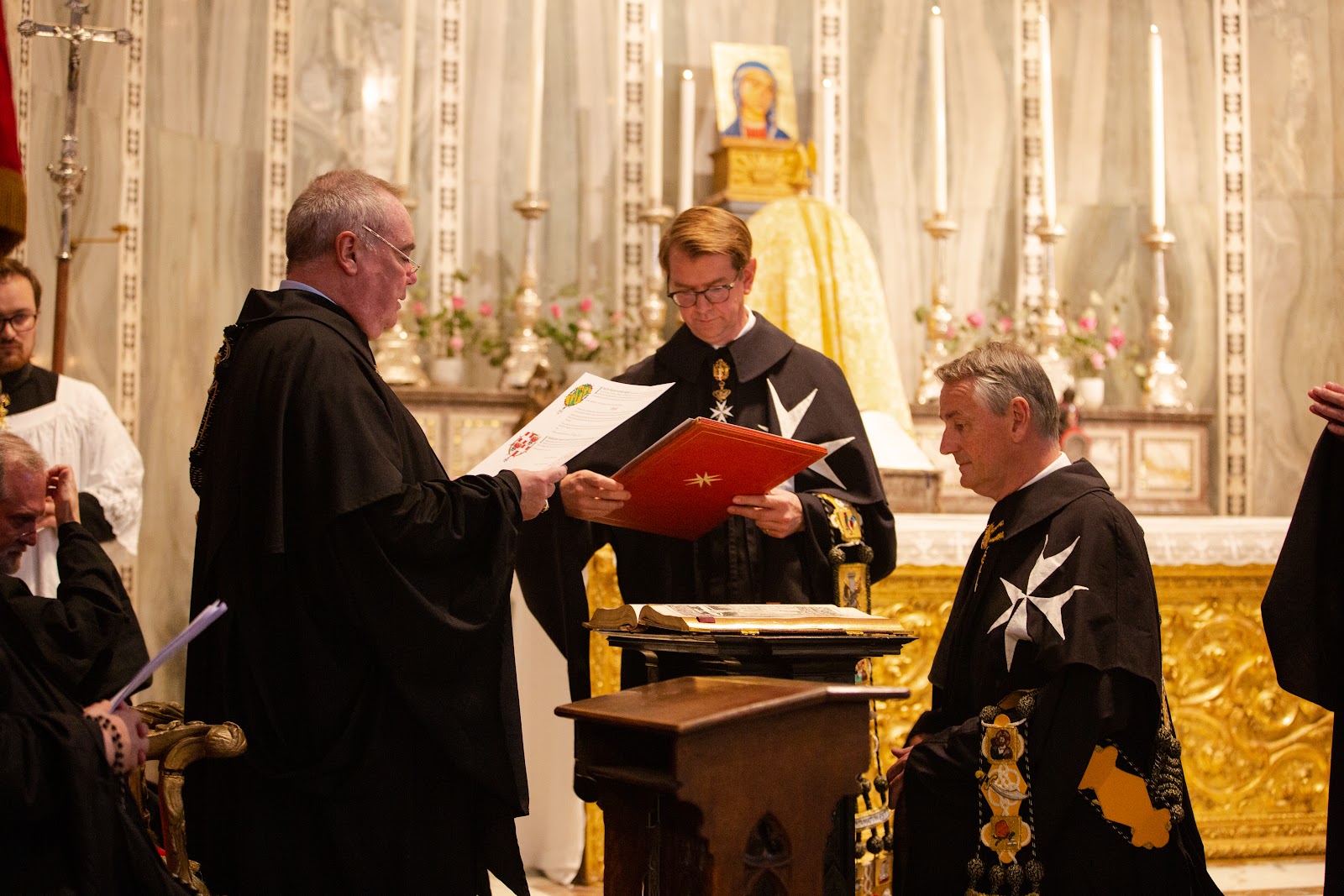
HOMILY FOR THE "VICTORY MASS", AND INSTALLATION OF THE GRAND PRIOR

The sermon preached by Monsignor John Armitage, Chaplain to the Grand Priory of  England, on the occasion of the Installation of Fra' Max Rumney as the 58th Grand Prior of England, by Fra' John Dunlap, Lieutenant to the Grand Master, at the "Victory Mass", The Nativity of the Blessed Virgin Mary, in the Priory's Conventual Chapel of the Assumption and St Gregory Warwick Street, London, on September 8th 2022. Further photographs of this glorious ceremony will follow in a later post.


Brethren, we know that in everything God works for good with those who love him, who are called according to his purpose.” In a world that seeks fulfilment by seeking what I want, the Church is the witness, that the good we encounter in our world, is the result of the God who works for this good through those who love him, for the whole of creation is called according to his purpose. Only love can give our lives meaning and purpose, and our true fulfilment is a consequence of not doing what I want, but seeking, sharing, and doing what we need, building the common good of all humanity.  The Church has its fair share of those of us who do what we want, but our Order has been greatly blessed by those whose lives had been dedicated to building up the body of Christ, living witnesses of what we need, these people we call saints.  

Our founder Blessed Gerard, was known by his contemporaries as “the humblest man in the East, a servant of the poor, devoted to pilgrims, of simple appearance, but shining forth with his noble heart.” In the darkness of 1941 Pope Pius XII in an address to the Order, explained the true meaning of nobility. “In these poor, these orphans these wounded these lepers, lie you own title deeds of nobility, received at Bethlehem from the King of Kings who being rich became poor, that by his poverty you might be rich.”

In every moment in time there is a grace to be found, and the history of the Church shows us that it is in the darkest moments that God’s grace is most profound. “For where sin increased, grace increased all the more,” Romans 5:20 

When Pope Gregory the Great sent St Augustine to evangelise the pagan English, Rome was a dark and dangerous place, the Roman Empire was collapsing, the barbarians were at the gates, plague was rife, yet the successor of Peter sent a frightened monk to the edge of a crumbling empire. Pope Gregory understood the wisdom of the modern saying “Better to light one candle than to curse the darkness.”

Augustine built a monastery, it was the spiritual foundation, lighting the flame of faith for his companions to spread the Good News in a dark and dangerous land. All works of the Gospel must be based on firm spiritual foundations which from time to time must be renewed. 

The Holy Father calls us to a Spiritual Renewal, but such a renewal presupposes a spiritual legacy, this legacy has inspired the men and women of our country to respond to the call of the Gospel and the charism  of our founder from the foundation of the Grand Priory in 1144, through the martyrdom of our brothers, Blessed Adrian Fortescue, David Gunston and Thomas Dingley after the suppression of the Grand Priory in 1540. The blood of these martyrs was the seed that would lead to the restoration of the Order in 1875 with the establishment of the British Association and the restoration of the Grand Priory of England in 1993.

Whatever the darkness humanity faces, whatever the trials and tribulations of the followers of Jesus, Peter and his successors, the rock on which the Church is built, reminds us “that in everything God works for good with those who love him, who are called according to his purpose.” There will be darkness and confusion, from time-to-time we are faced with challenges, but for those of noble heart and humble demeanour, God’s grace enables them to "Listen to what the Spirit is saying to the Church,” not through their own plans or human projects but according to Gods purpose, as he works for the good with those He has chosen. 

The saints and martyrs of our Order were heralds of the Gospel, men and women of noble heart, experts in humanity,  for they were grounded in prayer, and shaped by their love and service of the Sick and the poor. The Preface of Saints tells us that “the Church is renewed in every age by raising up men and women outstanding witnesses of your unchanging love. They inspire us by their heroic lives and help us by their constant prayers to be the living sign of Your saving power.”  

The renewal of our beloved Order will be the consequence of lives that defend the faith by serving the sick and the poor. These heroic lives, founded on fidelity to prayer, will as they have always done, renew the Church and renew our Order. We pray that the renewal will inspire a new spirit of vocational openness, discernment and generosity, to the Professed life, and Obedience and a spirit of loving service that will inspire men and women to join as members or volunteers in the service of those most in need. 

As we stand on the threshold of this new chapter in the ancient tale of Christ’s hospitality, may we, your poor servants, take to heart the words of St Bernard that “the measure of our love will be to love without measure.” 

The BIRTH of Mary, and the YES of Mary brought the light of Christ to shine upon us. This light is experienced only through a human encounter, for the Word became flesh and lived among us. Therefore, the world waits for women and men, who have said yes to God, who are beacons of light to those who live in darkness. 

Today we wish to say Yes, as Mary said yes, to say Yes as Gerard and our martyrs said Yes, to say Yes in the footsteps of the thousands of members of our Order who over the centuries have served the poor and the sick and protected the Church by their example and loving service, always at a cost to themselves, and sometimes at the cost of their very lives! 

Today we commend our dear brother Max to the care and intercession of Our Lady of Philermo, Blessed Gerard, and all the saints and martyrs of our Order and assure him of our prayers, and for Lady Celestia Hales as the new President of BASMOM, may the Lord bless them and strengthen them in the days to come. 

It is a joy to welcome our beloved brother Fra' John Dunlap and we assure him of our prayers and fraternal loyalty at this moment of Grace in the life of our Order.

Each moment in history demands great sacrifices, acts of love and kindness, acts of graciousness and radical generosity to address the darkness that so besets our world. The challenge of renewal within our beloved Order, is about the revitalisation of the personal and generous response in the lives of its members. May the Grand Priory and the British Association, united in our common cause of service to Our Lords the Sick, embrace this moment of grace. 

May Peter, who in the midst of a storm walked on the water and started to sink and was saved by the Lord, strengthen our faith and courage. May Gerard’s humility and nobility of heart inspire us to lives of service and may Mary the one who was “greatly troubled” at what the Lord was asking of her remind us of Gabriel’s words, that the holy spirit will come upon us so there is no need to fear, for nothing is impossible for God. 

At this point Mary's YES and openness to God's will in her life, brought salvation to a fallen world. She “conceived the Lord in her heart before she conceived him in her womb.” In the heart of Mary the Church was born, in the heart of Mary, the Church is sustained, with her words “do whatever he tells you.” The heart of Mary teaches us that all renewal begins in our own hearts. May we conceive Him on our hearts, so that we may bring His love to a fallen world and dedicate ourselves once again to the defence of the Church by our unconditional service of our Lords the Sick. 

Our Lady of Philermo, pray for us.
Saint John the Baptist, pray for us.
Blessed Gerard, pray for us.

PORTUNCULA INDULGENCE - TODAY!


Today is the day upon which every year we may gain the Portiuncula Indulgence, from the afternoon on the 1st August to sunset on the 2nd. This plenary indulgence may only be applied to the Souls in Purgatory, by the act of visiting a church following Confession and receiving Holy Communion. It is thus one of the greatest Acts of Charity we can perform, to release a soul from Purgatory. Why would one not do this? 

The Indulgence was granted miraculously to Saint Francis on a night of great temptation, in which he is said to have rolled as mortification in a briar-bush which became a bush of sweet thornless roses. Originally it required a visit to the cell where he died, now in the basilica at Portiuncula (see photo above) about a mile from Assisi, but by successive Popes, in their great mercy, has been granted more and more liberally until today any church may be visited to gain this indulgence. (This privilege has been finally established for an indefinite time by a decree of the S. Cong. of Indul., 26 March, 1911 (Acta Apostolicae Sedis, III, 1911, 233-4), and reformed and confirmed by Pope Paul VI in "Indulgentiarum Doctrina" (1967). This Apostolic Constitution established that a Plenary Indulgence may be gained only once a day.)

The obligations are the usual ones of Confession and Holy Communion, ideally on the day, and recitation of the Lord's Prayer and the Creed, and prayer for the Holy Father's intentions, carried out with the will to gain the indulgence, and a detachment from sin. That is all. The indulgence may be gained on each of the two days, thus twice, assisting two souls. Please make the effort to do this wonderful charitable work today! 

For more information see HERE.