EXCITING NEWS - NEW BLOG!
REPORT ON RORATE MASS
RORATE CAELI desuper, et nubes pluant justum : aperiatur terra, et germinet Salvatorem !
The Order's Rotate Mass was held last Tuesday, within the second week of Advent, at the Church of the Assumption, Warwick Street, in the presence of the Grand Prior. The Advent Recollection was preached by Monsignor Dr Michael Nasir Ali, who became a chaplain earlier in the year.
GP30! CHAPLAIN'S SERMON FOR BLESSED GERARD
The Feast of Blessed Gerard this year marks the 30th Anniversary of the reestablishment of the Grand Priory of England in 1993.
The Mass, celebrated in the Church of the Assumption and St Gregory Warwick Street, was presided over by the fourth Grand Prior since the restoration, and 58th since our foundation, Fra' Max Rumney.
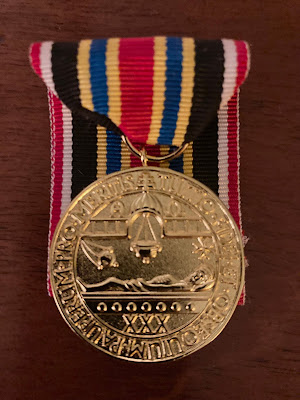
Before the Mass the General Assembly of the Grand Priory was held in choir, of which all members of the Order in Britain now form part. The 30th anniversary Medal of Merit was established at the end of the Assembly, and bestowed upon, initially, all current members of the Priory. It will henceforth be awarded annually on the Feast of Blessed Adrian Fortescue, patron of the Priory, to volunteers and benefactors of the Order in Britain whose contribution is noteworthy.
During Holy Mass, Benedict and Hannah Jennings made the Promise of Obedience. Please pray for them.
The celebrant and preacher was our Chaplain, Monsignor John Armitage. We are grateful to him for the text of this sermon.
“Where sin abounds, grace abounds all the more” (Romans 5:29) When we see the abundance of sin and evil in our world, we have to remind ourselves of this truth of our faith, for it is a truth of faith needed in each generation to guide humanity through the “abundance of sin” found in every age. The sense of powerless that comes in the face of man’s inhumanity to man was described by the Roman historian Livy in 56 bc. “Here are the questions to which I should like every reader to give their close attention: what life and morals were like; what men and what policies, in peace and in war, territory was established and enlarged. Then let him note how, with the gradual relaxation of discipline, morals first subsided, as it were, then sank lower and lower, and finally began the downward plunge which has brought us to our present time, when we can endure neither our vices nor their cure.” amid such turmoil, “The Word became flesh and lived among us”.
As the world today faces the challenges of war and peace our awareness that we can “can endure neither our vices not their cure” is either a recipe for despair, or a public witness, to the truth of our faith that “Where sin abounds, grace abounds all the more.”
The suffering of the people of Ukraine, the Holy Land and the many countries trapped in the grip of violence, injustice and poverty, witness to a seemingly never-ending story of violence and despair. The hymn “Abide with me”, describes the turmoil of “change and decay”, but most importantly gives the remedy! “O thou who changest not, abide with me.” Let us not be disheartened by the challenges that face the world, for the suffering of humanity, unlocks the wellspring of God’s Mercy, “which can make even the driest land become a garden, can restore life to dry bones (cf. Ez 37:1-14). So let us become agents of this mercy, channels through which God can water the earth, and make justice and peace flourish.”
This mercy is lived out each day as the Church seeks to witness to the teaching of the “Good News” that sets people free and the service of God’s people, especially the poor and the sick.
The talk of the Order’s ambassador to the Palestinian Authority last Friday, on the work of the Holy Family Hospital in Bethlehem, expressed in the most powerful way the continuation of a work of the Order inspired by our Catholic faith and the call to serve the sick and poor. The Holy Family Hospital has a direct link to the first hospital in Jerusalem set up by Blessed Gerard and which continues to this day to be open to all, regardless of faith or nationality. In these troubled times may our prayerful support and generosity to our hospital be great, as our brothers and sisters face a turmoil as great as any in the time of Blessed Gerard.
So where is the “abundance of grace” which will overcome the abundance of sin in our time? It is, where it has always been, in the hearts of faithful men and women who recognise that despite the change and decay, God always abides with his people for “The Word became flesh and lived among us”. New life does not come about by a change in structures, but by the renewal of the human heart for “You renew the Church in every age by raising up men and women outstanding in holiness, living witnesses of your unchanging love. They inspire us by their heroic lives and help us by the constant prayers to be the living sign of your saving power.”
Today we also celebrate our fellow countryman, St Edward the Confessor, who lived through the “change and decay” of his times. His simple piety, the unaffected generosity of his nature, enabled him to serve the men and women about him, by easing their burdens, relieving their necessities, and confirming them in their allegiance to the faith. Mgr. Knox reflected that “The Conqueror, who diverted the stream of history, went to his grave disappointed, and lies there a historical memory. The Confessor, whose ambitions could be satisfied by finding a poor man his dinner, saw no corruption in death, and lives the patron of his fellow countrymen." Mgr. Ronald Knox
Like all the saints we celebrate this month, St Therese, St Bruno, St John Leonardi, their lives were shaped by the knowledge that the one who never changes would always abide with them. This is a definition of holiness, where ordinary men and women who do extra ordinary things because they believe, like Our Lady, that “the promises made them by the Lord would be fulfilled.”
In the aftermath of the reformation, Pope Paul V asked St John Leonardi to reflect upon the problems facing the Church of their time. “Those who want to work for moral reform in the world must seek the glory of God before all else. If at first glance they appear difficult, compare them with the magnitude of the situation. Then they will seem very easy indeed. Great works are accomplished by great men and women, and great women and men should be involved in great works.”
The truth is we know we have to change, as St John Henry Newman reminds us for “To live is to change, and to be perfect is to have changed often”. We are troubled in our conscience by our cowardice, our complacency, our lack of courage. We feel guilty that we don’t do more, and this is where we stop. Perfection simply means becoming the person God has created me to be! Be cannot change structures unless we first change our selves. We give up what we are now, with the help of God’s grace, for what we can become.
As we celebrate the great works of Blessed Gerard, if they are to be more than the history of the past, the Church calls, challenges, even demands each one of us today, to build an Order of Great works fit for our times, as we defend the Church, by our service of the sick and poor. Great works are accomplished only by great men and women, and great women and men should be involved in great works, and if at first glance our structural challenges appear difficult, compare them with the magnitude of the situation we face as servants of Gods Mercy to our fallen world, then the “minor issues” we face will seem very easy indeed.
Gerard teaches us by his life that the changes we all long for in our troubled world, can only begin with the human heart, and this comes about by humility which understands that all I have is a gift of God, and the gift grows only by sharing it with others. The consequence of this gift is a greatness of the spirit that we know as nobility of heart. It is a depth of generosity, at the very centre of who we are, that we willingly share wight those most in need. I am what I share, and I share what I have received for a loving God.
It is holiness alone that renews and changes the world, the Church and the Order, and in our founder, we hear why. He was called "the humblest man in the East, the servant of the poor, and kind to strangers. His appearance was not impressive, but it was a noble heart that made him conspicuous.” On this his feast day, let us renew our vows and promises, made at our profession and when we joined the Order. Much is to be done, as in our time as we commit ourselves once again to be instruments of grace to overcome the evil and suffering of our world. Inspired by Gerard’s humility and nobility of Heart, may we walk in his footsteps as witnesses of hope, as great men and women who have committed themselves to the great works of our beloved Order, for “Where sin abounds, grace abounds all the more!”
Blessed Gerard, pray for us.
Grand Priory of England - ad multos annos!
SAINT JOSEPH - A MEDITATION
This wonderful meditation upon Saint Joseph was preached at the August day of Recollection by Fr Paul Keane, Chaplain of the University of Cambridge, priest of Brentwood Diocese, and recently a Magistral Chaplain of our Order. We are very grateful to him for these spiritual insights.
| From the Holy Family and St Catherine by Bordoni |
Devotion to St Joseph
AMDG
BL. DAVID GUNSON PILGRIMAGE - SERMON
The Vocation of Martyrdom
What would you have done…? That’s the question that I always end up asking myself, whenever I read about this country in the 1530s. What would I have done…?
Of course, we’d all like to think that we’d have been among the three percent of this country’s population who remained faithful, so as to give up their lives for the Faith. But, if we were faced with losing everything (friends, family, house, income — even the Sacraments, and ultimately our lives), what would have stopped us being like all the other Catholics (all the other bishops, priests, religious, and pious faithful) who ended up abandoning the Church that they had presumably loved and cherished…?
Why was it that only three of the English Knights of Malta—at the time of the Order’s suppression in this country—were crowned with the glory of martyrdom…? Three times the number of bishops, it has to be said; and three times the number of government ministers: Saints John Fisher and Thomas More being the only representatives of their class… And the Order is rightly proud of this supreme witness to the faith, when so many—who should have known better, who should have been leading their lambs to the slaughter—preferred convenience and comfort. But what would we have done…?
It’s true to say that there were others who suffered a ‘white’ martyrdom: Knights of Malta who suffered exile; those who died in prison; and the heartbreaking account of the then Grand Prior, William Weston, who was spared the gallows, but collapsed and died, on hearing the news of his beloved Order’s suppression. But what of all those other knights? What of those knights and professed chaplains who were later to be found in England, collecting their royal pension, and even in personal service to King Henry VIII? What about Fra’ Edward Bellingham, now Gentleman of the Privy Chamber, or Fra’ Ambrose Cave, soon to be Chancellor of the Duchy of Lancaster?
Or, to be more blatant, what about Fra’ Philip Babington, the former Knight of Justice who brought the accusation against the blessed martyr that we celebrate today — against his confrère in the Grand Priory? What made a Babington a Babington, and a Gunson a Gunson…?
It’s not as if one of them got lucky — as if one of them managed the ‘shortcut’ to Heaven — as if, had circumstances been different, it could have been otherwise… Gunson arrived in England after the Order’s suppression — and, indeed, after the double martyrdom of Fortescue and Dingley. He knew what was coming.
Martyrs are not martyrs because of the ‘incidental blood’ that was shed. The cause of their martyrdom—the cause of their blessedness, their sanctity—is not their death, but their life: the life that leads them to martyrdom. Martyrdom is an expression of a relationship that already exists; it is a fulfilment of a love for Christ and for His Church. Of course, it is only grace that can bring us to love to such an extent as to offer our lives for that love — to prove that fullness of love which is martyrdom. But that grace is there for us all.
We may not all be called to a martyrdom of blood, but we are all called to be martyrs (to be witnesses) of truth — to make that truth known, through our sufferings, through our sacrifices, but—most of all—through our love: through being holy.
To be holy is to live out one’s vocation — to answer God’s call to our own personal holiness. The vocation of the Knight of Malta is summed up by its famous twin charism; it’s enunciated in that well-known Prayer of the Order that we’ll all recite at the end of our pilgrimage this evening, at the very place where our martyr lived out his vocation to the full: first, “to practise and defend the Catholic, the Apostolic, the Roman Faith against the enemies of religion” (tuitio fidei); and thereby “to practise charity towards my neighbours, especially the poor and the sick” (obsequium pauperum).
Like all vocations, it’s a vocation of love: it’s a fulfilment of Christ’s double commandment of love — love of God (tuitio fidei) and love of neighbour (obsequium pauperum). And, in the words of Christ’s vicar on earth—our current Holy Father—to be holy is “to love as Christ loves”. To be holy is not to know something, nor to do something, not even to be something — but it’s to be some-one: to be Christ.
At Saint Thomas Waterings, 482 years ago today, Blessed David Gunson (the ‘Good Knight’, as he became known) loved as Christ loves. He consummated his vocation; he carried out the real work of the Order — which, as the late Pope once put it, is “not mere philanthropy, but an effective expression and a living testimony of evangelical love”. That is a love that turns a life of ‘tuitio fidei’ into a death ‘in odium fidei’. It’s a love that turns ‘obsequium pauperum’ into an ‘obsequium mortis’, an ‘obsequium crucis’ — an ‘obedience unto death’, an ‘allegiance to the Cross’. It’s a love that tells us what to do, and how to ‘be Christ’.
Blessed David Gunson, pray for us.
CARDINAL'S CORPUS CHRISTI HOMILY
On this day, the ancient Octave day of the Feast of Corpus Christi, we are happy to share a video of the Homily preached by Cardinal Nichols at Mass of the Feast last Sunday, in the Diocesan Shrine of the Blessed Sacrament, the church of Corpus Christi, Maiden Lane, in the presence of Fra' Max Rumney, Grand Prior of England. The Mass was followed by a Eucharistic procession around Covent Garden. (The video should start at the beginning of the homily at 21.23, which doesn't work in all browsers, and which lasts 15 minutes. If it doesn't work for you CLICK HERE)
ELECTION OF 81st PRINCE AND GRAND MASTER
At the Council Complete of State held at the Aventine villa today, Fra' John Dunlap was elected as Prince and 81st Grand Master of the Sovereign Military and Hospitaller Order of Saint John of Jerusalem of Rhodes and of Malta.
The new Grand Master, addressing the members of the Council Complete of State, said: “I accept this office with a profound spirit of service and with the solemn promise of a constant commitment. I thank each of you for having placed your trust in me and for having shown your great love for, and dedication to, our Order by your presence here today. There are many challenges that await us, but united in the awareness of our mission of Tuitio Fidei et Obsequium Pauperum (witnessing the faith, helping the poor), I am sure that we will be able to face them together united and cohesively, in the same spirit that guided Blessed Gerard, founder of the Order over 900 years ago."
Fra' John Dunlap approached the Order of Malta and found his religious vocation in the mid-1980s during his volunteer work with patients suffering from AIDS and other diseases at the Cardinal Cooke Medical Center in Harlem (New York). He has volunteered in that hospital every week for the past 30 years.
Admitted to the Order of Malta in 1996, he took his solemn vows as a Professed Knight in 2008. For over a decade he has served the Order of Malta as Chairman of the Committee for the Protection of Names and Emblems and Representative to the Alliance of the Orders of St John.
In 2009 Fra' John Dunlap was elected for a five-year term as a member of the Sovereign Council. He was re-elected for another five-year term by the Chapter General in 2014 and 2019. He has led the Order of Malta as Lieutenant of the Grand Master since June 2022, following the death of Fra' Marco Luzzago.
Ad multos annos!
SCOTLAND'S GENDER REFORM BILL - URGENT
| George Moreland - Children playing at soldiers, 1788 |
The Scottish government in the Holyrood Parliament, under Nicola Sturgeon, is proposing to push through a Bill to allow anyone to change their legal sex without a diagnosis of gender dysphoria, from 16 years of age. The two-year waiting period has been reduced to 3 months. Parents will not need to be consulted.
This grossly immoral Bill is a grave danger to vulnerable children, denying them the medical and mental care they need, and allows men of perverted disposition freely to threaten women, and thus children too, and invade their privacy with legal impunity.
Condemned by the Scottish Bishops (HERE), it has received very high profile opposition, including from the feminist author of the Harry Potter books, J K Rowling (see HERE), and is opposed by two-thirds of Scottish voters.
We are encouraged to support our Scottish friends by signing this petition to the MSPs. SIGN HERE. Let us fight this evil together as soldiers of Christ, to preserve the innocence of a future generation.
HOMILY FOR RORATE MASS
As promised, herewith Fr Dench's homily for the Rorate Mass this evening. We are very grateful to him. The Grand Priory wishes all its readers a very peaceful and blessed Christmas.
RORATE AND SAINT LUCY
Isaiah 7:1-15; Luke 1:26-38
Behold a virgin shall conceive and bear a Son, and his name shall be called Emmanuel.
Words from the prophet Isaiah which are, of course, familiar to us all. This prophecy, the Gospel account from St Luke, the singing of the Rorate Coeli, the church lit only by candles. . . all these aspects of this evening’s liturgy are to point us towards the great feast of Our Lord’s Nativity. Look at the altar this evening, and we cannot help but think of Midnight Mass, and we should.
Advent is more than just a period of getting ready to celebrate Christmas, of course. It is a season in which we are invited to consider the Four Last things of Death, Judgment, Heaven and Hell. It is a time in which are reminded of Christ’s promise that he will return, not with the cries and gurgles of a tiny child which marked his first coming, but rather with the sound of trumpets in the glory of his second. It is a time in which we are reminded that even now, before the Second Coming, He is still with us as he promised, in the Sacraments which we receive and celebrate and, above all, in the Eucharist.
This evening’s Mass brings out dramatically and vividly some of the great Advent themes. The flickering of the candles in our dark church remind us that it is in Advent that we relive that hopeful expectation of the children of Israel. We imagine ourselves as the people who walked in darkness and who have seen a great light.
Of course in many ways we still walk in darkness, yet guided by the Light that is Christ. A light which all too often is obscured by the darkness in our hearts, shadows of our own sin which mean we can’t pass that light on, or even see by its radiancy, because it is hidden in our own selfishness. That light all too often is hidden in our concerns with the world around us, in the trivialities of day to day existence and, yes, even in our anxieties and worries. But it is because we have been given that Light that we should take courage.
That Light, which is given to us, we are called to fan it into a flame, to keep it burning brightly, and to give it to others to burn all the more beautifully and warmly, scattering the darkness which blights their own lives and obscures the radiancy of God’s piercing love.
In Advent we remember that Light was born of the Virgin Mary to be given to the world. But before that Light was brought into the world, it was shielded within the darkness of the Virgin’s womb, carried, nourished, protected, before being brought forth into our world. So too for us we have a duty to protect that light in our hears, shielded from the fierce winds of doubt and despair which seek to snuff it out. Once guarded and preserved, it is then to be shared. Given away, even as Our Lady as offered her only Son for the world in order that God’s plan might be fulfilled.
Our calling as members of God’s Church is to protect that Light within our hearts and, like the Virgin, to bring him forth into the world, so that its darkness might instead be illuminated.
And St Lucy, who we commemorate today too, provides us with, for want of a better word, a shining example both in her life and name. And in that she stands in a long line of virgin martyrs of the early Church, consecrating her virginity, indeed her whole life and being to God. Famously it was through a dream that she received from God, a message carried by St Agatha, promising her healing for her family but also the glories that God was offering her, and what it was He wanted to accomplish through.
We remember that her virginity was no incidental adjective. It was an essential part of what she gave to God, and what she, and other virgin martyrs like her, possessed which radically upturned the values of the world around her. The dignity she possessed as a creature of God, and her use of God-given freedom, to give that dignity back to him was what enraged the culture around.
Her courage stands out as an example of us to follow in that path whatever the challenges and the dangers might be. To follow that same light of Christ as it guides on our journey, and holding true to the paths it illuminates for us, in spite of the what those around might think, in spite of those who seek to pull off that path in the vain promises of the dark.
Yes, as we will hear later on, ‘the people that walked in darkness has seen a great light.’
Christ is that light which will guide our journey towards our eternal home.
It is our fidelity to that path which will win us our lives in eternity.
ADVENT EVENING OF RECOLLECTION - THE FOUR LAST THINGS
![]() |
| Maarten van Heemskerck - The Four last Things, 1565. Royal Collection Trust, Windsor. |
The Evening Recollection was held at the Assumption Warwick Street on Tuesday 29th November. The evening began with sung Vespers of the Little Office Our Lady, followed by a most excellent talk by the Rector, Fr Mark Elliott-Smith, then Holy Hour, two priest were on hand to hear confessions, and ending with a fraternal party in the Chapter Room.
The text of the talk is given below. We are greatly indebted to Fr Elliott-Smith, a good friend of the Order, for his generous time and hospitality at the altar.
"DEATH, JUDGEMENT, HEAVEN AND HELL"