As Cardinal Mercier said : "When prudence is everywhere, courage is nowhere."                                                                                  From Cardinal Sarah : "In order to avoid hearing God's music, we have chosen to use all the devices of this world. But heaven's instruments will not stop playing just because some people are deaf."                                                                                              Saint John-Paul II wrote: "The fact that one can die for the faith shows that other demands of the faith can also be met."                                                 Cardinal Müller says, “For the real danger to today’s humanity is the greenhouse gases of sin and the global warming of unbelief and the decay of morality when no one knows and teaches the difference between good and evil.”                                                  St Catherine of Siena said, “We've had enough exhortations to be silent. Cry out with a thousand tongues - I see the world is rotten because of silence.”                                                  Chesterton said, “The Christian ideal has not been tried and found wanting. It has been found difficult; and left untried.”                                                Brethren, Wake up!

28th MAY - SAINT UBALDESCA, Virgin of our Order.

In addition to being the transferred feast of the Ascension of Our Blessed Lord, and that, in some calendars, of Saint Augustine of Canterbury, he who found the English to be both pious and comely,  a challenge to which we should well to try to live up, however difficult, today is also the feast of one of the great female saints out our beloved Order, Ubaldesca.

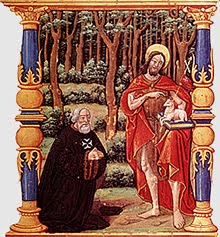
Window at
Saint John's Gate
London
She was born in 1136 at Calcinia, near Pisa. At the age of fifteen, she joined the Order of Saint John of Jerusalem, and worked for fifty-five years in the infirmary attached to the monastery at Pisa, caring for her neighbour out of love for God. 

Her parents, humble and simple farmers, were Godfearing people and good Christians; they taught her obedience and the love of silence which they themselves practiced. She was trained early to work at her household tasks and to pray constantly. She already macerated her poor little body and had resolved never to refuse the requests of the unfortunate. She gave them what she could and, when she had nothing to give, she offered at least the consolation of her smile, paying close attention to the tale of the troubles of each with fraternal understanding. No one left her without being comforted.

She soon understood the gravity of life and wondered what form hers should take to please God; she implored Him for guidance. At the age of fourteen, one day as she was baking the family's bread, she had the vision of an angel who ordered her to enter the convent of the Sisters of Saint John of Jerusalem. She was astonished, and said:
"But, I have no dowry. And my parents cannot give me any".
"The mothers have not so much need for dowries as for virtues", replied the angel.
Ubaldesca smiled. "But what if I have no virtues?".
And the angel in the same tone of voice: "The Holy Ghost will supply".

The messenger of God disappeared, and the girl, forgetting the oven and the bread in it, ran off to the fields where her parents were at work to tell them what had happened and to ask their permission to go away. Without more reflection or delay, the three left for the convent of St. John of the Temple of Carraia in Pisa.

Forewarned by the angel, the abbess and her forty cloistered nuns stood behind the door of the enclosure to wait for the postulant who was received as soon as she knocked. They went to the church where Ubaldesca immediately received the red gown and black cloak in the presence of her parents who wept with joy and sorrow and who returned home after having seen the doors of the convent close on their only daughter.

The next day, their supply of bread being exhausted, they remembered the bread in the oven, and not without irritation. They believed it to be completely charred. But, on removing the stone of the oven, they found the bread baked to perfection and as golden as never before. Not believing their eyes, they took it to the sisters, as a token of thanksgiving and a proof of the miracle.

Ubaldesca died on 28 May 1206. Her body was taken back to Calcinia where it is now enshrined. Not only honoured among the saints and blessed of the Order of Saint John of Jerusalem, she is celebrated also as a patroness of the City of Pisa. 
Collect of the Mass
O God, pride of the humble and lover of virginity, you called Saint Ubaldesca to the religious life in the Order of Saint John of Jerusalem : Grant that through her prayers and example we may rejoice in being humble and follow you with pure minds. We ask this through our Lord Jesus Christ your Son, who lives and reigns with you and the Holy Spirit, one God, for ever and ever. Amen.

ASCENSION OF THE LORD

Mattia Preti, Christ ascending in Glory
Collect:
Grant, we beseech thee, almighty God: that we who believe thy only-begotten Son our Redeemer to have this day ascended into the heavens; may ourselves also in mind dwell in heavenly places, though the same Christ our Lord, who liveth and reigneth with thee in the unity of the Holy Ghost, one God, world without end. Amen.

23rd MAY - FEAST OF BL VILMOS APOR, Martyr of Our Order

Blessed Vilmos Apor
Chaplain of the Order of Malta, Bishop, Martyr
Memorial

Vilmos (William) Apor, born 1892, was an Hungarian bishop who earned a special reputation for his service to the poor, especially during the months of hardship that came at the end of World War II. Named Bishop of Gÿor in 1941, he chose as his motto: “The Cross strengthens the weak and makes the strong gentle.” During the many air raids he opened his home to those whose houses had been destroyed. When Russian troops entered the city in 1945, many women including religious took refuge in his episcopal residence. 

On Good Friday 1945 three Russian soldiers came to the residence and demanded that the women be taken to their barracks. Monsignor Apor refused and placed himself in front of the women. One of the Russians shot and wounded him. Out of fear they then fled, leaving the women unmolested. Bishop Apor lived in great agony for three days and died on 2 April, Easter Monday.

On 9 April 1947, Cardinal Mindszenty wrote to Father Csavossy, the postulator for the cause: 'I can assure you that now is the appropriate time to introduce the canonization procedures. I wish it and officially approve of it, and want the necessary steps to be taken to do the same for all priests who lost their lives when protecting women.' He was beatified by Pope John Paul II on 9th November 1997.

Much historical information is given here.

The tomb of Blessed Vilmos in Gyor Cathedral, designed by the Hungarian artist Boldogfai Farkas Sándor

The Collect of the Mass

Almighty and Eternal God,
through your grace, Bishop William,
by courageously shedding his blood for his flock,
earned a martyr’s crown.
Grant that we, despite the difficulties of our daily lives,
may do your will and offer our good works
for the salvation of our brothers and sisters.
We ask this through Our Lord Jesus Christ, your Son,
who lives and reigns with you and the Holy Spirit,
one God, for ever and ever.
Amen.

FEAST OF BLESSED GERARD MECATTI DE VILLAMAGNA

Next to Saints Hugh and Ubaldesca, Blessed Gerard Mecatti is the most famous of the saints venerated in the Order of Saint John.  Born in 1174, at Villamagna, not far from Florence, he led an admirable life of humility, piety and compassion for the Poor. At an early age, he requested and obtained admission as a "servant d'armes" in our Order, in which he set an example of disinterested charity, giving all he owned to the unfortunate, living by choice in abject poverty. He died in 1245. For more biographical information, especially the wonderful miracle of the cherries at the moment of his death, read here.  

A solitary Knight, the Blessed Gerard Mecatti was able to overcome the greatest enemy of God he had met: himself, through holy silence and humiliation (cf Mgr Ducaud-Bourget). For those of our readers who are reading the recently-published new book 'The Power of Silence' by Robert Cardinal Sarah (see here), it is clear that Blessed Gerard Mecatti is very much a man of our age.  May we learn from his holy example, especially in these times of trouble.
O God, who, following the example of Thine own Son, didst bring blessed Gerard to a life of laborious solitude, grant, we beseech Thee, that by vigour of prayer and penitence, we may be strengthened to live out our Christian duties. Through our Lord Jesus Christ thy Son, who liveth and reigneth with Thee in the unity of the Holy Ghost, one God, world without end. Amen.
Blessed Gerard Mecatti, pray for us. 

CENTENARY YEAR OF OUR LADY OF FATIMA

Since we are an ancient Religious Order, it is fitting that the our spirituality should frequently reflect upon the past, and upon historical aspects of our faith, as we also look forward in hope.

It seems appropriate therefore to dwell for a moment, at the beginning of this Centenary Year, on this event we commemorate, the Apparition at Fatima to the peasant children Lucia, Francisco and Jacinta, in the wider context of 2000 years of the Church.  Pope Francis will canonise Francisco and Jacinta during his coming visit to Portugal.
Interior of the Basilica of the Rosary at Fatima,
by the Dutch architect Gerardus Samuel van Krieken
Fr John Huwicke provides on his excellent blog, a fascinating essay linking the Feast of the Apparitions on 13th May to the early Martyrs, and to the Roman Church of Our lady of the Martyrs, formerly Agrippa's Pantheon, in particular.  We reproduce his text below.  We can be thankful that, as he implies, quoting Saint John-Paul, God occasionally allows himself to make good with His own infinite memory our own rather feeble attempts to maintain an historical perspective. 
The Fatima visionaries, poor little peasant mites, are unlikely to have known this; but, in the first millennium, May 13 was sometimes a festival of our Lady within the Roman Rite. To me, who incline to share S John Paul's view that in the workings of Providence there are no coincidences, this seems interesting.  
This is how it happened. In 609, Pope S Boniface IV dedicated the old Roman Pantheon, built originally by Marcus 'Actium' Agrippa but subsequently rebuilt after a fire, as the Church of Sancta Maria ad Martyres. He did this in collaboration with the emperor Phocas ... not an altogether nice chap, but possibly the last emperor, I think, not to use the style Basileus; it had thus taken more than six centuries to dissipate the old Roman gut sentiment which animated Brutus and his associates, to the effect that no-one in Rome ought to deem himself Rex ... but I'm rambling again ...  
Phocas donated an Ikon of our Lady which is still enthroned above the Altar of that Church; and the relics of many of the martyrs were disinterred and brought into the church; hence its name. This was the period when Marian Ikons, and relics of Saints, used to be processed round the wall of Constantinople when barbarian enemies appeared on the scene; I rather suspect that Pope S Boniface had in mind to construct a defensive powerhouse in Old Rome rather than merely to stimulate pious devotion. Pre-modern, and particularly First Millennium, Christianity has a very practical and down-to-earth side to it. Possibly Pope and Emperor may even have had in mind the idea that, just as Actium had (according to the Augustan PR machine) saved Rome, so the Theotokos and the Martyrs might do the same in their own day.  
In the early centuries of the English Church, this festival on May 13 seems to have been important. The Leofric Missal, the Altar Book of the early Archbishops of Canterbury, based on texts brought to England by S Augustine, includes it and, interestingly, demonstrates the continuing relevance of this festival by including in the text later scribal additions and adaptations. Perhaps the Church of S Mary in Canterbury emulated the mother church in Rome. Something similar appears to have happened in Exeter (to which the Leofric Missal was later taken), where a Saxon church of Sancta Maria ad Martyres lay, I think, West of the present Cathedral and on the same axis. 
I am sure that the significance of the Martyrs will have struck readers. The Third Secret of Fatima is full of the theme of Martyrs and Martyrdom; indeed, we are still living in an Age of Martyrs which rivals any earlier such age. I would draw the attention of those who do not know it to the official CDF documentary collection of 2000, The Message of Fatima, and especially to the fine and elegant exposition by Cardinal Ratzinger.
Sancta Maria ad Martyres, ora pro nobis.
Beata Maria de Fatima, ora pro nobis.
Beate Francisce, ora pro nobis.
Beata Jacinta, ora pro nobis.

SAINT GEORGE, Martyr

Saint George, Patron of Christian Chivalry, pray for our Order, 
and give a true heart to all faithful knights.

St George. Rubens, 1605 - Prado
O GOD, who didst grant to Saint George strength and constancy in the various torments which he sustained for our holy faith; we beseech Thee to preserve, through his intercession, our faith from wavering and doubt, so that we may serve Thee with a sincere heart faithfully unto death. Through Christ Our Lord. Amen.

ADSUMUS, DOMINE SANCTE SPIRITUS

This ancient prayer is enjoined upon all those who hold the Order of Malta dearly in their hearts.  It has been used for many centuries at Councils, Synods, and other deliberative gatherings of Holy Mother Church.  It is taken from the Roman Pontifical, and carries a partial indulgence under the usual conditions. (Raccolta §682)

All readers of this blog are encouraged to say it daily in the coming week.
ADSUMUS, Domine Sancte Spiritus, adsumus peccati quidem immanitate detenti, sed in nomine tuo specialiter congregati. Veni ad nos et esto nobiscum et dignare illabi cordibus nostris; doce nos quid agamus, quo gradiamur et ostende quid efficere debeamus, ut, te auxiliante, tibi in omnibus placere valeamus. Esto solus suggestor et effector iudiciorum nostrorum, qui solus cum Deo Patre et eius Filio nomen possides gloriosum.

Non nos patiaris perturbatores esse iustitiae qui summam diligis aequitatem; non in sinistrum nos ignorantia trahat, non favor inflectat, non acceptio muneris vel personae corrumpat; sed iunge nos tibi efficaciter solius tuae gratiae dono, ut simus in te unum et in nullo deviemus a vero; quatenus in nomine tuo collecti, sic in cunctis teneamus cum moderamine pietatis iustitiam, ut et hic a te in nullo dissentiat sententia nostra et in futurum pro bene gestis consequamur praemia sempiterna. Amen. 

WE have come, O God the Holy Spirit, we have come before Thee, hampered indeed by our many and grievous sins, but for a special purpose gathered together in Thy name. Come to us and be with us and enter our hearts. Teach us what we are to do and where we ought to tend; show us what we must accomplish, in order that, with Thy help, we may be able to please Thee in all things. Be Thou alone the author and the finisher of our judgments, Thou who alone with God the Father and his Son dost possess a glorious name.

Do not allow us to disturb the order of justice, Thou who lovest equity above all things. Let not ignorance draw us into devious paths. Let not partiality sway our minds, nor respect of riches nor persons pervert our judgment. But unite us to Thee effectually by the gift of Thy grace alone, that we may be one in Thee and never forsake the truth; inasmuch as we are gathered together in Thy name, so may we in all things hold fast to justice tempered by mercy, so that in this life our judgment may in no wise be at variance with Thee and in the life to come we may attain everlasting rewards for deeds well done. Amen.

OREMUS PRO CONCILIO

Members of the Order of Malta, Companions, Volunteers, friends, and those associated in any way with the works of the Order, are invited by His Excellency the Prelate of the Order, Monseigneur Jean Laffitte, to pray in the coming week for the Council Complete of State as it prepares to elect the new leader of our Sovereign Order.  There is no need to rehearse in the this place the disturbing news which has been dragged across the Internet in recent weeks, our readers are rather invited to join themselves in prayer with the heart of the Order, so that the sacred work of the service of Our Lords the Poor and the Sick, and the sanctification of individual members of the Order may continue into the future as it has for 900 years.

Those wishing to assure the Electors on the Council of their prayers may inscribe their names at this link: https://www.oremusproconcilio.orderofmalta.int/en.  An option is present for participation in various languages. 

Our Lady of Philermo, pray for us.
Saint John the Baptist, pray for us.
Blessed Gerard, pray for us.
Blessed Raymond du Puy, pray for us.
Servant of God Andrew Bertie, pray for us.

Click to enlarge

MEDITATION ON THE CROSS III

The third and final part of Fr Hemer's magnificent conferences.

The Son of Man Must be Lifted Up

Eager students...
In his conversation with Nicodemus Jesus says something rather strange. As Moses lifted up the serpent in the desert, so must the son of man be lifted up so that everyone who believes in him might have eternal life. (John 3: 14-15) It's strange because Jesus is talking in a fairly straightforward way about the effect that his crucifixion will have on believers, but he uses a rather odd and obscure incident from the Old Testament to shed light on it. We would expect something like: "Just as Moses led our ancestors from slavery to freedom, so my death will set you free." So let's take a closer look. 
Jesus refers to the incident in Numbers 21:4-9 when the people accuse Moses AND GOD of bringing them into the wilderness to die. Note their resentment is towards God, they accuse him of being a murderer, of wanting bad not good for them. They are plagued by poisonous serpents who bite and kill many of them. So God instructs Moses to make a model serpent out of bronze and set it on a pole so that anyone who is bitten can look at this serpent and live. God is telling them that despite their blasphemies and doubts, he does have their good at heart. To drive the point home he takes the thing that they fear and despise the most, a snake, and makes that the source of their healing. He is saying something like: "You doubt my ability to look after you; not only can I look after you but I am so powerful and so creative that I can work my miracles through the thing that you find most horrible, the thing that you reject and loathe."

MEDITATION ON THE CROSS II

This is the second of the Retreat Conferences by Fr John Hemer MHM.


Gethsemane

The gardens at Douai Abbey
I’m sure many of us have seen Mel Gibson’s film “The Passion of the Christ.” It was I think profoundly moving and rather harrowing. Lots of Christian commentators criticized it for the extremely graphic display of violence and brutality. I personally think that there is room for a straightforward historical account of how awful crucifixion is and the film certainly achieves that. But of course the gospel writers are not nearly as gory, the say very little about the awful physical suffering, John hardly anything. There is a reason for this. People have always found the suffering of others a form of entertainment. In the Roman Empire it was gladiatorial contests, people being thrown to the lions. In modern times there are many films which for various reasons portray suffering and violence. Think of Papillon or midnight express, 12 years a slave. Think of roots, both the original and it’s recent remake. Think of Pulp Fiction and Reservoir Dogs and the Texas Chain Saw Massacre, Goodfellas, Silence of the Lambs, the Godfather, Slumdog Millionaire and many more, and we haven’t even touched the genre known as the Horror Film. The gospels don’t go there because that’s not the point. The evangelists want us to not just to observe the event but understand the deeper significance, so for instance we get a glimpse into the heart of Jesus at the scene in Gethsemane. It would be easy to concentrate on the physical suffering – which was dreadful and ignore the mental and spiritual suffering, which for the Son of God, being victim of the most dreadful injustice, must have been worse. The passion is not just another story of an innocent man being brutalised.

MEDITATION ON THE CROSS I

This is the text of the first conference given by Fr John Hemer MHM at the Douai Retreat for Knights last month.  While this formed part of the Lenten retreat, it is relevant at any season, and provides, within the Easter Octave, a fitting reflection for our thanksgiving for our Salvation through Our Lord's Passion and Resurrection.

The second part, upon Gethsemane, will follow later.

Why did we need the Cross?


I began my priestly life as a missionary in Pakistan. At first I was very impressed by the call to prayer. Five times a day, from every mosque in the land you hear this chant, allah hu akbar, God is great, there is no God but God. As a Christian I can go along with that much and coming from a secular country like this where you don’t mention the name of God in polite society I found it enormously moving to hear his name invoked so publicly so often and for it to be so normal. But I soon realised that it’s true as far as it goes, but it’s nothing like enough to make the human race want to love God, to be with him. It doesn’t have anything to say to people who suffer, to people who question, to people who are oppressed by religious power. I had to go somewhere else to learn about that.

ANNUAL RETREAT MEDITATION 2

This is the second part of Dr Conlon's talk.
Lively discussion
The Power and the Glory

In the second temptation Jesus is conveyed to the pinnacle of the Temple. This most magnificent of many buildings that arose under the governance of Herod the Great, stood on a plateau. There was a corner at which the portico of Solomon met the Royal Gate and from there was a sheer drop of 450 feet into the Kedron valley. This might well have been the location for the spectacular stunt suggested by Satan. Quoting psalm 91, which was intimately connected with the Temple as a place where protection is assured to the believer, Jesus is to demonstrate the veracity of that prayer in an obvious and unmistakable manner.  He responds by a biblical dispute with the Devil. Pope Benedict, in his scholarly way sees a contemporary resonance in this outcome. The interpretation of scripture is ultimately one about the image of God that it demonstrates. And that image is formed by how Christ is interpreted. What kind of Messiah is he? We apparently have so many from which to choose. But only one is genuine; the one that recognises his complete identification with the will of his heavenly Father on the one hand, and the other, the trusting abandonment of his bodily survival to the extremes of physical destruction.

ANNUAL RETREAT MEDITATION 1

The Order's Annual Retreat for Knights was held at Douai Abbey from 31st March to 2nd April.  There follows below the texts of the first of two conferences given by the Chaplain to the Grand Priory, The Reverend Dr Antony Conlon, Two reflections based on the Bible commentaries of Prof William Barclay and Pope Benedict XVI’s book Jesus of Nazareth.  The second will follow in another post, as will the later conferences of the Retreat.


  The Spirit and the wilderness

The first thing that we need to get to clear is the meaning of the word tempt in this context. The Greek word perezein used in the Gospels should be translated as “test”. It means to entice someone to do wrong or to take the wrong way. This is a familiar theme in the Old Testament. Abraham and Moses are classic examples of it. The Jews had a saying, “The Holy One, blessed be his name, does not elevate a man to dignity till he has first tried and searched him ; and if he stands in temptation then he raises him to dignity.” The aim is not to weaken us but to make us stronger through overcoming the ordeal. It is the test which comes from God to those whom he wishes to use. Jesus is tested in his humanity as the prophets and patriarchs were. It is another example of how he submitted to every contingency of weakness to which our human nature is subject. He was not spared that mental turmoil which accompanies the moral choices that risks personal calamity and hardship by rejecting the safer path of convenience, compromise and evasion. The second thing to notice is the place of the testing: the wilderness. Again, it is the biblical setting that strips away all the props and disguises that can be used to counterfeit righteousness and virtue. There’s no possibility of escape from the stark choices that have to be faced and resolved. Jesus is about to confront his mission and the consequences that flow from it and his human resolution must be forged in the fierce isolation from material comfort that the desert represents.  

LADY DAY RECOLLECTION - 2

There follows the second part of Fr Stephen Morrison's Meditation. It is a great tribute to Father Morrison's delivery, as well as to the content of his address, that although it was given straight after a quite festal lunch, nobody was seen to nod off!  The day ended with Sung Vespers and Benediction.
The Annuciation - Missal of John of Streda,  1364
Chapter Library, Prague
Welcome back! In the first talk we examined the human impossibility of comprehending fully even large numbers, let alone the Infinite. With God, who is, in the words of St John Damascene, “Infinite and Incomprehensible,” it is precisely the knowledge of this (ie. the fact that we know we cannot know Him) which is, according to St Thomas Aquinas, the very point: “To realise that God is far beyond anything we think, that is the mind’s achievement.” Our only response, then, can be the wonder and awe which His infinity inspires in us, and an act of adoration of the same, perhaps using these words of Cardinal Newman: “I adore Thee, O Lord my God, because thou art so mysterious, so incomprehensible. Unless thou wert incomprehensible, thou wouldst not be God. For how can the Infinite be other than incomprehensible to me?” I ended by saying that Our Lady is the finite vessel for the Infinite God, the blessed womb in which the eternal Son of God deigned to be conceived and to grow. On this, the feast of her Annunciation and His Incarnation, let us continue to marvel at the grace of God at work in the young Virgin Mary who says “yes” to God’s magnificent gamble of a question: would she become the mother of the Saviour? Her “fiat” to the will of God effects a miracle within her, one beyond our imagining.

LADY DAY RECOLLECTION - 1

Text of the First Part of a Meditation given by Father Stephen Morrison, o Praem, of the Premonstratensian Canons of Chelmsford, at the Recollection held at the Little Oratory on Saturday 25th March 2017.  The second part will be published tomorrow.

Prayer: O Jesu, vivens in Maria, veni et vive in famulis tuis, in Spiritus sanctitatis tuae, in plenitudine virtutis tuae, in veritate virtutum tuarum, in perfectione viarum tuarum, in communione mysteriorum tuorum, dominare omni adversae potestate in Spiritu tuo ad gloriam Patris.  Amen.  (Abbé Charles de Condren, Cong Orat. 1588-1641)
O Jesus, living in Mary, come and live in Thy servants, in the spirit of Thine own holiness, in the fullness of Thy power, in the reality of Thy virtues, in the perfection of Thy ways, in the communion of Thy mysteries, - have Thou dominion over every adverse power, in Thine own Spirit, to the glory of Thy Father.  Amen.
Welcome to this Lady Day retreat day, and thank you for inviting me! What a great feast this is, especially for us as Englishmen – since we have at Walsingham a shrine known as “England’s Nazareth,” and we are celebrating the feast of the Annunciation of Gabriel to Our Blessed Lady in that holy house which across the centuries has inspired so much devotion. If you go to Nazareth to see the Basilica of the Annunciation, you will see the famous Latin inscription: “Hic Verbum Caro Factum Est” – Here the Word became Flesh. And in just a few words, words at which we genuflect each time they are read at Mass, is summarized the greatest ever event of human history: the Incarnation. God became a man, and dwelt among us.

LENTEN MEDITATION

We are extremely grateful to The Revd Dr Michael Cullinan for the following Meditation, which was delivered during the Lenten Evening of Recollection at St James's Spanish Place on Wednesday 15th March 2017.

The Flagellation of Christ by Caravaggio
I’m not really very used to this sort of thing, you know. I feel a bit like a sprinter suddenly called upon to do a much longer distance. I’m used to giving short, British-length Mass homilies. Particularly here at Spanish Place, where my Mass is squeezed tightly between two others and so there isn’t any time to waste. But you have very kindly invited me – again – to say a few words to you in Lent. And for somewhat longer than a hurried Sunday homily.

Last year I said something about coming to God as the Prodigal Son did, and staying with God through daily quiet prayer. But what to say this year? I’m not one of those great guides who have a larder well-stocked with spiritual conferences. And I didn’t want to be either hackneyed, or, indeed, typecast as the tough priest got in every Lent to give them what for.

So I turned to the Mass of today. And its readings. But of course there are two sets. The older and the newer forms. As it turns out the gospel is the same. It’s the story of the apostles going up to Jerusalem, when Our Lord predicts his passion and death, and immediately afterwards, the mother of James and John rushes onto the scene and, like a good Jewish mother, tries to get her sons the best posts in the new government that she thinks Our Lord is going to head.

So today I thought we might spend some time looking at our own Lenten journey up to the Jerusalem of Holy Week and Easter and see how we are getting on.

But the Epistle comes first. In the newer form it’s quite safe. A piece from Jeremiah about digging a pit for the prophet. Familiar from Passiontide. Very appropriate. And very safe.

The Epistle in the older form isn’t safe at all. Particularly now.

DAY OF RECOLLECTION - Saturday 25th March

The Annunciation by Pietro Gagliardi, 1874,
in the Church of Tarxien, Malta
FEAST OF THE ANNUNCIATION

Through the kindness of the Oratory Fathers, Lauds, Mass, Vespers and Benediction, and the Spiritual Conferences will take place in the Little Oratory, Brompton Road, London SW7 2RP. The day will be led by Father Stephen Morrison O. Præm. of the Norbertine Priory at Chelmsford.

As ever, everyone is welcome: ALL members of BASMOM, other members of the Order in Britain, Companions and guests.

HORARIUM
10.30am           Lauds
11.00am           First Spiritual Conference, followed by opportunity for Confession/recitation of the Rosary
12.00 noon        Mass

1.15pm             Lunch

2.00pm             Second Spiritual Conference
3.15pm             Vespers, Exposition and Benediction

No formal arrangements will be made for lunch.  For those who wish to bring something with them, we will ‘picnic’ in St Wilfrid’s Hall.  Feel free to bring things to eat and drink which may be shared.  Some may wish to go to a local hostelry. The day will resume with the second Spiritual Conference promptly at 2.00pm.  A donation of £10 per head will be requested on the day.

MESSAGE FROM THE GRAND PRIOR


I am delighted to commend the Saint John of Jerusalem blog to you in its renewed form. The Order of Saint John exists for the sanctification of its members through hospitaller work and a common prayer life, in accordance with its twin charisms of Tuitio Fidei et Obsequium Pauperum. The Grand Priory of England continues to organise regular Masses, retreats and recollections throughout the year, and to celebrate the significant Feasts of the Order, so that we may come together regularly, and may link our devotional activities with the many generations who have gone before us.

This blog exists to serve this endeavour. I hope you will find it useful.

Fra' Ian Scott
Grand Prior

THE BLOG IS BACK

The Saint John of Jerusalem Blog, the blog of the Grand Priory of England, has been revived. 

It will provide items of spirituality, to assist members of the Order and our friends in their growth of faith, as well as notices of upcoming events.

Posts will be added regularly.

FEAST OF BLESSED GERARD, FOUNDER OF OUR ORDER


We are pleased, in this year of the ninth centenary of our foundation to post the address from the Chaplain to the Grand Priory, Monsignor Antony F M Conlon, Conventual Chaplain ad honorem, on the occasion of the Feast of our blessed Founder. This text is rallying cry for all members of the Order to renew our hearts within the 900 year old tradition we have inherited, through true conversion of spirit, for our own sanctification and the good of Our Lords the Sick and Poor.

TUITIO FIDEI 

The annual Mass for the Feast of Blessed Gerard provides us with an opportunity to revisit our original raison d’etre and recall the antiquity of our Order. In the coming twelve months we shall celebrate the 900th anniversary of the Papal Bull, Pie postulatio voluntatis. That reminds us that we were defined as an exempt religious order, directly responsible to the Holy See in providing care for the sick and also temporal and spiritual defence of the Faith. Those three words should never be far from our reflection of what it is for which we stand. Paschal II, who issued that bull has gone down as one the weakest pontiffs of his age. His reign was beset by opposition from the German Emperor, Henry V and three anti-Popes, Theodoric, Albert and Sylvester. But perhaps, despite his known timidity and weakness he may have been prophetic in one sense. Under pressure at home and beset by enemies he reached out to a new and vigorous source of spiritual and militant support emerging from the re-conquest of the Holy Land. By giving pontifical approval to the Order he linked his office directly to its future medicinal and military mission. He would not be the first or the last pope to seek to resolve major issues of contention in the Church by a bold and novel initiative appealing to the loyalty and generosity of Christian souls. 

Down through the centuries, the Order has continually reprised its original terms of reference in relation to its role in charitable endeavour and loyalty to the Catholic Faith. Even in the darkest times of the Order’s history in different parts of Christendom, the flame of fidelity to the needy in body and soul and to the Holy See has never been entirely extinguished. 

The urgency and exigency of that sacred trust still continues to inspire and draw volunteers and supporters to our banner. Today, we have (thank God) no difficulty in attracting helpers to assist the general effort of aid to the needy or an increasing number of candidates for the specific vocation to religious life that is still the very core of the Order’s existence. The afflicted in every accessible place still benefit from our ministry. The call to defend the moral, metaphysical and doctrinal truths of the Church is also being increasingly answered. 

And yet, if we are honest, we know that all is not entirely as it should be. Was it ever? Sometimes the appearance of tranquillity on the surface can be misleading. It is only the when the boat begins to rock that the awareness of troubled waters becomes apparent. So, it becomes imperative that all hands be on deck and alert to do battle with the elements. The spiritual conflict in which we have to engage is a perennial one that is a necessary part of the larger cosmic struggle that goes on unseen. 

The world is being won for Christ with heroic souls fighting against apparently insuperable odds and supernatural enemies. Nobody present in this church as a true believer can be indifferent to this reality. But it can make us timid or confused about what to do next. Fortunately, the leadership of the Church today is in stronger hands than was the case in 1113. 

Nine hundred years after Paschal II, we are fortunate to have at this moment, occupying the Throne of the Apostle, a pope of indomitable courage, accessible wisdom and indefatigable effort. In his recent and timely call to Catholics everywhere, identified in his document “Porta fidei”, issued in preparation for the Year of Faith, Pope Benedict XVI has issued a summons to serious prayer and reflection about the past 50 years. He is not asking for slogans, schemes, programmes or renewal, structural changes or soundbite spirituality. The refuse tips across the country have long since been filled with unread heaps of such useless documents. He is asking for sound doctrine and faith to return to all our churches, schools, seminaries and religious institutions. He is holding up for our edification and education, the consideration of the positive fruits that have come and could still come from a proper assessment of the Second Vatican Council. 

This is no easy task for us. Our minds and our culture have been for so long conditioned to the false interpretations and misrepresentation of the Council’s documents that many faithful and clergy are still in thrall to them. We need to rid ourselves of these notions. If our original purpose of radical attachment to tuitio fidei and obsequiem pauperum still has the same vigorous application for us as it had in the 12th century, it is our duty to rally to the Pope’s call for spiritual reawakening. One way accessible to all of us is that of St Therese of Lisieux- making every little action of service count as a gesture of love and even the smallest prayer offered one of utter sincerity and devotion. Such apparently inconsequential elements have the power to move mountains. 

Let us not look to see where others are going wrong or who else will lead the charge. Unity and strength comes with the resolve to individually do the best we can under the banner of St John, despite our differences in temperament, age, talent and gender. May Our Blessed Lady of Philermo, St John Baptist and Blessed Gerard come to our aid.  Amen.

Blessed Gerard, pray for us.

PRAYER FOR VOCATIONS


This Saturday, the 6th of October, is the First Saturday of the month and the first anniversary of this project which was initially started on Facebook in answer to the request of the Grand Master to pray for an increase of vocations of professed knights of the Order. Our Brethren in the United States, who have responded to this initiative, offer us the following opportunity for Tuitio Fidei - without the professed we cannot pursue this necessary work of the Order.

We are invited to consider making a holy hour praying for the intentions of an increase of vocations to the First Class or Professed Knights of the Order and the sanctification of all members and their works. If you cannot make a full hour please try and offer at least a few minutes of the day asking Our Lady of Philermo for her intercession for these intentions. Since we started this day of prayer we have had one vocation to the novitiate and another who has recently begun the process toward entering formation. Let’s pray that we can see at least five new vocations by next October. Below are two prayers for vocation which may be of assistance.
Eucharistic Holy Hour Prayer for Vocations

O my Jesus, I have come to spend this hour alone with you, in humble petition for an abundant increase in vocations to the professed knights of our Order. You have said, “The harvest is plentiful, but the laborers are few; pray therefore to the Lord of the harvest to send out laborers to His harvest.” Encouraged by your words I come into your presence and confidently present my prayers in your sight. Graciously bestow upon Your Church an abundance of vocations to the professed knights. Enlighten the minds and hearts of many to respond to your invitation to heroically labor for the salvation of souls through service to the poor and in defense of the Faith. Gather under the standard of the eight pointed cross a multitude of men willing to give their very lives for the sake of the Gospel. May all those who feel your call stirring in their hearts join the ranks of those already working for the new evangelization of the world. You who live and reign forever and ever. Amen. 

Vocation Prayer for Professed Knights of the SMOM

Blessed Gerard, in the early days of the Order, your example and zeal prompted many young men to follow you in serving Christ in “our Lords the Sick” As the founder of our Order, continue to inspire talented and devoted men to consecrate their lives to God as professed knights. Through your intercession, lead to the Order of St. John of Jerusalem generous and sacrificing men, willing to give themselves fervently to the apostolate of tuitio fidei and obsequiem pauperum.  
Our Lady of Philermo prepare your sons to be worthy of the grace of the Hospitaller vocation. Inspire their hearts to become learned of God, that with firm determination they might aspire to be “champions of the Faith and true lights of the world.”
St. John the Baptist as patron of our Order strengthen with courage and conviction those called to wear the eight pointed cross of the Order. Pray that they may be filled with constancy, strength, and zeal to be witnesses of Christ’s saving presence in the world, serving Him faithfully and beyond reproach. Amen.
Oremus pro invicem.

HISTORIC VIDEO ARCHIVE OF A BLESSED OF THE ORDER - CARDINAL SCHUSTER


The See of Milan has released video footage of Blessed Alfredo Ildephonso Cardinal Schuster OSB, Archbishop of Milan from 1929 to his death in 1954, and late Bailiff Grand Cross of the Order. The video (which has no sound) shows the Cardinal being received solemnly in a carriage at the steps of the Duomo as he takes possession of his cathedral, and vesting at the throne.

The wonderful informality of the execution of ornate and complex ceremonial is a joyful illustration of the true liturgical tradition of the Roman rite, and therefore even in this way this great teacher can guide us fruitfully in the reforms of our Holy Father Pope Benedict.


h/t to New Liturgical Movement
Blessed Ildephonso Schuster, pray for us.

REPORT - HOLYWELL PILGRIMAGE 2012


This year the Order's Pilgrimage to the medieval shrine of Holywell, North Wales, started in the ancient market town of Ruthin. While there pilgrims were able to pray at the spot where, in 1679,  Blessed Charles Meehan, a Franciscan, gained the unsought distinction of being the last Catholic to be martyred by hanging, drawing and quartering. After Mass on Saturday morning in the tiny Catholic church of Bala the pilgrims visited various sites along the "Pilgrims' Way" which goes from St David's to Holywell. Sunday, as usual, started with Mass in the parish Church of St Winefride's followed by a hearty lunch provided by the sisters who run the Pilgrim Hospice. It ended with prayers at the Shrine led by our chaplain Fr. Mark Elvins. Next year the pilgrimage is booked for a week earlier than usual - 26th-28th July - in order to avoid a clash with the Welsh National Eisteddfod.

Saint Winifrede, pray for us.

FATHER HUGH THWAITES, SJ. RIP

We announce the death of Father Hugh Thwaites SJ earlier today.  Please pray for the repose of his soul. 

He converted to the Catholic faith as a result of his experience as a prisoner of the Japanese during World War II. He never bore resentment for his treatment, reasoning that the Japanese guards did not have the benefit of the Christian faith. His approach to evangelisation was direct and simple because he understood the truth and beauty of the Christian faith and wished others to benefit from it. 

Father Thwaites always spoke in a kindly and gentle manner while firing off spiritual advice that could blow you off your feet; he was a priest who made many converts almost instantly by his sincerity and holiness, and converted countless lukewarm Catholics to a deeper following of Christ. He was passionately devoted to the Rosary, loved the older form of the Mass, and remained faithful to the traditional Jesuit daily spiritual exercises. (Notes courtesy of Fr Tim Finigan)

Father Thwaites, always otherwordly, was a true friend of many members of the Order of Malta. He will be much missed.

Our Lady of the Rosary, pray for him.
Saint Ignatius, pray for him.

Requiescat in pace.

OBSEQUIUM PAUPERUM - CASTLE CRAIG

The Annual Open Day at Castle Craig, at West Linton in Peebleshire, which provides a most entertaining day of festivities and activity for a number of Our Lords the Sick, organised by Mr and Mrs Peter McCann, took place on Saturday June 30th, under considerably brighter skies than endured by those in the South. The Grand Prior, Fra' Ian Scott of Ardross, commends this rather moving video of the event to our readers, which shows a significant contribution to the necessary hospitaller work carried out by members of the Grand Priory. All those involved in the work of organisation are to be warmly thanked.


Our Lady of Philermo, pray for us.
Saint John the Baptist, pray for us,
Blessed Adrian Fortescue, pray for us.

TUITIO FIDEI - BEING PREPARED

We do not often on this Blog publish things which do not come directly from the work of the Order, but we are grateful indeed to a post from our friend Father Zulsdorf, about a young man in the army.

While at first glance this seems to have little directly to do with the life of a modern knight of Malta, in fact the spiritual desire to be daily prepared and armed for battle is something to which we should all strive.

This is a report from a young officer on the front line, who was formerly a seminarian before deciding to join the army. As such, he may perhaps share much with the traditional character of our Order. We shall let him speak for himself. The letter is addressed to Fr Zulsdorf.
"I know you often preach the use of vesting prayers for Mass, and after seeing something today, thought you may appreciate knowing what I witnessed. 
"As a backround, I am a former seminarian who left in good faith. I later felt a calling to, and joined the armed forces becoming a commisioned officer. In my time as a seminarian, I grew an appreciation and facination for the vesting prayers (which the priest says) before Mass, but have never had quite the appreciation as I do now, finishing up my tour in combat. 
"I lead Soldiers as a full time job now, part of my job is leading the recovery of destroyed vehicles and ensuring personnel make it back to safety when things go for the worse. I always say a quick prayer as I put my equipment on, as it is the one physical thing often protecting my life from leaving this world when I am in the open. 
"Past myself however, I have been stuck recently with a sense of amazement as I have witnessed my Soldiers ‘vest’ in their armour before we head into an area we know will be dangerous. Everytime, no matter their beliefs on the divine, or how excited or scared they may actually be, I have noticed every one of them has at least a moment of reflection or invocation, as their myriad of equipment is hastily put on by themselves and their brothers. 
"I know there are many seminarians, Priests, and we can only hope… Bishops that read this site. I myself consider what I do a trifle in regards to what the Priest does as he ascends calvalry in the Divine Liturgy. While accidental when considered to the substance of the Mass, I hope all Priests realise and take the time to meditate on what is happening as they vest in the armour the Church has provided for her Soldier. We need them to build this fundamental block, it will keep them alive and healthy for the Church Militant. 
"End point, I just felt like I was suppose to share this experience with you."
Each of us should begin our day like this, whatever battle-dress our own vocation gives us. The robing prayer of the Order, to be said by every knight as puts on the Order's habit, is one which we may fruitfully say each day with our day clothes:

Clothe me, Lord, with the robe of salvation,
and may I wear the mantle of justice.
In the name of the Father, and of the Son,
and of the Holy Ghost.  Amen.

For those of us the Grand Priory of England, it is worth noting that this image of a praying knight is the heraldic crest of the Grand Prior, Fra' Ian Scott of Ardross.


Please also pray for these young men and women at war.

Saint Michael, pray for them and for us.

PRINCE WILLIAM INVESTED AS KNIGHT OF THE THISTLE


At the annual ceremony of the Most Noble and Ancient Order of the Thistle in Edinburgh last week, Her Majesty the Queen invested Prince William, Earl of Strathearn as a Royal Member of the Order.

As ever, our confrere Peter Beauclerk-Dewar, Knight of Honour and Devotion of our Order, and Falkland Pursuivant Extraordinary to the Court of the Lord Lyon, assisted with the Royal procession. In the video above, courtesy of BBC Scotland, he can be seen undertaking what must have been the most pleasurable duty of greeting Her Royal Highness the Countess of Strathearn, the Duchess of Cambridge in England, on one of her first official visits to Scotland. This may be seen at 1:09 in the video.
Saint Andrew, pray for us

FEAST OF BLESSED DAVID GUNSTON M ON

The Order in England is blessed with many English saints, who act both as intercessors and examples to people living and working in our own troubled age. Blessed David is one of them.
Icon by Olga Shalamova with Philip Davydov
Sir David Gunston (or Gonson) was a member of an English naval family who was received into the Order at the Auberge of England in Valetta on 20 October 1533.

He served on the ships of the Order in the Mediterranean until 1540 when he returned to England, by which time Henry VIII had suppressed the Order in his kingdom by an Act of Parliament of 10 May 1540. David Gunston was imprisoned in the Tower of London in 1540 and was condemned to death by an Act of Parliament in 1541 for denying the authority of the King in spiritual matters, and there is little doubt that he died in the cause of religion at the time when the Order was suppressed in England by Henry VIII. At Malta, against the name of Sir David Gonson in the register of the Knights of St. John, a subsequent hand has written "The Good Knight".

He was hanged, drawn and quartered at St. Thomas' Waterings, Southwark on 12 July 1541. Pius XI declared him Blessed on 15 December 1929.

Collect of the Mass.
O God, who made of blessed David a notable champion of the Catholic faith whose martyrdom shed glory on our Order, grant that he may stimulate us to defend the unity of your holy Church. We ask this through our Lord Jesus Christ your Son, who lives and reigns with you and the Holy Spirit, one God, for ever and ever. Amen.

Blessed David Gunston, Pray for us and for England.

SANCTITY OF MARRIAGE

Following recent post, and an article about the deputy prime minister Mr Clegg, our readers are once more asked to turn their attention to an article of "gay marriage" at the Daily Telegraph, in which a poll is being taken. At the moment, rather cheeringly, the results are 46% against "gay marriage". We would encourage you to VOTE (here), to improve these statistics.

As a parenthesis to this article, our attention is drawn to a post on Rorate Caeli, HERE, in which the teaching of St Thomas More on conscience and the power of Parliament may assist us, as Catholics, to form our own consciences in line with the mind of Holy Mother Church. "An Act of Parliament, directly oppugnant to the laws of God and his holy Church..." A man of clear words. Pope John Paul proclaimed St Thomas Patron of statesmen and politicians by the Apostolic letter "E Sancte Thomae Mori" in October 2000.  His teaching is thus as relevant to us today as ever.

Our Lady of Philermo, pray for us.
Saint Thomas More, pray for us.