As Cardinal Mercier said : "When prudence is everywhere, courage is nowhere."                                                                                  From Cardinal Sarah : "In order to avoid hearing God's music, we have chosen to use all the devices of this world. But heaven's instruments will not stop playing just because some people are deaf."                                                                                              Saint John-Paul II wrote: "The fact that one can die for the faith shows that other demands of the faith can also be met."                                                 Cardinal Müller says, “For the real danger to today’s humanity is the greenhouse gases of sin and the global warming of unbelief and the decay of morality when no one knows and teaches the difference between good and evil.”                                                  St Catherine of Siena said, “We've had enough exhortations to be silent. Cry out with a thousand tongues - I see the world is rotten because of silence.”                                                  Chesterton said, “The Christian ideal has not been tried and found wanting. It has been found difficult; and left untried.”                                                Brethren, Wake up!

Bl PIETRO PATTARINI DE IMOLA

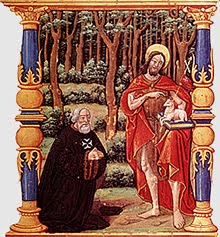
Today is the Feast of Blessed Peter Pattarini, who was a Prior of the Order.

With Blessed Fra' Peter d'Imola, who was born about 1250 at Imola (Italy) into the family of the lords of Linasio, we find another aspect of the Order, which has always been interested in matters of the spirit. He was a well-known jurist of his times, he mediated between the Guelphs and Ghibellines at Romagna in 1297. Of his earthly life few things are known. He was born at Imola, Emilia, and Prior of the Hospital in Rome. Was he the Commander in Florence? That is a supposition which takes its likelihood from the fact that, after his death (October 15, 1320); he was buried in that city in the church of Saint James in Campo Corbellini, which belonged to the Order.

Relic of Blessed Peter.
But if the existence of the Blessed Peter passed almost unnoticed here on earth, (it is enough to be a real saint, no one except God knowing it no one including the saint himself!), that was not the case after he died.
One day the brothers were preparing and adorning the church to celebrate the feast of Saint James in a worthy fashion. A high ladder had been placed against the tomb of the Blessed Peter, and one of the priests was working hard to attach a hanging to the wall. His support began to slip, threatening greatly to fall and shatter the bones of its religious burden. It was then that the clerics present saw the arm of the holy man open the tomb slightly and hold the falling ladder as it passed him.

In consequence of that miracle, which was charitable though macabre, and well-authenticated by witnesses, the venerable body was taken out of its resting place - relative rest - and placed under the main altar in a reliquary that Commander Fra' Augustine Mego had made for it, not without having set aside the miracle-working arm in a little box.

Nevertheless, it must be admitted that our saint is particularly humble, for, though we already knew so little about him, he allowed the documents concerning him - both his life and his miracles - to disappear When his church was flooded during the great inundation of the Arno, in 1557. The reliquary was submerged for several days; evidently, it must have suffered much damage, together with the relics it contained. But in the 17th century, they still venerated the arm, which had been preserved with its flesh and nails.

May we, like Peter d'Imola, be learned, pious, courageous and beneficent, alive and dead, without, however acting too much the ghost. His humility, his charity, his knowledge, are virtues which we shall try to imitate without risking error, in the great simplicity of God.

(From: Ducaud-Bourget, Msgr. François: The Spiritual Heritage of The Sovereign Military Order of Malta, Vatican 1958)

COLLECT OF THE MASS
O God, who gave to blessed Peter, Prior of our Order, the gift of healing discord and division, grant to us through his prayers the grace of striving for peace and so being called the children of God. Through the same Christ your Son, who lives and reigns with you and the Holy Spirit, one God, for ever and ever. Amen.

SAINT THERESE - THE LITTLE FLOWER

Saint Therese of the Child Jesus (Saint Therese of Lisieux) teaches us that all our works, however humble, must be done to and for God.  This is very helpful as we carry out our hospitaller works for the Order, everything, however small, however pedestrian, however unpleasant, is directed towards God, whom we particularly find in Our Lords the Poor and the Sick. She shows us that our prayers too must be directed as acts of love to God, away from ourselves, and towards Him, as our beloved Patron Saint John the Baptist also teaches - illum oportet crescere me autem minui - He must increase, and I diminish.

This year Saint Therese's lovely feast was omitted as it fell on the Sunday in the New Rite, but in the calendar of the Extraordinary Form it falls today, so we are not deprived of the Little Flower's particular prayers for us at the altar this year. May we strive in all we do to be worthy of them.
A friend sent the Editor this lovely photograph of the reliquary of the Saint in the nuns' choir at the new Abbey of Notre-Dame de l'Assomption at le Barroux last year.  The same reliquary which we see in the photograph above in our own church in St John's Wood in 2009.
Collect: O Lord, who said: "unless you become as little children, you shall not enter into the Kingdom of Heaven,", grant us, we beseech you, so to follow the footsteps of blessed Therese, the Virgin, in humility and simplicity of heart that we may obtain everlasting rewards. Through Christ our Lord. Amen.
Saint Therese of Lisieux, pray for us

FEAST OF THE HOLY GUARDIAN ANGELS

Pietro da Cortona
Today's feast of the Holy Guardian Angels reminds us that we need metaphysical assistance to defend ourselves from the powers of Darkness, which every day, every minute, try to drag our souls into sin and eventually down to hell.  God has given each of us spiritual helpmates, we should pray to them daily and become familiar with their protective presence always beside us; and learn to thank them for the efforts they make that we are not worse than we are!

PRAYER TO OUR GUARDIAN ANGELS
O HOLY ANGELS, whom God,
by the effect of His goodness
and His tender regard for my welfare,
has charged with the care of my conduct,
and who assist me in all my wants
and comfort me in all my afflictions,
who support me when I am discouraged
and continually obtain for me new favours,
I return you profound thanks,
and I earnestly beseech you,
O most amiable protectors,
to continue your charitable care and defense of me
against the malignant attacks of all my enemies.
Keep me away from all occasions of sin.
Obtain for me the grace of listening attentively
to your holy inspirations
and of faithfully putting them into practice.
In particular, I implore you to obtain for me
the favour for which I ask.
[Here mention your need.]
Protect me in all the temptations and trials of this life,
but more especially at the hour of my death,
and do not leave me until you have conducted me
into the presence of my Creator
in the mansions of everlasting happiness. Amen. Pater, Ave, Gloria.

OCTOBER - MONTH OF THE HOLY ROSARY

Madonna of the Rosary by Lorenzo Lotto 1539
The Feast of the Holy Rosary falls on 7th October, and Holy Church has for many centuries dedicated this month to Our Lady's honour in this mystery. There are many internet groups set up to join together in praying the Holy Rosary daily this month, and we should never forget that the Rosary is a communal prayer, to be recited together, by which we gain additional graces, not just a private devotion. These groups facilitate this, even when we are physically alone. If you have found one you are warmly encouraged to join it.

We in the Order of Malta have a special relationship to the Holy Rosary, which has come to the aid of our Brethren over the centuries in their battles against the Ottoman forces, and it is fitting that, without the need to subscribe our names or intentions, all members of the Order, Companions, OMV and our many supporters and friends, should say a daily Rosary together this month for the intentions of the Lieutenant Grand Master and for the furtherance of the twin charism of our Order, Tuitio Fidei et Obsequium Pauperum - the Defence of the Faith and the humble Service of the Poor.

As the forces of Islam on one hand, and the destroyers of Christian ethics on the other, once again range themselves against Holy Mother Church, the 150 beads of the Holy Rosary are our weapon - our canons, our halberds, the oars of our galleys.  Let us bend our backs to this battle together, and Our Lady promises us Victory, as she has so often before!

S Bernard by Georg Andreas Wasshuber
at Heiligenkreuz Abbey (17th C)
From a Hymn of Praise to the Blessed Virgin Mary by Saint Bernard of Clairvaux, herald of the Second Crusade:
If squalls of temptations arise, or thou fall upon the rocks of tribulation, look to the star, 
call upon Mary.


If thou art tossed by the waves of pride or ambition, detraction or envy, look to the star, 
call upon Mary.

If anger or avarice or the desires of the flesh dash against the ship of thy soul, 
turn thine eyes towards Mary.

If, trouble by the enormity of thy crimes, ashamed of thy guilty conscience, terrified by dread of the judgment, thou beginnest to sink into the gulf of sadness or the abyss of despair, 
think of Mary.

In dangers, in anguish, in doubt, think of Mary, 
call upon Mary.

Let her be ever on thy lips, ever in thy heart; 
and the better to obtain the help of her prayers, imitate the example of her life.

Following her, thou strayest not;
 
invoking her, thou despairest not;

thinking of her, thou wanderest not;
 
upheld by her, thou fallest not; 

shielded by her, thou fearest not;
 
guided by her, thou growest not weary;
 
favoured by her, thou reachest the goal.

And thus dost thou experience in thyself how good is that saying: ‘And the Virgin’s name was Mary!' 

MONSIGNOR AUGUSTINE HOEY, Obl.OSB, RIP

Of your charity pray of the repose of the soul of Monsignor Augustine Hoey, who died this morning,  a couple of months short of his 102nd birthday, a great friend and spiritual father to many members of our Order.

Our Lady of Walsingham, pray for him
Saint Augustine of Canterbury, pray for him
Requiescat in pace

FEAST OF SS ELIZABETH AND ZACHARY, PARENTS OF OUR HOLY PATRON


The Virgin and Child, with Saints Elizabeth and Zachary,
and the Infant Baptist, by Andrea Mantegna, 1490
APERTUM est os Zachariæ, et prophetavit, dicens : benedictus Deus Israel.

Benedictus + Dominus Deus Israel; quia visitavit et fecit redemptionem plebi suae
et erexit cornu salutis nobis, in domo David pueri sui,
sicut locutus est per os sanctorum, qui a saeculo sunt, prophetarum eius,
salutem ex inimicis nostris, et de manu omnium, qui oderunt nos;
ad faciendam misericordiam cum patribus nostris, et memorari testamenti sui sancti,
iusiurandum, quod iuravit ad Abraham patrem nostrum, daturum se nobis,
ut sine timore, de manu inimicorum liberati, serviamus illi
in sanctitate et iustitia coram ipso omnibus diebus nostris.
Et tu, puer, propheta Altissimi vocaberis: praeibis enim ante faciem Domini parare vias eius,
ad dandam scientiam salutis plebi eius in remissionem peccatorum eorum,
per viscera misericordiae Dei nostri, in quibus visitabit nos oriens ex alto,
illuminare his, qui in tenebris et in umbra mortis sedent, ad dirigendos pedes nostros in viam pacis.
Gloria Patri et Filio, et Spiritui Sancto.
Sicut erat in principio et nunc et semper, et in saecula saeculorum. Amen.

A SPIRITUAL CALL TO ARMS

This is the text of the meditation preached by Father Joseph Hamilton at the Order's Walsingham Pilgrimage last week. We are very fortunate to have some Chaplains who understand the true nature of the Order, Fr Hamilton is most certainly one of them. He has been a friend of the Order in England since long before his vocation to the sacred priesthood, and joined the Order as a layman so has himself lived our vocation of knight; we are grateful to him for coming back to us to assist us in our journey to holiness.

+J.M.J+

As you all know at some point in the 11th century just before the Battle of Hastings the Mother of God chose to reveal herself in this place, as she has done again and again down through the history of the Church as a pledge of her maternal care for us, her children, entrusted to her by her Son as He hung dying upon His cross. Walsingham, like Lourdes, Loreto, Pompeii, Fatima and Knock is treasured by the Catholic faith as a place closely associated with the presence of the Queen of Heaven. But unlike these other apparition sites Walsingham is older, much older, so much so, that if you were to go to the Basilica of the Annunciation in Nazareth in Israel, you will see Walsingham listed as the first Marian apparition site outside of the Holy Land.

Who needs Game of Thrones for an epic tale, when just a mile from here in the slipper chapel you can read in Latin ‘signum magmun apparuit in caelo mulier amicta sole’ - There appeared a great sign in the Heavens, a woman clothed with the sun, standing on the crescent moon and crowned with twelve stars – and there is even a dragon! A great red dragon who drags a third of the stars of the sky from the heavens with his tail, and attacks the woman - but God sends his holy angels to protect her and bear her away – that crowned figure vested with the sun is the same as Our Lady of Walsingham, and the same as Our Lady of Philermo under which title she is venerated by the Order of Malta.

STIGMATA OF ST FRANCIS - PRAYERS FOR THE POPE

Tomorrow, Sunday, is the feast of the Stigmata of Saint Francis.  Let us offer our prayers especially today for the Holy Father, who took the holy name of this beloved saint, for his intentions and for his papacy.


SUFFRAGE OF SAINT FRANCIS
THIS MAN, despising the world, and triumphing over earthly things, laid up treasures in heaven by word and deed.
V. The Lord conducted him through the right ways.
R. And shows him the kingdom of God.
Let us pray :
O LORD Jesus Christ, who to inflame our hearts with the fire of your love when the world was becoming cold in spirit, renewed in the flesh of the most beloved Francis the sacred marks of your own Passion, graciously grant that by his merits and prayers we may steadfastly carry our cross and bring forth worthy fruits of penance. Who live and reign with God the Father, in the unity of the Holy Spirit, one God, for ever and ever. Amen. 
PRAYER FOR THE HOLY FATHER
LET US PRAY for Francis our Pope; may the Lord preserve him, give him a long life, make him blessed upon the earth, and may the Lord not hand him over to the power of his enemies.
V. May your hand be upon your holy servant.
R. And upon your son whom you have anointed.
Let us pray :
O GOD, the Pastor and Ruler of all the faithful, look down, in your mercy, upon your servant, Francis, whom you have appointed to preside over your Church; and grant, we beseech you, that both by word and example, he may edify all those under his charge; so that, with the flock entrusted to him, he may arrive at length unto life everlasting. Through Christ our Lord. Amen.
Let us also ask the prayers for Pope Francis of Saint Pio of Pietrelcina (Padre Pio), the most recent saint to have borne the holy stigmata of our Blessed Lord, and for our beloved Order and for the wellbeing of the whole Church.


Saint Francis of Assisi, pray for us and for the Holy Father.
Saint Pius of Pietrelcino, pray for us and for the Holy Father.

NOVENA TO OUR LADY OF WALSINGHAM

One of our confreres has proposed that we say a Novena to Our Lady of Walsingham, asking especially for Our Blessed Mother's intercession for the deliberations and reforms currently under way in our Order.  The Shrine at Walsingham has a full set of prayers, with devotions for every day, in preparation for the rededication of England as the Dowry of Mary in 2020, HERE. All readers of this blog are encouraged to join in this Novena. This Novena starts today, the Feast of Our Lady of Sorrows (or of the Seven Sorrows of the Blessed Virgin Mary, depending on which calendar you follow), and finishes on the eve of the feast, which this year falls on Sunday 24th September.
The Walsingham shrine at Corpus Christi Maiden Lane.
Any other suitable prayers may be used, the follow simple suggestion is adapted from the Customary of the Ordinate of Our Lady of Walsingham, for those who do not have online access at the times they may wish to say the prayers.
MARY, great Mary, most blessed of all Marys, greatest among women, great Lady, great beyond all measure, I long to love you with all my heart, I want to praise you with my lips, I desire to venerate you in my understanding, I love to pray to you from my deepest being, I commit myself wholly to your protection. (from a prayer of S Anselm)
Responsory:
V. Blessed is the holy Virgin Mary, and most worthy of all praise*

through her has risen the Sun of Justice, Christ our God, by whom we are saved and redeemed.
V. Let us joyfully celebrate this feast of the Blessed Virgin Mary*
through her has risen the Sun of Justice, Christ our God, by whom we are saved and redeemed. 
Let us pray:

O LORD God, in the mystery of the incarnation Mary conceived Thy Son in her heart before she conceived Him in her womb: grant that, as we, Thy pilgrim people, rejoice in her patronage, we also may welcome Him into our hearts, and so, like her, be made a holy house fit for His eternal dwelling. Through Jesus Christ Our Lord, who liveth and reigneth with Thee in the unity of the Holy Spirit, one God, world without end. Amen.
Our Father, Hail Mary, Glory be.  
Please pray also for the members of the Order in England who are in Walsingham on pilgrimage this weekend, and for those of Our Lords the Sick whom they serve.

Our Lady of Walsingham, pray for us.

INTERNATIONAL MILITARY ORDERS CONFERENCE

The 7th Military Orders Conference, founded by our late confrere Professor Jonathan Riley-Smith, took place last weekend at St John's Gate, Clerkenwell, site of the former English Priory.

We give below part of the text of the opening address by Fra' Ian Scott, 57th Grand Prior of England.
Model of the Grand Prior's regiment (see below)
Thank you Michael for inviting me this evening. Every time I come here I’m struck by the irony of being a guest in my own house.

The Order of Saint John of Jerusalem is generally thought to have been established around 1080 and the Grand Priory of England was established about 80 years later in 1140. Unfortunately, as Jonathan Riley-Smith pointed out to me, we were pipped to the post by the Venetians who established their Grand Priory a couple of years earlier – so we are the second oldest Grand Priory in the world.

After the reformation there were several gaps but Grand Priors were appointed right up to the beginning of the 19th century – sometimes with such old English names as Feretti, Geraldin, and Laparelli – no doubt the Scottish Laparellis! As you know, the Grand Priory was then re-established in 1993 with Fra’ Matthew Festing as the 55th Grand Prior and I am the 57th Grand Prior. 
A little known fact is that Henry Fitzjames, natural son of King James II was created Grand Prior of England by the bull of Grand Master Gregorio Caraffa in 1687 and was given the title Duke of Albemarle and Baron Romney by his father. He raised what was called the Grand Prior’s regiment, which saw service in the battles at Dublin in 1689, the Boyne in 1690, then at Limerick, Athlone and finally at Auchrin in 1691 which saw the defeat of the Jacobite army in Ireland. The regimental banner was a white flag with in the centre a picture of a burning city and beneath it the motto ‘The Fruits of Rebellion’. I sometime think that maybe this banner should be carried before me on ceremonial occasions.

On a different subject, I should like to mention that my confrere and friend Michael Hodges, Chancellor of the British Association, is currently working on a book listing all the Commanderies of the Order of Malta in Great Britain and I am looking forward to seeing this important work when it is published next year.

Finally, I should like to say how pleased the Grand Priory and the British Association are to support the 7th International Conference and to wish you all an enjoyable and instructive time over the next few days.

Fra’ Ian Scott
Grand Prior  

DR CONLON'S HOMILY FOR THE VICTORY MASS

We are pleased to be able to reproduce here the homily preached at the Victory Mass last Friday, and express our gratitude to Dr Antony Conlon, Chaplain of the Grand Priory, for celebrating the Mass and for preaching.


In the long history of the progress of human ideas misunderstanding of interaction and integration of the spiritual and the physical has been a major problem. A major heresy known as dualism hindered the spread of Christianity from the beginning and has continued in various forms to afflict religious experience to this day. Dualism may be described as a radical scepticism and disapproval regarding all things physical and material. This would include obviously the visible and tangible creation, the body and all its attributes, human organisations and objects fabricated or designed by human effort. Essentially, matter is evil and only spiritual things are good. One extreme form of dualism denies outright any possibility of good coming from or being associated with the body and bodily or man-made institutions or things.

NATIVITY OF OUR LADY - "VICTORY MASS"

"Sprung from a royal race, Mary shines forth to the world; the help of whose prayers we devoutly implore with heart and mind." (Antiphon 3 of Lauds and Vespers, 1962)
The Icon of Our Lady of Philermo, as she would have appeared 
annually on this day in Malta, wearing the festal 'dress' given by
Grand Master Villiers de l'Isle-Adam (16th to 18th centuries)
Today, the Birthday of our blessed Mother, the Order celebrates the great naval victory of the lifting of the siege of Rhodes in 1565, won at her intercession, known as the Victory Mass. This is also recognised as the feast of Our Lady of Philermo, the precious icon which the Knights found on Rhodes, and which has been their most prized devotion ever since.

High Mass will be sung at the Church of St James, Spanish Place at 6pm.  the celebrant will be the Chaplain to the Grand Priory, Dr Antony Conlon.
The Grand Priory's copy of the icon.
In this troubled age for our world and for the Church, let us ask for Our Blessed Lady's prayers once again to bring peace, in the words of the collect of the Mass.
Let us pray.
Bestow upon your servants, we beseech you O Lord, the gift of heavenly grace, that, as the child-bearing of the Blessed Virgin stood for the beginning of our salvation, so may the solemn feast of her Nativity bring about an increase of peace. Through our Lord Jesus Christ your Son, who lives and reigns with you in the unity of the Holy Spirit, one God for ever and ever. Amen.
"Whoever you are who understand that in the floods of this age you are walking among squalls and storms rather than on land, do do not turn your eyes from the brightness of this star, if you do not wish to be overwhelmed by the squalls. If gales of temptations arise, if you run aground on rocks of tribulations, look upon this star, call upon Mary. If you are tossed around by waves of pride, or ambition, or depression, or envy, look upon the star, call upon Mary. If anger or greed or the lure of the flesh strike the poor little ship of your mind, look upon Mary. If you are thrown into confusion by a great mass of sins, or bewildered by a sense of disgust in your conscience, or terrified by a horror of judgement, and you begin to be sucked down by a whirlpool of grief or an abyss of desperation, think upon Mary. 

In dangers, in tight corners, in dubious matters, think upon Mary, call upon Mary. Let her not leave your lips, let her not leave your heart, and, so that you may win the help of her prayer, do not abandon the example of her way of life. As long as you follow her, you have not strayed from the path; as long as you call upon her, you are not without hope; as long as you think upon her, you are not lost; if she holds you fast you do not fall to the ground; as she protects you, you are without fear; with her as your guide, you are not wearied; with her favour, you reach your destination and thus experience within yourself how fittingly it was said: 'And the Virgin's name was Mary'." 
(From the Homilies in praise of the Virgin Mother of S Bernard the Abbot, taken form the Office of Readings for The Holy Name of Mary, Sept 12th. Hat/tip Fr John Hunwicke) 

CELEBRATION OF THE DECOLLATION OF OUR PATRON IN VALETTA

We are grateful to one of our confreres for the photographs below, which shows the relics of Saint John the Baptist at the former Conventual Church of Saint John of Jerusalem in Valetta, now the Co-Cathedral, displayed for the veneration of the Faithful on the Feast last Tuesday.  The reliquary is in the form of a very realistic severed head upon a dish, but does not, of course, contains a head (See our earlier post on the Feast, illustrating the three supposed relic heads).
Those members of the Grand Priory and British Association who occasionally opine that the liturgical practices of the Order in Britain are elaborate might do well to reflect upon this splendid image, which shows the glorious character of the Order's liturgy though most of its history.  We should be grateful that, despite the ravages of Napoleon, the disappearance of the Knights, and the reforms of the Second Vatican Council, the liturgy of Saint John's Valetta retains much of the ceremonial and custom of our noble tradition.

Any Maltese member reading this who knows the origin and date of the reliquary would be very welcome to post a comment in the box.

MASS OF Bl ILDEFONSUS SCHUSTER OSB, Ep. ON

The Monthly Mass today will be celebrated in honour of one of the great 20th Century saints of our Order. Mass is at 7pm in the Lady Chapel at St James Spanish Place.

He was born in Rome of Bavarian parents on 18 January 1880 and was baptized Alfredo Ludovico Luigi. He entered the Benedictine monastery of St Paul-Outside-the-Walls when he was 11, and in 1896 began his novitiate, taking the name of Ildefonso. He made his solemn profession in 1902. After studying philosophy at Sant' Anselmo (Rome) and theology at St Paul's Abbey, he was ordained a priest in 1904. He was appointed Archbishop of Milan by Pope Pius XI on 26 June 1929 and created a Cardinal on 15 July. In 1933 he was invested Bailiff in our Order. A few days before he died, he withdrew to Venegono seminary. His last, moving words were to the seminarians: “You want something to remember me by. All I can leave you is an invitation to holiness...”.

The Collect of the Mass
Almighty God, through your grace, Blessed Alfredo Ildefonso, by his exemplary virtue built up the flock entrusted to him. Grant that we, under the guidance of the Gospel, may follow his teaching and walk in sureness of life, until we come to see you face to face in your eternal kingdom. We ask this through our Lord Jesus Christ your Son, who lives and reigns with you and the Holy Spirit, one God, for ever and ever. Amen.
THE SACRED POEM 
The following text is an article written by Blessed Ildefonso Cardinal Schuster OSB, Blessed of the Order of Malta, who was Archbishop of Milan in the 1920's, a most learned scholar of liturgy.
The Sacred Liturgy in its widest meaning, has as its object, the religious and supernatural culture of Christianity in its various sacramentary, euchological, ritualistic, literary and artistic manifestations, embracing thus, as in a vast synthesis, all that which is most sublime which has been created in the world, in order to grasp and express the indescribable and the Divine. Nor is that all.

As children of the Catholic Church and heirs of the dogmatic revelation made to the ancient Patriarchs and Prophets of Israel, our religious culture not only pre-exists, in its fundamental elements, the very coming of the Son of God to the world, but it is present many centuries prior to the most ancient cultures which record history, establishing itself, for that reason, to be respected and venerated by the learned. Moreover, it is not possible to speak of a purely natural and human origin, both because the dogmatic element of Christianity originates from direct and positive Divine Revelation and also because the life and activity itself of the Church are derived from the Spirit of Jesus Who lives in Her.

Therefore we are speaking of a sacred poem, to which Heaven and earth have truly placed their hand, and in which humanity, redeemed in the Blood of the Spotless Lamb, on the wings of the spirit, soars on high, thrusting itself up to the throne of God. This is something more than a simple elevation; since the Sacred Liturgy does not only express that which is ineffable and Divine, but through the Sacraments and its euchological formulae, produces it, so to say, and fulfills it in the souls of the Faithful to whom it communicates the grace of Redemption. One may also say that the very source of the holiness of the Church is wholly comprised in Her Liturgy, so that without the Divine Sacraments, the Passion of the Saviour, in the present economy instituted by God, would not have any efficacy for us, due to the lack of instruments able to transmit its treasures to us.
The sphere of the Liturgy is unsurpassed by that of any other science, since it embraces the first origins of humanity, its essential relations with the Creator, the Redemption, the Sacraments, Grace, Christian eschatology, in other words, all that there is which is most sublime, most aesthetically perfect, most necessary and important to the world.

As for science, the Sacred Liturgy has its canons, its laws, its subdivisions, the same as all other sciences and particularly of positive theology, which is similar both in its method and its aim. One of its purposes, in fact, is the systematic study of Christian worship, distinguishing and classifying the various liturgical formulae according to the basic structure characteristic of each family, ordering them by date of compilation and instituting examinations and comparisons between the various forms, with a view to tracing elements of common origin in them.

It is only thus that apparently irreducible liturgies, such as the Roman, the Gallican and Hispanic liturgies can be traced to a common source. If such were not the case, it would be difficult to see how the unity of the Symbol of Faith (The Creed) failed to lead(as an immediate consequence of its unity) to primitive unity in its liturgical expression. Instead, recent studies and detailed and patient investigation have uncovered in all the liturgies, even the most dissimilar, a common substratum.

At times an identical concept is expressed using quite different ritual formulae and language. Nevertheless, it can now no longer be doubted that eastern and western liturgies all derive from an identical, very ancient form, which provides a foundation for Catholic unity in ecclesiastical worship.