FEAST OF OUR HOLY PATRON SAINT JOHN THE BAPTIST
LITANY OF LORETO - NEW INVOCATIONS
From the Vatican, June 20, 2020
Memorial of the Immaculate Heart of the Blessed Virgin Mary
Eminence,
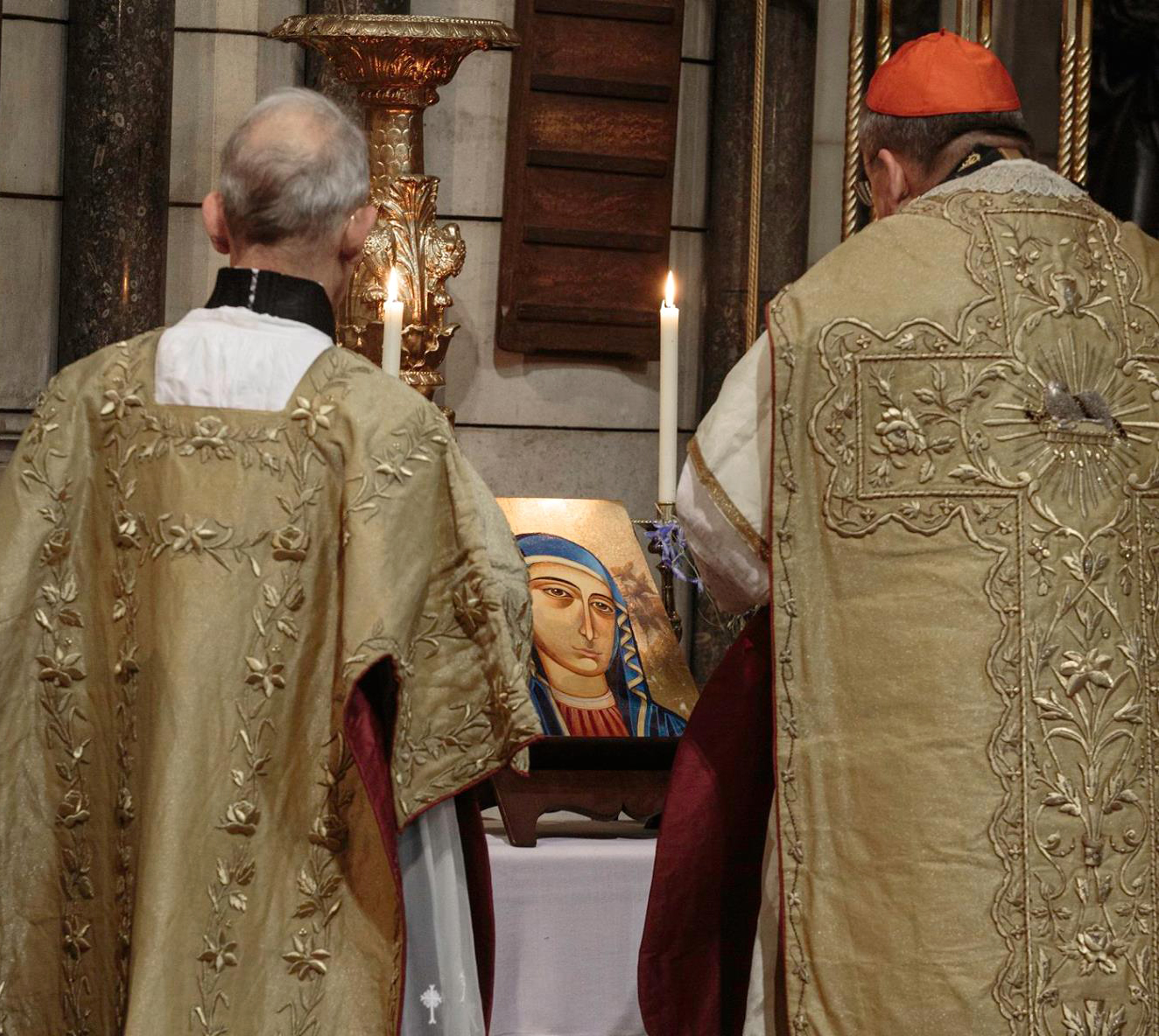
The Church, on pilgrimage to Heaven’s Holy Jerusalem, — to enjoy inseparable communion with Christ, her Spouse and Saviour –, walks along the paths of history entrusting herself to Her who believed in the Lord’s word. We know, in fact, from the Gospel that Jesus’ disciples learned from the beginning to praise the “blessed among all women” and to count on Her maternal intercession. One cannot name the titles and the invocations that, in the course of the centuries, Christian piety has given to the Virgin Mary, privileged and sure way of encounter with Christ. In our time also, which is going through reasons of uncertainty and bewilderment, pious recourse to Her, full of affection and confidence, is particularly dear to the People of God.
Interpreter of this sentiment, the Sovereign Pontiff Francis, receiving the desires expressed, wished to establish that, in the formulary of the litanies of the blessed Virgin Mary, called “of Loreto,” the following invocations be inscribed: “Mater Misericordiae,” “Mater Spei” and Solacium Migrantium.”
The first invocation will be inserted after “Mater Ecclesiae,” the second after “Mater Divinae Gratiae,” and the third after “Refugium Peccatorum.”
While I am happy to communicate this disposition to Your Eminence, so that it is known and implemented, I take the occasion to express to you the sentiments of my esteem.
Yours very devotedly in the Lord,
Robert Cardinal Sarah Prefect
Monsignor Arthur Roche Archbishop Secretary
DISTRACTIONS!
Ah, dear Reader, we thought that headline would get your attention! Distractions in prayer, the enemy of the Covid-19 Retreat! Distractions in prayer, or "spiritual distractions," are not new. In the form of images or ideas, they parade through even the most pious minds. Is there a cure to rid ourselves of them? Yes, do not give them too much importance, and interpret them as an opportunity to turn back to the Lord; an opportunity for “conversion”. We are very grateful to the international Catholic news-site Aleteia, and to the author, Élisabeth de Baudöuin, for this article, to whom all credit.
Distractions touch all forms of prayer (Holy Mass, communal prayer, holy rosary, private prayer, adoration). They vary according to one's temperament, state of life, and circumstances: the philosopher reasons, the parents think of their children, the resentful harks back, the ambitious man builds his future... Their nature informs the person about himself: his worries, affections, passions, temptations. Who escapes distractions in prayer? No one, not even the saints! Saint Teresa of Avila speaks of it as a true "infirmity", as much painful as unavoidable. She recounts that sometimes, even in solitude, she could have "no fixed and settled thought, neither of God nor of any good thing", and that her spirit resembled "a madman that nobody can chain". She admits that she was thinking "of nothing bad, but only of pointless things". One day, she found herself counting the nails in the shoe of the nun who was praying before her. Nothing serious, if we consider some of our less bright distractions. But how are we to understand this "infirmity"?
“Prayer Disorders” That Prevent Concentration
Spiritual distractions are inherent in our condition as bodily beings. The explanation is simple: man is not merely a spirit. And as the spirit seeks to reach God, its efforts are thwarted by the weight of the "matter" which holds it down. The "matter"? First of all the five senses, constantly in activity, which grasp, despite themselves, "everything that passes": this or that noise (the ringing of the mobile phone that one’s neighbour forgot to turn off), some image (our new neighbour's hairstyle), some smell. True “prayer-disturbers”, the senses constantly provide food for the mind with what they capture, thus preventing it from concentrating on the supernatural truths that it is nevertheless seeking.
But the action of the senses does not explain everything: with earplugs, a blindfold and a clothes-peg on the nose, there are still distractions. Why? Saint Teresa of Avila replies: "The natural powers, that is to say, memory, imagination (the “madwoman of the house”) and understanding (the faculty of reason), which never cease to wander, divert the will from its objective: to settle on God”.
Faced with the often painful and disconcerting experience of distractions, one may be tempted to be discouraged. Indeed, when you have too many distractions, you can say to yourself: "I am not made to pray". The temptation may then be to abandon everything. This is what you certainly should not do. If we stopped praying because we have distractions, we would never pray! Distractions only reach the peripheral part of our being. But God gives himself to us in the depths of the soul, where distractions do not enter, where the bodily senses have no access. They therefore do not prevent prayer from working within the soul and transforming it.
Distractions are an opportunity to choose the Lord again
So what should we do? Persevere, of course! And don't pay distractions too much attention, much less dramatize them. But do not take pleasure in them. That temptation nevertheless exists, and can be strong. As long as one does not dwell on them voluntarily, spiritual distractions are not a sin. “They are even a grace!” says one priest loud and clear. Because they are an opportunity to turn back to the Lord, to actively chose him, whom we had temporarily abandoned. To come back to him in the form of the prayer which we were making before.
“To abandon a distraction that pleases us to return to Christ is to perform an act of love.” “They teach us to live on dry, black bread in the house of God”, so we read from the pen of Fenelon. Interest on such a modest allowance, on such a pittance? Yes, by making prayer difficult, distractions allow man to seek God for himself, and not for the consolations of the senses he can give. Likewise, because of the effort they involve to rid oneself from them, they strengthen the will to find Him and stir up the desire to unite ourselves with Him.
Yet more graces: this concerns also our very poverty. Now, "the poorer we are […], the more we are fit for the operations of consuming and transforming love", writes Thérèse de Lisieux. The young doctor of the Church, however, poses two conditions: choosing to remain poor; and love of this poverty. Saint Paul says a similar thing: “So, I will boast all the more gladly of my weaknesses, so that the power of Christ may dwell in me.” (2 Cor. 12:9)
And so here is the unexpected consequence: to live in praise, submission and thanksgiving; spiritual distractions allow God to establish his reign in the heart of man. They become then a pathway, far more than an obstacle, to come to God in humility.
Elisabeth de Baudöuin
Translation Grand Priory of England
FEAST OF THE MOST HOLY BODY AND BLOOD OF CHRIST
PROTECT THE YOUNG FROM TRUE EVIL INCARNATE - POPE'S WEEKLY AUDIENCE
THE MOST HOLY AND UNDIVIDED TRINITY
SIR GEORGE BOWYER ANNIVERSARY - RIP
REFLECTION ON OUR REDEMPTION 15 - PENTECOST
SAINT UBALDESCA, VIRGIN
Saint Ubaldesca Taccini represents the perfection of female service in the Order of Saint John.
THE HOLY EUCHARIST AND CORONAVIRUS
FEAST OF SAINT PHILIP NERI

(Photo courtesy of James Barton.)
REFLECTIONS ON OUR REDEMPTION 14 - AWAITING THE HOLY GHOST
PLEASE HELP TO OPEN OUR CHURCHES!
A group of young London based Catholics have today announced the launch of a new initiative aimed at enabling the swift reopening of Catholic Churches across the UK. The website, Open Church Doors, encourages lay Catholics to indicate their willingness to volunteer at their local parish in order to safely enable private prayer and liturgy in Catholic churches once again. Following an initial soft launch, slightly under 500 volunteers have signed up so far.
The website https://opendoors.church/ forwards the name and email address of each volunteer to their local parish, in order for each parish priest to know that they have sufficient help to, among other things, disinfect surfaces and manage social distancing inside.
In addition, the website is designed to show national support for the Bishop’s efforts in negotiations with the government in order to reopen churches as soon as possible. The volunteer counter on the website keeps track of the national total in a way individual emails to parishes otherwise would not be able to demonstrate.
Co-founder and Spokesman Anton’ de Piro said:
‘This initiative is designed first and foremost to be of support and help to bishops and priests in their efforts to get churches open again. Everybody involved in the project is rooting for all of them and praying for them and we hope that the numbers that sign up can be a concrete source of encouragement for all.’
Contact: openchurchdoors@gmail.com
07748 272 908
BLESSED VILMOS APOR, MARTYR OF OUR ORDER
THE OPENING OF OUR CHURCHES?
The Ascension of Our Lord
May 21st, 2020
Your Excellency,
Last Monday, I received a copy of the diocese’s letter regarding the opening of our churches as we enter the “yellow phase.” After being denied access to the Sacraments for two months, I cannot begin to tell you how absolutely heartbreaking the letter was to read.
What has happened these last two months, to our Church and Sacramental life, is a tragedy, and it is unacceptable. It is a grave mistake, however well-intentioned, to consider the closure of the Church and denial of access to the Sacraments to be a form of “charity.” No one is being forced to attend Mass, forced into a confessional, or forced to adore Our Lord—the very same Lord, in the Blessed Sacrament, as He before whom we will one day stand in judgment. If a person is frightened or vulnerable to illness, they have always had the option to stay home. The implication of your letter, that those of us who wish to attend The Holy Sacrifice during these times are somehow uncharitable, selfish, and inconsiderate of the safety of others, is an unjust characterization.
I am a physician and work almost exclusively with acute illness and injury. I understand better than most people the risks—whether real, imagined, or feared—of the coronavirus, as well as every other infectious disease that I encounter. More importantly, I am the father of five very young children. Knowing full well that I come in contact with COVID, influenza, RSV, C. diff, Syphilis, Zoster, and an untold number of other pestilent entities, should I quarantine myself out of “charity” to my family, for their own safety, to protect them from the dangers of this life? Should I wring my hands, bemoan my circumstances, and give them my love from six feet away through a plexiglass shield? What of my patients? I can’t order them to stay home out of concern that they could be exposed to illness. I can’t repair a child’s head wound through a Zoom meeting or replace a dislocated shoulder via Facebook Livestream.
As a father and husband, I cannot in times of crisis simply lock my doors and sequester myself. I can’t wave from the window and wish my children well while they stand in the elements outside, deprived of food, clothing, and shelter. I cannot deny them my presence while I allow the crisis to pass. I’m obligated to care for them. A bishop is the spiritual father of his diocese, tasked with the welfare of the souls of his flock. Regardless of intentions, every single bishop in our country has deprived his spiritual children from their primary source of nourishment!
It is frankly scandalous that I may go to Home Depot and the grocery store but may not enter a Catholic church. I may receive a bag of fast food at a drive-through window from the hands of a stranger but not Our Lord from the consecrated hands of a priest. I may wash my clothing at a public laundromat but not wash my soul in the confessional.
How long will this go on, and how far will things be allowed to go? What will you do this fall when the virus surges again? What will you do during future flu seasons? Will laymen stand alone when immorality is legislated; when the forces of the world rage against the faithful, against Christ and His Church; when a greater crisis than this one strikes (which is very easy to imagine)? What would the great English Martyrs say? What of the Cristero soldiers? St. Damien of Molokai? What of Pope John Paul II, who famously said “Open wide the doors for Christ!”?
From the beginning, religious institutions and places of worship have been exempt from the government-implemented mitigation measures. Believe me, I checked, many times. Our interdict comes entirely from ecclesiastical authorities, and unless I am mistaken, only you, dear bishop, may lift our restrictions. Please, let us return to Mass. Don’t set limits on church capacity or mandate masks.
Please, I beg you, open wide the doors of our churches, and may they never be closed again.
Sincerely,
(A Catholic Medical Doctor)
UPDATE: The French Republic, notoriously anti-clerical, has opened all churches from this weekend, with sensible precautions similar to other public places. The Conseil d'Etat had ruled that the prohibition of public religious practice was illegal, and a violation of 'fundamental rights'.
Britain, it seems, is to be left alone. Perhaps, after three centuries of the worst religious persecution of any Western country, that should not surprise us. What, as the good doctor says above, would the Martyrs say?
Here is the video of the President of the United States of America:
"WE NEED MORE PRAYER, NOT LESS."