We wish to all our Readers a happy feast of Saints Elizabeth and Zachary, holy parents of Saint John the Baptist. The painting above, of the second holy family, is by Louis-Jean-François Lagrenée, 1724 to 1805.
FEAST OF THE HOLY PARENTS OF OUR BLESSED PATRON
INTERNATIONAL BUY A PRIEST A BEER DAY
O most esteemed, charitable and generous Reader!
Today is "International Buy a Priest a Beer Day". Much salutary information may be found on the website of "The Catholic Gentleman" HERE.
As this is rather short notice, and this Feast is of an hospitaller rather than purely doctrinal nature, the Grand Priory of England of the Order of Malta feels itself entitled to establish an Octave, applicable to the entire English-speaking world within the Order, its Members, Companions and Associates.
We are deeply indebted for this liturgical intelligence to a Companion of Malta who may one day be a beneficiary of this Feast.
Go out and do your hospitaller duty!
Please note the photograph is from some time ago, from when some of us were, indeed, very young, and modern priests may nowadays quite properly, as may girls, be offered pints.
St Hopswald of Aleyard, opn!
UPDATE - A kindly Knight has volunteered the following photograph - pour encourager les autres. And enlarge to see what he is drinking!
BLESSED ADRIAN FORTESCUE - TUITIO FIDEI - COME DRINK AT THE FOUNTAIN
It is very fitting that within the week of the Feast of Our Blessed Lady of Philermo, the reverend compilers of the little volume "Mementoes of the Martyrs" (Burns and Oates, 1961) should have chosen to include the text of Blessed Adrian Fortescue's maxims, this day and tomorrow, written in his manuscript within his Book of Hours. As many members of the Order will know, this treasured volume, the only relic of our martyr saint, the property by inheritance of the Constable Maxwell family, is on loan to the Grand Priory, and one of our most treasured artefacts. Third-class relics are available for the devotion of the faithful, by gracious courtesy of former Grand Master Fra' Matthew Festing.
It gives us much pleasure to offer to our dear Readers the published Maxims of Blessed Adrian, which have never before appeared on this blog, and which are as apposite for our day as they clearly were in his. It shows how little changes, and for all the claims of development and increased 'sophistication' which our liberal friends would have you believe we have achieved, we actually change very little, and are still just as guilty of the same foolishness as our 'unsophisticated' 16th Century ancestors. Much comfort therein. These admonitions are for every layman; take heed, beloved Confrere, dear Companion!
MAXIMS OF BLESSED ADRIAN FORTESCUE, Martyr, ON.
ABOVE all things love God with all thy heart.
Desire His honour more than the health of thine own soul.
Take heed often with all diligence to purge and cleanse thy mind with Confession, and raise thy desire
or longing from earthly things.
Be thou houseled [receive Communion] with entire devotion.
Repute not thyself better than any other person, be they never so great sinners, but rather judge and esteem thyself most simplest.
Use much silence, but when thou needs must, speak.
Delight not in familiarity of persons unknown to thee.
Be solitary as much as is convenient with thine estate.
Banish from thee all judging and detraction, and especially from thy tongue.
Pray often.
Also enforce thee to set thy house at quietness.
Resort to God every hour.
Advance not thy words or deeds by any pride.
Show before all people a good example of virtues.
Be not partial for favour, lucre or malice, but according to truth, equity, justice and reason.
Give fair language to all persons, and especially to the poor and needy.
In prosperity be meek of heart, and in adversity patient.
And pray continually to God that thou may do what is His pleasure.
Pray for perseverance.
Continue in awe of God, and ever have Him before thine eyes.
Renew every day thy good purpose.
What thou hast to do, do it diligently.
'Stablish thyself always in well-doing.
The picture at the head of this post shows Bl. Adrian Fortescue, a copy of the painting at the College of San Paolo, Rabat, Malta, by the Grand Master's brother, the renowned painter, Andrew Festing.
RELIGIOUS TOLERANCE?
We are invited to support a petition against the decision of Barclays Bank to deny banking facilities to a charity, which happens to be Christian, on idealogical grounds. See HERE.
It matter not whether we agree with everything this charity states, the greater point of being allowed legally to practice one's beliefs freely in a free society must override any subjective opinion. Or so we should like to think. You may read about the Core Issues Trust HERE.
This subject calls to mind a recent deeply ironic blogpost from our dear friend Fr John Hunwicke, HERE. There is much truth in irony, which is why it is so hated.
To say the world is a messy place is an understatement.
Our Lady of Philermo, pray for us!
TUITIO FIDEI ET OBSEQUIUM PAUPERUM
Gnädige Readers are directed to the PREVIOUS POST as a pleasant corrective antidote! But not as an opiate.
AND MANLY HEARTS TO GUARD THE FAIR!
A happy end to the Summer for all our readers!
HOMILY FOR THE VICTORY MASS
The Victory Mass took place in some splendour at St James's Spanish Place, with polyphonic choir, on Tuesday, Our Lady's Nativity, and the celebration of the victorious outcome of the Siege of Malta by our Blessed Mother's powerful intercession. This victory should give us confidence in our own troubled times to ask Our Lady for Her aid, in the firm confidence that our prayers will be answered; as God wills, not necessarily as we do.
Holy Mass was celebrated by Fr Richard Biggerstaff. Many Knights, Dames and Companions attended, a good return after the long absence of Lockdown. We give below the homily preached at the Mass by Monsignor John Armitage, newly appointed Chaplain of the Grand Priory. Please pray for the soul of Monsignor Antony Conlon, his late predecessor, may he rest in peace.
His humility was the true fount of his nobility, and his humility was inspired by the one who God called Mother, our Blessed Lady. In today’s first reading from the prophet Micha, we hear; The Lord says this, “But you, Bethlehem Ephrathah, the least of the clans of Judah, out of you will be born for me the one who is to rule over Israel.”
At the heart of our Order, is the one who is “the least of the clans of Judah”, the woman who would rejoice and glorify the Lord, for He who is Almighty had worked great marvels in her life. The humility of our Lady arises from her recognition of God's great work in her life, for humility is the recognition that all I have, is freely given to me, by the God who loves me. The nobility of Blessed Gerard was born of a graciousness that comes from being a servant, walking in the footsteps of the one who washed the feet of the apostles, and said to Peter, “unless you let me wash your feet, you can have nothing to do with me”. Like Our Lady, Gerard had recognised in his own life that the Lord had done great things for him, and because of these great things he was able to do great things in the service of others, especially the Poor and Our Lords the Sick. Gerard had a noble heart, a great heart, because he was humble, not counting on his worldly status, for he had experienced the wonders of God's love in his life. It was in serving the Sick and the Poor that he discovered his strength, it was in the challenges of his times, faced with violence, disease and injustice that he gained the strength to serve others and not to count the cost to himself.
Whether it was in the growing needs of sick pilgrims in Jerusalem, or the courageous stand of the Siege of Malta that we remember today, or the challenges that we face in today’s pandemic, our Order needs men and women of great heart, whose nobility is firmly rooted in the humility of Our Lady and the example of Blessed Gerard.
During the Second Word War Pope Pius XII addressed the Order in 1941 “In these poor, these orphans, these wounded, these lepers, you own the title deeds of nobility received at Bethlehem from the King of Kings, who being rich, became poor, that by his poverty you might be rich. Nor are you content with aiding them by your gifts; you love and honour them as the privileged courtiers of our common king."
These profound words of the Pope, remind us that the title deeds of our nobility, as members of our Order lie in the service of the poor, the wounded and the lepers, and that they were given to us in Bethlehem by the King of Kings, who “being rich, became poor”.
From the moment of her Conception, Mary was blessed by God, blessed in order that salvation could come to the “people who walked in darkness”, it was through Mary’s yes, that these “people saw a great light” in her son, Jesus Christ.
Our world still walks in darkness, for so many of our brothers and sisters have not seen the great light. The birth of Mary, and the yes of Mary enabled that light to shine upon us. This light is known through a human encounter, for the Word became flesh and lived among us. Therefore, the world waits for women and men, who have said yes to God in their lives, to be beacons of light to those who live in darkness.
Each moment in history demands great sacrifices, acts of love and kindness, acts of graciousness and radical generosity to address the darkness that so besets our world. The challenge of renewal within our beloved Order, is not about administration, it is about a renewal of the personal and generous response in the lives of its members to say yes as Mary said yes, to say yes as Gerard said yes, to say yes in the footsteps of the thousands of members of our Order who over the centuries have served the Poor and the Sick and protected the Church by their example and loving service, always at a cost to themselves, and sometimes at the cost of their very lives!
At the Annunciation, the message of the Angel “greatly troubled” Mary, but he said to her “Do not be afraid, for the power of the most high will come upon you”. The feast we celebrate today reminds us of what is to come in Our Lady’s life, and what is to come in our life. Like her we may be afraid, afraid of what is happening in the world, what is happening in our family and country. Like Mary we may be afraid of what God may be asking of us to be a “light in the darkness”. Yet the Archangel reassures us, as he reassured Mary, for “Nothing is impossible for God” and so we join with Mary Our Mother and say “Behold the handmaid, (the servant) of the Lord, let it be done to me according to Gods word.”
The painting shows the Lifting of the Siege of Malta, by Charles-Philippe Lariviere. Salle des Croisades, Versailles.
OUR LADY'S INFLUENCE
As the page turns, and August move into the autumn, we should keep in mind, most notably in these troubled and Godless times, the promise of Our Lady to be with us in all our troubles, as in our joys; a role She was given from the Cross, but which was Hers from Eternity.
These words are from His Eminence Charles Cardinal Journet, "Entretiens sur Marie - Éditions Parole et Silence, 2001"
"The mystery of the Virgin is the first repercussion of the mystery of the Incarnation. The mystery of the Virgin is like when a stone is thrown into water: a first ripple is produced which will be the cause of all the others.
"This first concentric circle is the Virgin Mary in relation to the Incarnation. And the ripples will continue until the end of time, and they will be the Church."
Our Holy Father Pope Francis spoke of ripples from a stone early in his pontificate, but his ripples seemed to be going the other way.
Which sort of ripple are we?
Translation: Grand Priory of England
HOMILY FOR OUR LADY'S ASSUMPTION
![]() |
As the Month of August draws to a close, as a final joyful reminder of the traditional dedication of this month to Our Blessed Mother assumed body and soul into Heaven, we are greatly indebted to our dear friend Fr Mark Elliott-Smith of the Ordinariate of OLW, for his homily preached at his church of eponymous dedication, Warwick Street, on this glorious feast a couple of weeks ago.
TODAY is a day of great joy and triumph!
It is the day when Our Lady, at the end of her earthly life was taken up, body and soul into the glory of Heaven.
Mary was, from the moment of her Immaculate Conception, preserved from the stain of original sin: it is the ultimate triumph of grace, that she who stood at the foot of the Cross, most blessed of all women, should be crowned as Queen of Heaven. And there she prays for us: we can call her Mother, for we are all her children. Her presence in Heaven, a Woman clothed with the sun, and the moon under her feet; and upon her head a crown of twelve stars, tells us of the victory of God’s love, and the resurrection of the body, and a pledge of future glory for all of us.
The dragon, the seven headed and ten horned horror that seeks to devour the child of her womb, is defeated, but he doesn’t give up. Although he knows that his days are numbered, although he knows that God’s love will always win in the end, he will try to drag as many souls down with him when his final defeat take place: when Christ, having put all enemies under his feet, delivers the Kingdom to God the Father. The dragon hates our Lady, for she is the Ark of the New Covenant who, without loss of her virginity, brings salvation to the world; so we, her children, fly to her for refuge, and her sure protection.
In the Gospel, we heard Mary sing her great song inspired by the Holy Spirit: the Magnificat. Such is the power of grace, making her way with haste and urgency to see Elizabeth, that the older woman, too, is filled with the Holy Spirit, and the child leaps in her womb.
‘My soul magnifies the Lord.’
The greatness of Mary lies in her humility, and her obedience. She acknowledges God’s greatness, and the great things that He has done for her. It is her worship of her Heavenly Father in Spirit and truth, in virginal purity and in utter obedience that makes her great, and makes her free.
It is this that makes her so hated and feared by the devil, because he cannot do to her what he tries to do to us: namely, tempt us by saying that we don’t need God. He has been doing it since the beginning, he does it now: he offers us a false freedom.
This is the greatest and most tragic mistake we can make, and society is making it again today: ‘Can we not do without God?’ ‘Why do we need to accept the demands the Gospel places on our lives?’ ‘Can we not live precisely how it feels good to us to live?’
This was the mistake of the Prodigal Son. He came to see his Father’s house, not as the place he was truly free, but as a place of restriction and rules and prohibitions. It was only after discovering that the far country to which he had strayed had in fact enslaved him that he realise what true freedom means: that God is great and worthy to be praised, and when we worship him, our own true greatness as God’s adopted sons and daughters is revealed in us. Mary is great, indeed the greatest, because God is great. The devil, the proud spirit, is vanquished, and the humble are exalted; and we, who are hungry for the Bread of Life and the Chalice of Eternal Salvation, are fed to our heart’s content.
And all this has happened because of Mary, conceived Immaculate, obedient to the Father, and Assumed, body and soul, to Heaven.
And it is because she is in Heaven that she remains close to us: she stayed with Elizabeth for about three months and then went back home. But we can be sure that Mary, who rushed to be by her cousin’s side remained close to Elizabeth in prayer. We can be sure that Mary, who Jesus named as mother of all disciples while she remained at the foot of the Cross, remains with us and prays for us in the joy of the resurrection.
So it is the most natural thing in the world to ask Mary to pray for us. That simple act of prayer makes room in our hearts for God, to let Jesus be our Ruler and Guide.
Today we entrust ourselves to her Motherly intercession, we look upon her as the source of our hope, and the example of true freedom in obedience and humility. May the grace which made her the highest honour of our race, and most blessed of all women, be poured into our hearts, and that we made brought to the glory of the Resurrection.
Our Lady Assumed into Heaven. pray for us.
MEMENTO HOMO
"Sacrilega sunt arma quae sacra tractantur manu...
Miles mitrae imperat cum mitra militibus imperat."
It matters not if it be a soldier or a banker.
OBSEQUIUM PAUPERUM - A SACRAMENT - WHAT YOU NEED TO KNOW
This charming little video is offered to Members of the Order and Companions as a vade mecum for the ultimate act of charity we can give to Our Lords the Sick, namely to accompany them to a holy death. Every Catholic needs to know this, and this film, make by Fr Joe Dunn and the Catholic film company Radharc in the 1960s, remains wholly relevant today. Indeed more so, as so many of us have forgotten these simple duties.
It' all very well knowing how to nurse, but for every human being there comes a time when nursing ceases to be necessary, and then both their soul and ours benefits from this outward sign of God Love in the sacrament of Extreme Unction. CLICK ON VIDEO IMAGE.
REPORT ON BLESSED DAVID GUNSON PILGRIMAGE - AND SERMON TEXT
![]() |
| The Professed Brethren 'social-distancing' carefully! |
+ In the Name of the Father and of the Son and of the Holy Ghost, Amen.
Greetings to everybody listening to this video-sermon, and to all our friends in the order of Malta who will receive it on the feast day of Blessed David Gunson, Knight of the Order of Malta, naval man and an extraordinary hero, who was martyred under Henry VIII in defence of the rights of the Church. He was a martyr for the Truth - one who was tried for treason by the civil authorities for the admission of the Truth, namely that the King did not have supremacy in spiritual matters in this realm, and that King Henry was no better than a heretic for purporting to do so. As a result, Blessed David suffered the ultimate punishment, which at that time was an extremely cruel death by hanging, drawing and quartering. As a martyr, he is an example of heroism for all of us, alongside others of our holy religion who died at the same time, particularly Blessed Adrian Fortescue and the Venerable Thomas Dingley. But there were so many others - some named, some unnamed - who perished at the time of the Protestant Reformation, who remain examples to us of courage and fortitude, and of ‘speaking truth to Power,’ which is not always an easy thing to do.
PRINCE BERTRAND D'ORLÉANS-BRAGANÇA and ST LOUIS
BLESSED DAVID GUNSON HOMILY
BLESSED DAVID GUNSON PILGRIMAGE
FEAST OF BLESSED ADRIAN FORTESCUE MARTYR ON. PATRON OF THE GRAND PRIORY OF ENGLAND
![]() |
| Painting of Blessed Adrian Fortescue by Andrew Festing, brother of Grand Master Festing, in the possession of the Order in London, and based upon the portrait in Rabat, Malta |
O God, since all things are within your power, grant through the prayers of blessed Adrian, your martyr, that we who keep his feast today may become stronger in the love of your name and hold to your holy Church even at the cost of our lives. Through our Lord Jesus Christ your Son, who lives and reigns with you and the Holy Spirit, one God, for ever and ever. Amen.
TUITIO FIDEI ALERT - SAINT LOUIS
The painting is by el Greco, in the collection of the Louvre.
UPDATE
CANON TUCKWELL RIP
Administrator of the Cathedral Church of the Precious Blood, Westminster,
Chaplain of our Order,
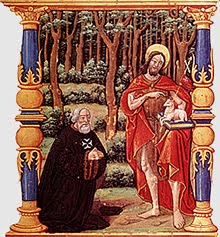
FEAST OF OUR HOLY PATRON SAINT JOHN THE BAPTIST
LITANY OF LORETO - NEW INVOCATIONS
From the Vatican, June 20, 2020
Memorial of the Immaculate Heart of the Blessed Virgin Mary
Eminence,
The Church, on pilgrimage to Heaven’s Holy Jerusalem, — to enjoy inseparable communion with Christ, her Spouse and Saviour –, walks along the paths of history entrusting herself to Her who believed in the Lord’s word. We know, in fact, from the Gospel that Jesus’ disciples learned from the beginning to praise the “blessed among all women” and to count on Her maternal intercession. One cannot name the titles and the invocations that, in the course of the centuries, Christian piety has given to the Virgin Mary, privileged and sure way of encounter with Christ. In our time also, which is going through reasons of uncertainty and bewilderment, pious recourse to Her, full of affection and confidence, is particularly dear to the People of God.
Interpreter of this sentiment, the Sovereign Pontiff Francis, receiving the desires expressed, wished to establish that, in the formulary of the litanies of the blessed Virgin Mary, called “of Loreto,” the following invocations be inscribed: “Mater Misericordiae,” “Mater Spei” and Solacium Migrantium.”
The first invocation will be inserted after “Mater Ecclesiae,” the second after “Mater Divinae Gratiae,” and the third after “Refugium Peccatorum.”
While I am happy to communicate this disposition to Your Eminence, so that it is known and implemented, I take the occasion to express to you the sentiments of my esteem.
Yours very devotedly in the Lord,
Robert Cardinal Sarah Prefect
Monsignor Arthur Roche Archbishop Secretary
DISTRACTIONS!
Ah, dear Reader, we thought that headline would get your attention! Distractions in prayer, the enemy of the Covid-19 Retreat! Distractions in prayer, or "spiritual distractions," are not new. In the form of images or ideas, they parade through even the most pious minds. Is there a cure to rid ourselves of them? Yes, do not give them too much importance, and interpret them as an opportunity to turn back to the Lord; an opportunity for “conversion”. We are very grateful to the international Catholic news-site Aleteia, and to the author, Élisabeth de Baudöuin, for this article, to whom all credit.
Distractions touch all forms of prayer (Holy Mass, communal prayer, holy rosary, private prayer, adoration). They vary according to one's temperament, state of life, and circumstances: the philosopher reasons, the parents think of their children, the resentful harks back, the ambitious man builds his future... Their nature informs the person about himself: his worries, affections, passions, temptations. Who escapes distractions in prayer? No one, not even the saints! Saint Teresa of Avila speaks of it as a true "infirmity", as much painful as unavoidable. She recounts that sometimes, even in solitude, she could have "no fixed and settled thought, neither of God nor of any good thing", and that her spirit resembled "a madman that nobody can chain". She admits that she was thinking "of nothing bad, but only of pointless things". One day, she found herself counting the nails in the shoe of the nun who was praying before her. Nothing serious, if we consider some of our less bright distractions. But how are we to understand this "infirmity"?
“Prayer Disorders” That Prevent Concentration
Spiritual distractions are inherent in our condition as bodily beings. The explanation is simple: man is not merely a spirit. And as the spirit seeks to reach God, its efforts are thwarted by the weight of the "matter" which holds it down. The "matter"? First of all the five senses, constantly in activity, which grasp, despite themselves, "everything that passes": this or that noise (the ringing of the mobile phone that one’s neighbour forgot to turn off), some image (our new neighbour's hairstyle), some smell. True “prayer-disturbers”, the senses constantly provide food for the mind with what they capture, thus preventing it from concentrating on the supernatural truths that it is nevertheless seeking.
But the action of the senses does not explain everything: with earplugs, a blindfold and a clothes-peg on the nose, there are still distractions. Why? Saint Teresa of Avila replies: "The natural powers, that is to say, memory, imagination (the “madwoman of the house”) and understanding (the faculty of reason), which never cease to wander, divert the will from its objective: to settle on God”.
Faced with the often painful and disconcerting experience of distractions, one may be tempted to be discouraged. Indeed, when you have too many distractions, you can say to yourself: "I am not made to pray". The temptation may then be to abandon everything. This is what you certainly should not do. If we stopped praying because we have distractions, we would never pray! Distractions only reach the peripheral part of our being. But God gives himself to us in the depths of the soul, where distractions do not enter, where the bodily senses have no access. They therefore do not prevent prayer from working within the soul and transforming it.
Distractions are an opportunity to choose the Lord again
So what should we do? Persevere, of course! And don't pay distractions too much attention, much less dramatize them. But do not take pleasure in them. That temptation nevertheless exists, and can be strong. As long as one does not dwell on them voluntarily, spiritual distractions are not a sin. “They are even a grace!” says one priest loud and clear. Because they are an opportunity to turn back to the Lord, to actively chose him, whom we had temporarily abandoned. To come back to him in the form of the prayer which we were making before.
“To abandon a distraction that pleases us to return to Christ is to perform an act of love.” “They teach us to live on dry, black bread in the house of God”, so we read from the pen of Fenelon. Interest on such a modest allowance, on such a pittance? Yes, by making prayer difficult, distractions allow man to seek God for himself, and not for the consolations of the senses he can give. Likewise, because of the effort they involve to rid oneself from them, they strengthen the will to find Him and stir up the desire to unite ourselves with Him.
Yet more graces: this concerns also our very poverty. Now, "the poorer we are […], the more we are fit for the operations of consuming and transforming love", writes Thérèse de Lisieux. The young doctor of the Church, however, poses two conditions: choosing to remain poor; and love of this poverty. Saint Paul says a similar thing: “So, I will boast all the more gladly of my weaknesses, so that the power of Christ may dwell in me.” (2 Cor. 12:9)
And so here is the unexpected consequence: to live in praise, submission and thanksgiving; spiritual distractions allow God to establish his reign in the heart of man. They become then a pathway, far more than an obstacle, to come to God in humility.
Elisabeth de Baudöuin
Translation Grand Priory of England