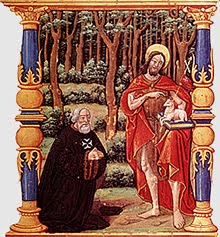
THE CROWNING OF SAINT JOHN THE BAPTIST!
DOMINE MI REX, DA MIHI IN DISCO CAPUT JOANNIS BAPTISTAE
Today is the annual commemoration of the first finding of the Head of Saint John the Baptist in Jerusalem, the head reputedly now in Rome in San Silvestro in Capite.
FEAST OF OUR PRINCIPAL CHURCH
How awesome is this place! This is none other than the house of God, and this is the gate of heaven!
Saturday 20th is the Feast of the Dedication of the Conventual Church of Saint John of Jerusalem in Valetta, the principal church of our Order, now the co-cathedral. It is also celebrated around the world as the feast of all those churches the date of the dedication of which is unknown, including our own lovely eponymous church in Saint John's Wood. Thus a little celebration before Lent gets going in earnest on Sunday is recommended.
Pray for the religious life of the Order as we enter this holy season, for the numerous benefactors of our churches, whose great generosity is everywhere self-evident, and for those buried in them; including of course our own founder, Sir George Bowyer, whose heart lies beneath the pavement before the high altar. Good men all, who served God first.
May their souls, and the souls of all the faithful departed, rest in peace.
SHIPWRECKS AND ORDINATIONS
OUR LADY OF LOURDES - THE ROSARY, BY CHARLES PEGUY
We offer below a poem by Charles Péguy, the great early 20th century French Catholic thinker (1873-1914), entitled "The Rosary". It is given first in translation, then in the French original.
Say your rosary, God says,
and don’t worry about what the crazy people say:
that is an out of date devotion and will be thrown away.
I tell you, when you pray
it’s a Gospel ray
and I’ll let noone make a change.
What I love about the rosary, God says,
is that it’s simple, and it’s humble.
Like my Son.
Like my Mother.
Say your rosary: and you will find
all the Gospel company gathered at your side:
the poor unlettered widow
and the repentant publican who never learnt his catechism,
the frightened sinner woman they wanted to stone,
and all the cripples saved by their faith,
and the good old shepherds, like those from Bethlehem,
who found my Son and His Mother...
Say your rosary, God says,
you prayer must go round, round and round again
like the beads through your fingers.
Then, when I wish it, that I promise,
you will receive nourishing food
which will strengthen your heart and comfort your soul.
Come on, says God, say your rosary
and keep your soul at peace.
Récite ton chapelet, dit Dieu,
et ne te soucie pas de ce que raconte tel écervelé :
que c'est une dévotion passée et qu'on va abandonner.
Cette prière-là, je te le dis
est un rayon de l'Évangile :
on ne me le changera pas.
Ce que j'aime dans le chapelet, dit Dieu,
c'est qu'il est simple et qu'il est humble.
Comme fut mon Fils.
Comme fut ma Mère.
Récite ton chapelet : tu trouveras à tes côtés
toute la compagnie rassemblée en l'Évangile :
la pauvre veuve qui n'a pas fait d'études
et le publicain repentant qui ne sait plus son catéchisme,
la pécheresse effrayée qu'on voudrait accabler,
et tous les éclopés que leur foi a sauvés,
et les bons vieux bergers, comme ceux de Bethléem,
qui découvrent mon Fils et sa Mère...
Récite ton chapelet, dit Dieu,
il faut que votre prière tourne, tourne et retourne,
comme font entre vos doigts les grains du chapelet.
Alors, quand je voudrai, je vous l'assure,
vous recevrez la bonne nourriture,
qui affermit le cœur et rassure l'âme.
Allons, dit Dieu, récitez votre chapelet
et gardez l'esprit en paix.
Our Lady of Lourdes, pray for us!
COMPANIONS' DAY - A REFLECTION
Life goes on. "Companions' Day" falls, as ever, on the feast of the Apparition of Our Lady of Lourdes, this Thursday, 11th February.
We are grateful to our Chaplain, Father Edmund Montgomery, for this insightful reflection. It is hoped that all Companions will stop from their good works to listen to, or read, this meditation, which goes to the heart of why we do what we do.
Pray, especially during this difficult time of Covid, for all our fellow Companions who keep the work going. Pray also for Our Lords the Poor, whom God has given us for our sanctification.
It is a great privilege to be able to speak to you today on Companions’ Day and to be invited by Fra’ Max to say a few words by way of reflection for all of us, on the particular theme of ‘giving’, giving within the context of the role and responsibility of being a Companion of the Order, and within the charism, of course, of the Order of Malta.
For those I haven’t been able to meet in the time I’ve been working in and for the Order, my name is Edmund, I am a diocesan priest of the diocese of Shrewsbury, I’m based here at the Cathedral in Shrewsbury, where I have three churches, I am also the Vocations Director of Shrewsbury diocese, and in the house here we have a programme of discernment for men considering a vocation to the priesthood, so in a way I am surrounded by giving, in that sense, men who have given their lives to discern for a year about the vocation to the priesthood, to accompany our nine seminarians who wish to offer their lives in service to Christ and His Church, and, of course, the People of God who I serve here who give day after day, both to their family and in the parish in generous service in response to the Lord’s call.
HOMILY FOR CANON GOWARD - VIGIL OF THE FUNERAL
Our dear late Chaplain lay in his Pugin Chapel for Sunday Mass yesterday. The homily, given below, was preached by the Vice-Rector, and acting Rector, Father Paul Keane.
Canon Goward had an exemplary death, from the first Ave mouthed as his seminarians and staff gathered outside the College to process reciting the Rosary to his rooms; his final hours surrounded in prayer, natural but now so rare, by his friends and students around the bed; the tolling of the bell at the moment of his passing; and the pomp which rightly attends his earthy remains read, to our modern eyes, as the long-past death of a mediaeval prince or prelate. Yet they are no more than the natural Christian death due alike to peasant and prince, in this day as any before. This afternoon he will be buried in the snow, with many of his predecessors.
Sunday Mass in the Chapel of Saint Mary's College, Oscott,
following the Reception of
Giles Canon Goward’s Mortal Remains,
homily preached by Father Paul Keane, Vice-Rector.
7th February 2021
AMDG
Canon Giles Goward became the Rector of Oscott on 28 June 2020. He died on 28 January 2021. Seven months exactly. His time in office was brief but not his influence – it will continue. Fr Giles’ faith and cheerfulness in illness and dying were equal in their power to years of house talks and scrutiny reports. We can live and die better because of his example.
Sutton Coldfield has never been at the centre of world or national events but our chapel is not obscure. It is, as Cardinal Nicols once said, ‘the beating heart of the Church in England.’ Not only because many of the Oxford Movement, including Newman, were confirmed here; and not even because the founding charters of the Church in our land were drawn up here during the three Synods of Westminster. Our chapel gives life to the Church by the men who have prayed and been formed in prayer within its walls. From this chapel generations of priests have been born and sent out in mission. And, as Fr Giles was on the Formation Staff for seven and a half years that this chapel has stood, so under his care as Pastoral Director and then Rector, thirteen separate Year Groups have been nurtured for priestly service. His priesthood lives in theirs and will live in ours as much as we trust that Fr Giles, by God’s mercy, lives in heaven.
In the photocopier room, the Staff can leave letters for postage. Fr Giles would leave his in quite a deliberate manner; one in which he knew some of us delighted. His daily correspondence was never left with an envelope on top addressed to a bank or utility company. No, his top envelope was always addressed to someone who was at least above the rank of a baronet, sometimes rising to a continental princess of a not forgotten duchy. The titles and names of members of the Order of Malta were a joy to behold as one’s less grand addresses were added to the pile of letters. Fr Giles delighted in the history of the Order. He was not inured to the charm of its pomp. Yet, it was its work of service to the sick and the poor which had drawn him; work which he supported for many years. Fr Giles had a heart for those who could be overlooked. In our community, he was quick to speak out behind the scenes in support of seminarians who were not born in this country but had come here to serve. He honoured their sacrifice. And, of course, as we all know, he fought for the rights of him who can be most under-appreciated: the permanent deacon. In these men, supported by their wives, he recognised Christ the servant. Fr Giles was quick to quip and celebrated generosity whenever he saw it.
As we gather around the catafalque which bears our rector’s body, today’s words of Job are too marvelously apt: ‘Swifter than a weaver’s shuttle my days have passed, and vanished.’ Fr Giles was only fifty-four years old. He had just begun his new responsibilities. His death is a tragedy. To our eyes he has vanished. These ceremonies, which are so right and beautiful, only heighten his absence; on such a day of significance for the College, Fr Giles should be here, presiding. Job’s final words are a prayer to his Creator: ‘Remember that my life is but a breath, and that my eyes will never again see joy.’ Why did the Church choose this passage for this Sunday, one which reflects so well grief? Because the Gospel of Mark presents today God’s answer to that prayer: Jesus. Jesus heals the sick and frees the possessed; he gives life again. Our lives are no longer a mere breath but, because of our Saviour, ones of lung-expanding eternity. We shall see joy forever. And so, the Psalmist sang: ‘Praise the Lord who heals the broken-hearted.’
And yet we grieve for ourselves because we miss the rector. He was the Father of this House and there is nothing more solemn than the funeral of a parent. Yet Newman said, when he preached in this chapel at the funeral of Mgr Weedall, the first Rector of New Oscott:
‘Everyone is made for his day; he does his work inhis day: what he does is not the work of any other day, but of his own day; his work is necessary in order to the work of that next day which is nothis, as a stepping-stone on which we, who come next, are to raise our own work. God grant that we too may do our own work, whatever it may be, as perfectly as he did his, whom we are now consigning to the grave.’
The stepping-stone which Fr Giles has laid down is made-up of priestly service, faithfulness, kindness, and humour. It is upon that stepping-stone which we are to place our feet as a sure foundation for future growth. Yet, paradoxically, the best stepping stones are not hard beneath the foot for, as we heard St Paul say today in his First Letter to the Corinthians: ‘For the weak I made myself weak.’ The good priest - and, however much be hidden from us in anyone’s life, we can confidently say Fr Giles was a good priest – the good priest does not serve from a place of strength but from out of his human frailty, strong in the grace of the Holy Spirit, as he supports others in their frailty. Fr Giles’ stepping stone that he has laid down for us to tread upon, one of priestly service, faithfulness, kindness, and humour, can be our stepping stone because he was no less frail than us - but in his days as rector and in his passing, we saw what grace could do.
There will be a portrait, a grave stone, and a brass in the Weedall. However, there are already two memorials to Canon Goward at Oscott: this living community and a silver Maltese cross that shimmers in the cloister on top of the orb of our Lord, carried by Our Lady of Oscott. If we continue to seek to be the fellowship that the Rector sought for us, and share in his devotion to Mary then, truly, Giles will rest in peace.
OBSEQUIES FOR GILES CANON GOWARD
The Requiem Mass for our late confrere, Chaplain of Magistral Obedience, the Very Reverend Giles Canon Goward, twenty-fifth Rector of St Mary's College Oscott, will be held tomorrow, Monday 8th February, at Noon.
The Order will be formally represented in Choir by our confrere Andrew Grant. Numbers, due to Covid, will be limited.
The Mass may be followed live on YouTube, by CLICKING HERE. The photograph above shows the lying-in this evening in the Pugin chapel of the College.
Canon Goward died a holy death, fortified by the Sacraments and surrounded in his last hours by groups of his seminarians reciting the Holy Rosary around his bed in the College. Vespers of the Dead were sung in the Chapel that evening, in the presence of His Grace the Archbishop. Please pray for the repose of the Canon's soul, for his Seminarians and the community of the College, and for his family.
Requiescat in pace.
FRA' ANDREW BERTIE - ANNUAL COMMEMORATION
Most Holy Trinity,we, your humble children, thank you for having given usyour servant Fra' Andrew Bertie,and for having made him, in the fulfillment of his lofty chargeand in his personal consecration to you,an example of radiant faith,shown by his love for the Holy Eucharist,the intensity of his prayer,his fidelity to the Divine Office,his most edifying spirit of recollection,and his assistance to the poor and sufferingaccording to the ancient charism of the Order of Malta:Tuitio Fidei- Obsequium Pauperum.Gloria Patri.O Lord,your servant Fra' Andrew Bertieshowed us, by his fidelity to your example and teaching,the path of holiness as the true measure of the Christian life.through the mediation of the Blessed Virgin,venerated under the title of Queen of Mount Phileremos,whom he so deeply loved and confidently invoked,grant, we pray, that he may be exalted also on earthfor your greater glory,and that we may obtain by his intercessionthe grace we so ardently implore (...).Amen.
Pater, Ave, Gloria
(Imprimatur Vicariate of Rome, 2012)
FRA' PAUL SUTHERLAND - RIP
TUITIO FIDEI - PRAYER FOR CHRISTIAN UNITY
This day, the Feast of the Chair of Saint Peter at Rome, sadly no longer observed in the Universal Calendar, marks, in a tradition spanning much of the 20th Century, the start of the Week (or Octave) for Christian Unity. It ends on the Feast of the Conversion of Saint Paul on the 25th January. The logic of the choice of these dates requires no elucidation here.
PLENARY INDULGENCE AMONGST OUR FRIENDS
It is ten years since the Holy Father Pope Benedict presented his great gift to England in the form of the Apostolic Constitution Anglicanorum Coetibus, a very concrete reply to Cardinal Wiseman's Prayer for England - "O Blessed Virgin Mary, Mother of God..." On this day, the Ordinary, Mgr Keith Newton, and the two other prelates, Monsignori Burnham and Broadhurst, were ordained Priest, and the Personal Ordinariate of Our Lady of Walsingham was established for convert Anglicans in this land.
To celebrate this event to the supernatural benefit of all the Faithful, the Holy See has graciously approved a Plenary Indulgence, which may be gained in any church served by the Ordinariate of Our Lady of Walsingham with Holy Mass or Evensong in the Ordinariate Rite, during 2021. Thus in London those who are able to attend The Assumption Warwick Street on Sundays may avail themselves, for the benefit of their living or departed family and brethren, of this Indulgence every week. Or indeed more often.
Please note that the concessions during time of the Covid pandemic (HERE), for those who genuinely cannot attend Mass, made so generously by our Holy Father Pope Francis last March, continue to apply in this case.
The text issued by the Ordinariate is given below.
Plenary Indulgence
The Apostolic Penitentiary in Rome has agreed to a request from Mgr Newton for a Plenary Indulgence to be available during our anniversary year. From 15th January 2021 to 1st January 2022 any member of the faithful who attends Mass celebrated according to Divine Worship: The Missal or who participates in a public celebration of the Divine Office according to Divine Worship: Divine Office may receive a Plenary Indulgence. The indulgence is subject to the usual conditions of Sacramental Confession, reception of Holy Communion and prayers for the Holy Father's intentions.The sick and those physically unable to participate may equally benefit from the Indulgence.
A Solemn Mass of Thansgiving will be celebrated by Monsignor Newton at Warwick Street tomorrow, Saturday 16th January, at 12 noon.
Our Lady of Walsingham, pray for England
LONDON SHRINE OF SAINT JOHN HENRY NEWMAN
As previously reported, the evening of the Order's Advent Recollection saw the blessing of the new Shrine of Saint John Henry Newman at the Church of the Assumption of Our Lady and Saint Gregory, Warwick Street, seat of the Ordinariate, which lives under the patronage of our new Saint.
The shrine is a bust reliquary, sculpted by our confrère Dr Neil Weir. It is located at the side of the Lady Chapel, with its important statue of the Rue de Bac Immaculate Conception, erected in the 1870s, and heavily indulgenced by Pio Nono in 1877. It is very fitting that this new shrine, the first newly-crafted post-canonisation shrine in London, should be sited in this historic church, because it was here, at the high altar, that Saint John Henry celebrated his First Mass on these shores upon the day of his return from Rome as a Catholic priest in 1847. He had a great love of this place, and indeed wrote of it – "Were St Athanasius or St Ambrose in London now they would go to worship, not at Saint Paul’s Cathedral, but to Warwick Street."
A brief description of the sculpture and its genesis is given below.
The blessing was performed by The Right Reverend Monsignor Keith Newton, Ordinary of the Ordinariate of Our Lady of Walsingham, who has followed in Newman's footsteps, and is himself a fruit of the Saints intercession. Following the blessing, Mgr Newton gave Benediction of the Blessed Sacrament, in the presence of former Grand Prior Fra' Ian Scott, and Monsignor John Armitage, Chaplain of the Grand Priory, who had preached the meditation, see HERE.
RELIQUARY BUST OF SAINT JOHN HENRY NEWMAN
Saint John Henry Newman (1801 -1890) is the Patron of the Personal Ordinariate of Our Lady of Walsingham. The Rt Rev Mgr Keith Newton desired an image of Cardinal Newman in the Ordinariate’s Church of Our Lady of the Assumption and St. Gregory, Warwick Street. Mindful of his two sculptures of Dom Gervase, a monk of Douai Abbey, it was suggested that the sculptor Neil Weir might be asked to produce a small maquette of Cardinal Newman. This was made in terra-cotta and was loaned to Monsignor Newton.
With the news of the impending canonisation of Cardinal Newman on the 13thOctober, Neil Weir offered to create a devotional image befitting Newman’s new status of elevation to the altars rather than merely a portrait bust of an historical figure. The saints are intercessors and role models; without denying Newman’s firm and often difficult character in life, the image conveys great kindness and patience. Here is a holy man to whom people will entrust their intercessions, a man who reflects the Love of Christ which has invaded his soul. Neil Weir has chosen an ambiguous age (Newman was 79 years old when created a cardinal and lived for a further 10 years) to emphasise the eternal dimension while still showing him as a cardinal – his primary attribute in the Universal Church. In terms of style of execution, the contemporary approach emphasises that Newman is a saint for our time, while also rooting the image in the long and noble tradition of English sculpture.
The finished work was cast in bronze resin for reasons of weight and cost. The design of the base of the bust allows the insertion of a reliquary, a locket of the Cardinal’s hair. A marble corbel for the bust has been designed to accord with the other fittings of the church.
Donation: Richard Grey Esq. made a very generous donation towards the overall costs in memory of his parents Sir Paul and (Agnes) Lady Grey.
About the sculptor: Neil Weir’s professional life as an otorhinolaryngologist has given him the opportunity to observe the head and neck in great detail. When he first started sculpture classes under the tuition of Michael Marriot FRBS, in the mid-1970s, he found that his understanding of anatomy helped him in modelling the head and neck. He continued his tuition with the late Trevor Collis, who taught him mould making and casting, the late Sheila Mitchell FRBS who was a valuable mentor and more recently with Mark Swan FRBS who has brought him up to date with modern mould making and casting methods. Neil Weir has been working to commission for many years and his works are to be seen on permanent exhibition at the Royal Society of Medicine and in private collections in the UK, USA and Denmark. He has twice held the office of president of the Medical Art Society and has been a recipient of the Baron ver Heyden de Lancey three-dimensional prize. He has also exhibited with the Society of Portrait Sculptors, by invitation from the London School of Economics at a show entitled ‘Private painters in public life’ and at the Royal College of Surgeons of England.
Saint John Henry, pray for us.
HERALDS OF THE GOSPEL - A MEDITATION FOR THE NATIVITY
We are grateful to the Chaplain of the Grand Priory, Monsignor John Armitage, for sending the text of his wonderful Meditation for Advent, given as we prepared ourself for Christmas, for many of us the most usual Christmas of our lives.
While this may seem unfortunately late, we must remember the God's eternity is not our earthly time, which truth Holy Mother Church signals to us in the ever-turning wheel of the Church's Calendar. So it does not really matter when we read things, and indeed, as so many of us are alone and quiet this year, rereading within the Octave of the Nativity of Our Blessed Lord the spiritual preparation for the Feast we have just celebrated will allow us to revisit its glorious message of Salvation and enter deeper into the Mystery. So do not just pass it by! The Truth is for all Time!
The Meditation was given at the Assumption Warwick Street, on Thursday 17th December. It was followed, most appropriately, by the blessing of the new Shrine of Saint John Henry Newman, a reliquary-bust made by our illustrious sculptor confrere Dr Neil Weir. The officiant for this, and for Benediction, was our chaplain Mgr Keith Newton. A report on this will follow tomorrow.
So often we don’t feel like praying, this is often because of the many distractions that come along when we set out to pray. If we only pray when we are in the mood, our prayer will be determined by our feelings – praying when I feel like it! Choice as opposed to feelings, feeling is about emotions, choices are about the decisions we make in life. Freedom of choice can be good or bad, freedom to choose is not to simply choose what we want but to choose the good.
Pope Francis recently said that “we are not living in an era of change, but a change of era.” reflecting onthe loss of faith in our present generation. The extraordinary truth is that men and women have lost sight of the ordinary truth built on faith in God, a reality that helps us find the meaning of life outside of ourselves, in order that we may find the purpose of life within ourselves. We have failed to see the God who is around us, because we have been blinded by the things that are around us. We fail to recognise that there are two realities in life – Spiritual and Material. When the material realities of life overwhelm us, we need the spiritual realities to help us regain our balance once again. One description of the search for this balance is given in the title and contents of a remarkable book written after the Second World War by Victor Frankel, “Man’s Search for Meaning”. In the darkness and suffering of the Camps, he reflects on the strengths that in the face of such inhumanity, men and women were still able to navigate their way through the appalling “events”that threatened to overwhelm them. “We who lived in concentration camps can remember the men who walked through the huts comforting others, giving away their last piece of breed. They may have been few in number, but they are sufficient proof that everything can be taken away from a man but one thing: the last of the human freedoms – to choose one’s attitude in any given set of circumstances, to choose one’s own way. And there were always choices to be made. In the final analysis it became clear that the sort of person the prisoner became was the result of an inner decision, and not the result of camp influences alone. Fundamentally, therefore, any man can even under such circumstances, decide what shall become of him. Mentally and spiritually. It is this spiritual freedom – which cannot be taken away – that make life meaningful and purposeful.” (P86, Man’s Search for Meaning, Victor Frankel)
For so many, life has lost its meaning, the anaesthetics of modern life fail to compensate for the loss of a faith in something greater than ourselves which helps us understand ourselves. Having more, is no substitute for being more! You only find yourself by finding God, and in finding God we discover ourselves...
FEAST OF SAINT THOMAS A BECKET - A MARTYR FOR OUR AGE
Today is the 850th anniversary of the Martyrdom of Saint Thomas à Becket, on the steps of his altar at Canterbury. He dies defending the right of the Church to rule in the field of men's souls, through the Holy Church which Christ had founded, free of the pragmatic interference of men of power. In this land, as throughout Europe, many men have died in this cause.
In our own age, we see again the clouds of persecution and secularism. Maybe in our own age new Martyrs will rise up in succession of these illustrious forebears. Our newest English saint, Saint John Henry Newman, saw this possibility; in his praise of the English Martyrs in The Second Spring Sermon he foresaw the Martyrdom which might yet await English Catholics, as he addressed the priests of his own day – " ... calmy, gracefully, sweetly, joyously, you would mount up and ride forth to the battle, as on the rush of Angels' wings, as your fathers did before you, and gained the prize. You, who day by day offer up the Immaculate Lamb of God, you who hold in your hands the Incarnate Word under the visible tokens which He has ordained, you who again and again drain the chalice of the Great Victim; who is to make you fear?"
May our priests, those whom we know and love, rise to this challenge. May our prayers and charity sustain them, and wipe away all fear and timidity. And may we, as members of the Order of Malta, never hesitate in our readiness to follow them.
HAPPY CHRISTMAS TO YOU ALL!
The Grand Priory wishes all its gentle readers a very happy and blessed Christmas. For many of you this will have been a singular year, stripped of its usual cheer and fellowship; yet, as our Sovereign Lady reminded us in her Christmas broadcast this afternoon, "You are not alone."
No, we are never alone, because as baptised Christians we are assured of the constant companionship of Our Lord and Saviour, today the tiny Infant in the manger in Bethlehem, but today also reigning for all Eternity in Heaven, and of His Blessed Mother, our own mother and advocate.
This feast, above all feasts, may be called the feast of Hope. Hope is always needed, but most poignantly in times of trial. Our hope is ultimately for eternal Salvation, but firstly for an unwavering Faith.
We are reminded of this in the touching poem below penned this morning over 400 years ago by a Jesuit, Blessed Robert Southwell, hanged, drawn and quartered in 1595. Our trials are different, but all trials lead us to Hope, if we open our hearts, and that is the purpose of the this Holy Day.
THE BURNING BABE
AS I in hoary winter's night stood shivering in the snow,Surprised I was with sudden heat, which made my heart to glow;And lifting up a fearful eye to view what fire was near,A pretty babe all burning bright did in the air appear;Who scorchèd with excessive heat such floods of tears did shed,As though His floods should quench His flames which with His tears were fed."Alas!" quoth He, "but newly born in fiery heat I fry,Yes none approach to warm their hearts or feel my fire but I!My faultless breast the furnace is; the fuel wounding thorns;Love is the fire, and sighs the smoke, the ashes shame and scorns;The fuel Justice layeth on, and Mercy blows the coals,The metal in the furnace wrought are men's defilèd souls;For which, as now on fire I am to work them to their good,So will I melt into a bath to wash them in my blood."With this He vanished out of sight and swiftly shrank away,And straight I callèd unto mind that it was Christmas Day.
THE HUMAN MASK
One does not need to tell one's readers that part of the charism of our Order, Tuitio Fidei, is being able to argue the Faith in front of non-Christians and atheists. To do this we need to think things through, and consider arguments maybe not our own.
To this end, we present a challenging article, by an American religious sister (sadly anonymous as our modern intolerant world requires of her), presenting a Thomist consideration of the new world order of mask-wearing. The original article is HERE.
Unlike the BBC and much of the modern media and politics, the Grand Priory does not avoid or censor opinions it may not agree with, but feels that our charism is best served by looking at all sides of an argument. No apologies are thus offered for the text which follows, which the discerning and educated reader may make of what he will.
It is worth perhaps observing that this is the very profound view of a female religious, one who, one imagines, has understood and lived the importance of the veil, and thus understands the divinely given nature, the sacramental nature, of the human face.
For the past ten months or so, we have been urged, commanded, and threatened to wear masks. The majority of the populace seems to be complying. It is the exception, rather than the norm, to see unmasked faces at a grocery store, a gas station, or the gym. Christians seem to be like their neighbours in this regard; walking into most Masses on a Sunday morning, one is likely to be “greeted” with masked parishioners, social distancing, and lots of sanitizer.
There are some, however, who refuse to wear a mask—in church or anywhere else—even when masks are required by state law and when the Bishop has requested that masks be worn. When questioned as to why they do not follow the law in this case, they are typically unable to articulate the reason—except to say that they have a deep-seated sense that wearing masks is just wrong, that it is somehow offensive, and that this sense is even stronger within the context of a church than elsewhere.
While having a sense of something is helpful, we must be able to articulate the reason for the sense, especially since refusing to wear a mask is often an act of disobedience to the civil and religious authorities that the Christian must normally obey. Are we able to give a defense, grounded in faith as well as in reason, for refraining from wearing masks? We have chosen to present this defense in the format of an article from St. Thomas’s Summa.
Whether, in the present day, one ought to wear a mask?
Objection 1: It would seem that one ought to wear a mask. The consensus of the scientific and medical community is that the Wuhan Virus is an infectious disease and that wearing a mask protects one from contracting a virus which could lead to sickness and even to death. But avoiding sickness and death is taking proper care of one’s bodily health, which is a gift from God. Therefore one ought to wear a mask.
Objection 2: Further, as Christ says, “Amen, I say to you, as long as you did it to one of these least of my brethren, you did it to me.”[1] The wearing of a mask protects a person from not only catching the virus, but also, if the person is contagious, from passing it along to others. One does not have knowledge of the potentially fragile physical state of others. Wearing a mask, a little inconvenience to oneself, could save another person from serious illness which could lead to death. Such a motive of charity makes the wearing of a mask a corporal work of mercy of caring for the sick.
Objection 3: Further, it is presently the quasi-universal practice of governors, mayors, and other lawmakers to mandate the wearing of masks in public. These lawmakers have the power and responsibility to care for the common good of the community over which they have been given the authority to rule—an authority that comes ultimately from God, as Scripture teaches. It would seem that the present public crisis requires and justifies the public authorities to enact laws to protect their citizens. One must obey all just laws enacted by legitimate authorities. As Christ says, “Render therefore to Caesar the things that are Caesar’s, and to God the things that are God’s.”[2] Anyone who disobeys in refusing to wear a mask frustrates the common good.
Objection 4: Further, Canon Law obliges the faithful to be obedient to the hierarchy: “The Christian faithful, conscious of their own responsibility, are bound by Christian obedience to follow what the sacred pastors, as representatives of Christ, declare as teachers of the faith or determine as leaders of the Church.”[3] Some ecclesiastical authorities, at both the parish and diocesan level, have either mandated or encouraged the wearing of masks during the Sacred Liturgy. Failure to wear a mask at church (or at Masses which take place outside of churches) compounds civil disobedience with religious disobedience.
I answer that, the wearing of a mask in the present circumstances is motivated by fear of illness and death. Fear, as a natural passion, is morally neutral. St. Thomas Aquinas explains that fear “is caused by the imagination of a future evil which is either corruptive or painful.”[5] Natural evils—such as the Wuhan Virus—are objects of fear. It is normal to fear sickness and death as natural evils. It is important, however, to clarify that man fears not present evils, but what his imagination presents to him as a future evils. A man may fear being ill with cancer. Once he has cancer, he may experience pain or sorrow, but strictly speaking, he does not fear cancer any more. He may fear the cancer getting worse; he may fear various plans of treatment which his doctors discuss with him; he may fear death—but all of these things are in the future, not the present.
All men experience sickness to varying degrees, and all men will experience death. Why have the majority of men lived their daily life without the crippling fear of sickness and death which permeates the current day? St. Thomas explains that man generally does not fear remote and distant things, “for as the Philosopher says (Rhet. ii, 5), ‘we do not fear things that are very far off; since all know that they shall die, but as death is not near, they heed it not.’”[6] For most modern men, death is a distant reality; indeed, there is a veritable societal amnesia about death. Death is “very far off,” and we “heed it not.” At least we did not…until the advent of the Wuhan Virus. With the “global pandemic” seems to have arisen a new global fear of death—not the salutary fear which is the beginning of wisdom, but the fear which cripples men and destroys economies.
Tragically, the average man turns to physicians who appear on the media, career politicians, and pop stars for answers about how to respond to the fear of death. Politicians, mainstream media outlets, and so-called “medical experts” say: “You shall not die”[7] if you wear a mask. “Cover your nose and mouth to stop the spread of the Virus.” “Stay safe; stay home.” “Love wills the good of the other. Christians wear masks!” “Save lives—wear a mask.”
Because a virus cannot be seen by the naked eye, every human person one encounters is a potential carrier, a potential threat. Even if a person has no concern for his own health, he may, unbeknownst to himself, pass the virus to someone who does have health concerns. Masks become a necessity in the attempt to save oneself and one’s neighbours from illness and death. An unmasked face has become a threat of illness and a reminder of death. Yet it is wholly un-Christian to consider any other human person first as a threat to oneself. Before the Wuhan Virus came into the public view, someone who habitually considered any other as a potential threat to his own physical health was rightly labelled paranoid. Before Wuhan, being paranoid in that manner was considered abnormal, contrary to the common good, and opposed to the communion which ought to exist between men.
Man is called to love his neighbour and to be in communion with him. The mask obstructs the development of genuine community, which is the basis of human society: it muffles the human voice; it hides the human smile; it obscures the deeply human facial expressions which are integral to forming human friendships. Man is by nature a social animal. The spiritual dimension of man—the fact that he has a rational soul—is expressed most pointedly, profoundly, and truly in his face. A man recognizes his wife, his children, his brothers, and his friends not primarily by their elbows or knees, nor even by their hands (as unique as each person’s fingerprints are). No; a man knows the people he loves by their faces and by their voices. Man communicates most profoundly with his face—with words, looks, facial expressions. When faces are hidden and voices are muffled, the person himself is obscured. It is precisely for this reason that burglars wear masks; they do not want their identity to be known.
Upon encountering a masked person, one’s gaze is drawn to the body rather than to the face. When one looks at the body, to the exclusion of the face, one encounters an object, a thing, rather than a person. Seeing arms, legs, a body, and a third of a face, the intellect categorizes this thing as a human being. That category is objective, not subjective. Without the view of the face—that essentially personal and subjective element of the human body—how can one avoid objectifying the rest of the body and the person whose body one sees? To illustrate the point, often, during serious operations and autopsies, the face of the patient is covered to help the doctor or coroner make a mental separation between the task at hand and the person (or former person) into whom (or into which) they are cutting. The doctor is objectifying the person, in a sense, in order to complete the operation. What is true in this legitimate use of face coverings during medical procedures is likewise true in the current context: masks objectify human subjects.
Furthermore, masks indirectly promote thinking of others in terms of oneself. “You are not wearing a mask; you are a danger to me. You are making me feel uncomfortable by failing to wear a mask.” Objects are meant to be used; that is, to be used as a means to an end. Persons are primarily subjects to be known and loved. When the face is obscured, the person is obscured. However, the only proper response to persons is not use, but love.[8] Love which establishes communion is at the heart of the Christian life; for, God is a communion of three Persons. The Evil One seeks always to separate and to isolate, and the mask is presently his useful instrument to that end.
While one must take reasonable measures to ensure one’s health, physical health is neither the primary nor the sole determinant of a man’s actions. There are more important realities than bodily health, especially spiritual health. A mask worn at all times and in all places conveys the message that physical health is the primary good. There have been numerous saints who, motivated by supernatural charity, contracted contagious diseases and died in service to those who had these diseases. Such persons were canonized because they had a right ordering of goods: physical health, while important, is less important than and must be subordinated to spiritual health.
It is, therefore, not bodily death, which St. Augustine aptly calls the “first death,” that ought to be man’s primary concern, but rather the eternal death of the damned, the “second death,” which man must avoid at all costs.[9] It is thus only the evil man who needs to fear death.
From the depths of our hearts, each Christian unites himself with the Psalmist in saying: “My face hath sought Thee: Thy Face, Lord, will I still seek. Turn not away Thy Face from me; decline not in Thy wrath from Thy servant. Be Thou my helper, forsake me not; do not Thou despise me, O God my Savior… O God of hosts, covert us: show us Thy Face, and we shall be saved.”[10] The Psalmist seeks the face of God with his own face. The face, more than any other body part, represents the fullness of the person. It is from his face that man speaks, sees, listens. It is with his face that man communicates. It is by means of his face that he is in relationship with others. An infant knows his mother’s face and develops under the gaze of his mother. The Psalmist understands that the turning of one’s face to God represents the turning of the whole self. He turns himself to God and begs that God would turn towards him.
Reply to Objection 2: Charity is any action we do for God or do for others for the sake of God. If we do not act for the sake of God, the action, while good, is not charity. Is charity actually the reason why many wear masks? We cannot know another’s motives, but, as Our Lord says, “by their fruits you shall know them.”[14] The fruit of the societal wearing of masks is fear. “Fear is not in charity: but perfect charity casteth out fear, because fear hath pain. And he that feareth, is not perfected in charity.”[15] While the corporal works of mercy—feeding the hungry, sheltering the homeless, visiting the sick, etc. are acts of charity, if motivated by love of God, it is not clear that wearing a mask qualifies as such a work of mercy. Rather, it seems that the isolation caused by mask-wearing and social-distancing procedures amounts to a failure in the corporal works of mercy.
Reply to Objection 3: Law, as St. Thomas defines it and as the tradition consistently holds, is “an ordinance of reason for the common good, made by him who has care of the community, and promulgated.”[16] As a dictate of reason, “the proper effect of law is to lead its subject to their proper virtue: and since virtue is that which makes its possessor good, it follows that the proper effect of law is to make those to whom it is given good.”[17] Human laws therefore bind in conscience if they are just. It is sinful to disobey just laws. The question is, therefore, whether the virus-related ordinances, regulations, and other mandates which lawmakers across the nation have enacted over the past ten months are just laws.
Laws are just when they are ordered to the common good and when the law does not “exceed the power of the lawgiver.”[18] Furthermore, to be just, the law must not impose disproportionate burdens for the citizens whom the law binds. A law may be unjust in four ways. (1) First, a law is unjust when it is contrary to human good, “as when an authority imposes on his subjects burdensome laws, conducive, not to the common good, but rather to his cupidity or vainglory.”[19] (2) Second, a law is unjust when the one who makes the law “goes beyond the power committed to him.”[20] (3) Third, a law is unjust when the burdens imposed by the law weigh more heavily on certain people or groups within the community even though the common good is being sought. (4) Finally and most importantly, a law is unjust when it is opposed to the divine good or to the divine law.
The requirement to wear a mask is most often a mandate given by executive order. Such mandates exceed the regular power and authority granted to the executive branch of the government. The place of the legislative branch—which has the purpose of creating the laws—seems to have been usurped.
It is doubtful that the government has the authority to mandate peculiar articles of clothing such as facemasks and to punish those who do not comply. There is a parallel that can be drawn to another time in history when citizens were ordered to wear peculiar articles of clothing: the Jewish star. If the lawmakers exceed their authority in the creation of the laws mandating masks, then the laws are unjust.
Mask-wearing mandates place a disproportionate burden on many groups within society. Many anecdotes are told about infants and small children who are afraid of the masked adults they see. Time will tell what the psychological impact is on these youngest members of our society. Children are often required to wear masks at school, even though the masks can make breathing difficult. Furthermore, the teachers and students’ voices are muffled, hindering the learning process. Many adults have various health problems which are exacerbated by wearing masks. Those who have an objection to mask-wearing on ethical or religious grounds are forced to comply or else will not be allowed to participate in life in both the public and private sector. The mask-wearing mandates place a disproportionate burden on Catholics who are hindered from the free exercise of their religion. It is contrary to the nature of the Holy Sacrifice of the Mass, as the public worship of the Church, to have the clergy, servers, or even the faithful wearing masks. Even if this point is debated within Catholic circles, the reality is that according to the First Amendment to the United States Constitution, the government cannot prohibit the free exercise of a person’s religion—including what may or may not be worn in public worship.
For all of these reasons, the mandates issued by local governments are unjust and therefore, in good conscience, may be disobeyed.
Reply to Objection 4: Canon 212 obliges the faithful to obey declarations which the clergy make as “teachers of the faith” or as “leaders of the Church.” The faithful are not required to obey declarations of bishops or priests which fall outside of the domain of the Catholic faith. Wearing masks in Church is not a matter of faith. Canon 212 states that the faithful “are bound by Christian obedience to follow what the sacred pastors…determine as leaders of the Church.”[21] It does not seem that the mandating of masks, in accordance with public health regulations, is specifically a matter pertaining the bishop’s authority as leader of the Church. The vast majority of bishops and priests are not medical doctors nor health experts; thus, when they make declarations about mask-wearing for the physical health of their flock, they are exceeding the limits of their competence. The action of the clergy to mandate masks exceeds the bounds of their ecclesiastical authority. Lastly, “the Christian faithful have the right to worship God according to the prescriptions of their own rite approved by the legitimate pastors of the Church.”[22] Nowhere in the Roman Rite, or any other Rite, is there a mandate to wear a mask.
From the foregoing, we may conclude that the “sense” many people have against wearing masks is legitimate. For the light of human reason, and, even more, the light of faith, shines forth in the darkness of the present day.
NOTES (these will redirect to the original Rorate Caeli page)
[1] Mt 25:11. All Scriptural translations are taken from the Douay-Rheims, unless otherwise noted.
[2] Mt 22:21
[3] Code of Canon Law, Latin-English Edition, trans. Canon Law Society of America (Vatican City: Libreria Editrice Vaticana, 1983): can. 212 §1, p.71.
[4] Ps 26:8-9; 79:8
[5] Saint Thomas Aquinas, Summa Theologiae, trans. Fr Laurence Shapcote, O.P. (Lander, WY: The Aquinas Institute for the Study of Doctrine, 2012), I-II, q. 42, a. 2, resp., p.384-385.
[6] STh I-II, q. 42, a.2, resp., p.384-385.
[7] Gen 3:4
[8] Cf. Karol Wojtyla, Love and Responsibility, trans. H.T. Willetts. (San Francisco: Ignatius Press), 1993.
[9] cf. Saint Augustine, City of God, Book XIII, Ch. 2.
[10] Ps 26:8-9; 79:8
[11] The three authors are: “Dr. Martin Kulldorff, professor of medicine at Harvard University, a biostatistician; and epidemiologist with expertise in detecting and monitoring infectious disease outbreaks and vaccine safely evaluations. Dr. Sunetra Gupta, professor at Oxford University, an epidemiologist with expertise in immunology, vaccine development, and mathematical modeling of infectious diseases. Dr. Jay Bhattacharya, professor at Stanford University Medical School, a physician, epidemiologist, health economist, and public health policy expert focusing on infectious diseases and vulnerable populations.” https://gbdeclaration.org
[12] Dr. David Deavel, “Properly Political Scientists: The Great Barrington Declaration.” The Imaginative Conservative. Oct. 14, 2020.
[13] “The Great Barrington Declaration”: https://gbdeclaration.org
[14] Mt 7:16
[15] 1 Jn 4:18
[16] STh I-II, q. 90, a.1, resp., p.202.
[17] STh I-II, q. 92, a.1., p.214.
[18] STh I-II, q. 96, a.4, resp., p.250.
[19] Ibid.
[20] Ibid.
[21] CIC, Can. 212 §1.
[22] CIC, Can. 214.