We are, as previously noted, extremely grateful to Father Gary Dench, of Brentwood Cathedral, for celebrating Holy Mass and preaching this year's annual Sermon for this Pilgrimage, the sixth consecutive year.
A good number of Pilgrims attended at the church of Our Lady of la Salette, Bermondsey, with several then walking along the Old Kent Road to the site of the Martyrdom at St Thomas Waterings, for the customary prayers. We were joined, by happy circumstance, by Father Gwilym Evans FSSP, an old friend of the Order ordained in Bavaria a month ago, who served the Mass and gave First Blessings afterwards. The evening concluded with an informal supper in the Borough.
Here then is the text of Fr Dench's sermon, which places our beloved Martyr in the wider context of the numerous other martyrs who came from the Venerable English College to serve the Faith in these shores.
Just off the Piazza Farnese is a road called the Via di Monserrato. In 1362, two rosary sellers set up a small establishment offering hospitality to English pilgrims. Apparently there had long been a problem with foreign visitors being over-charged by locals (dare I say that say that some things have not changed in 650 years) and this was an attempt to provide decent accommodation at a fair price for the English pilgrim.
Like much of the work of Providence throughout history, it is those things with humble beginnings which God tends and nurtures, and allows to flourish. By the sixteenth century, with English Reformation in full swing, the site was considered large enough to house a community of young men who would be trained, formed, and ordained as priests to be sent back to the English mission. They were sent back to their homeland in order that the dying embers of faith in our land could be fanned and tended. The Venerable English College was founded in 1579 for that very purpose and still it stands, a community which has withstood Reformation, Enlightenment, Revolution and war.
High above in the top level of the College Church, dedicated to the Holy Trinity and St Thomas of Canterbury is the history of the British Isles portrayed in a series of images. But this is no ordinary history of our islands. These images tell the story of our faith and all that it has suffered through the centuries.
Today is the Feast of our third Martyr in the scourge of Henry VIII. Blessed David Gunson (Gonson, or Gunston) was this day dragged from the Kings Bench Gaol in the Borough, along the start of the Pilgrim Way to Canterbury, to be hanged, drawn and quartered at Saint Thomas Waterings, for his defence of the Pope's supremacy. Two years earlier his friends Adrian Fortescue and Thomas Dingley has suffered likewise at Tower Hill. May they pray for us, and for all who persecute the Church in our own day. May their example enlighten those engaged in the reforms of our beloved Order.
Holy Mass will be celebrated for the Order at the Church of Our Lady of La Salette, Bermondsey, (14 Melior Street, SE1 3QP), at 6pm this evening (Tuesday 12th July), followed by a silent walk to the site of the Martyrdom. The preacher and celebrant will be Fr Gary Dench of Brentwood Cathedral.
We are deeply indebted to our Chaplain Fr Stephen Morrison, O Praem, for this exposition on the devotion to Blessed Adrain Fortescue, which forms a sequel to last year's sermon on this holy feast, which may be read HERE.
This year Father Stephen was himself celebrant of the Mass, at the Assumption Warwick Street, assisted in very monastic 'half-High Mass' by Fr Gerard Skinner, and glorious choir. The Order's rarely seen 'Fort Augustus' vestments were worn. Veneration of the Relic followed the Mass, which was itself followed by a reception in the Grand Priory Library.
Dear Fathers, Dear Confreres, Dear Faithful,
We celebrate the feast of the patron of the Grand Priory of England, fifty years after he was first chosen as such, with grateful hearts. We are grateful for so many graces received through his intercession, and for the inspiration his witness has given over the years to so many who would take up the Cross of the Order of Malta, calling on him to pray – as we have done countless times – that we may “forget ourselves and love God more.” The line which strikes me most in our prayer to Bd Adrian, however, and upon which I wish to speak this evening, is the last phrase: “Pray also that like you I may risk all for Christ and His Holy Catholic Church.”
Reading for 8th July from "Mementoes of the Martyrs", Burns and Oates 1961, which every anglophone Catholic gentleman should have by his bed or board.
ADRIAN FORTESCUE (fort escu - strong shield) was born of an old Devon family in 1476. He served in the French campaign of 1513 with the young King Henry VIII, and became attached to Henry's court. He served again in France in 1523, and assisted at the coronation of Anne Boleyn, his first cousin, for the pope had not yet declared Katherine's marriage valid. But the oath of supremacy in 1535 opened his eyes to Henry's pretensions. Adrian had always been true to his faith (he was a knight of St John of Jerusalem and a Dominican tertiary), and early in 1539 he was sent to the Tower. He was then attainted by Parliament, and on July 9 of the same year beheaded on Tower Hill. The knights of his order have always revered him as a martyr, and his picture is in the church of St John at Valletta in Malta, with the martyr's palm.
Today is the Anniversary of the late 56th Grand Prior of England, Fra' Fredrik Crichton Stuart. Of your charity pray for the repose of his beautiful soul, and invoke his intercession for the future reforms of our beloved Order. The Rosary pictured is the one he held when he died.
Over then last few weeks the Order has celebrated Requiem Masses for some of our late brethren. Father Michael Lang, of the London Oratory, celebrated a Mass in the Chapter Room at Golden Square for the rose of the souls of Desmond Seward, Knight of Grace and Devotion in Obedience, and Herbert Coutts, Magistral Grace in Obedience, on Monday 22nd May. On Tuesday 2nd June, in die obitus, Father John Hemer MHM offered Mass for the repose of the soul of Sir George Bowyer, benefactor and founder of our Conventual Church in London and founder of the British Association.
On Saturday 28th May many members of the Order gathered at Goring-on-Thames for Mass in the parish church of our late Chaplain Mgr Antony Conlon, the first visit we have been able to make collectively following Covid, the celebrant being his successor, Father Kenneth Macnab, who generously gave the meditations. Following a suitably convivial lunch in the new parish hall complete in Fr Antony's memory, we processed to his grave for Absolutions supra tumulum.
The Lourdes Pilgrimage is under weigh, Deo gratias, after two year's hiatus, and each day one of the Chaplains is giving a spiritual meditation which will be available here. These talks last about half an hour, the first two can be streamed below, with the text of the second talk provided at the end of this post.
Our Lady of Lourdes, pray for us
Our Lady of Philermo, pray for us
Talk 2 : St. Joseph the Worker
Order of Malta Lourdes Pilgrimage
1 May 2022
Some of you are aware that my last parish was Hatfield. The Salisburys were always very gracious: he as Chancellor of the University of Hertfordshire, where I was chaplain; she as a parishioner. It troubled me that many of the international students had never even heard of Hatfield House and had certainly never visited the place. I determined to rectify that, but felt some students might have been discouraged by the entry fee. So, I asked Lady Salisbury was there any chance of a discount? ‘Absolutely not,’ she replied. ‘You must all come for free, and I will show you round myself.’ She kept her word.
The Salisburys were not always so tolerant of Catholics. A century earlier they were distinctly unimpressed when a member of the family, Algernon Cecil, became a papist. To compound the crime, the new convert grew a beard. Hugh Cecil challenged his cousin:
‘Algernon, why have you grown that absurd beard.’
Algernon defended himself: ‘Our Lord had a beard.’
Hugh was having none of it: ‘But Our Lord was not a gentleman.’
Today is the anniversary of the death, the heavenly birthday, of Charles I of Austria, the last Emperor, King of Hungary, and Blessed of our Order. Today is also the feast day of Blessed Nuno Alvarez Pereira, Prior of our Order.
He was beatified by Pope Saint John Paul II on 3rd October 2004. Pray for the continuation of his cause of sainthood, and for his intercession for our world today.
We are indebted to Monsignor Philip Whitmore, former Rector of the Venerable English College, for the Lenten Recollection he preached to the Order last Tuesday, in the presence of the Procurator of the Priory, Fra' Max Rumney, of the President, Chancellor and Vice-President of the British Association, and many knights and dames, in the Lady Chapel of St James's Spanish Place, by grace of the Rector.
For the benefit of those members of the Order unable to be present, the text is given below. We extend our prayers and commiserations to the two members of the British Association who had intended to make the Promise of Obedience that evening, but were unable due to having Covid. May they soon be fully recovered and pursue their religious conviction
The evening concluded with Sung Compline of the Little Office, for which we are grateful to Fr Stephen Morrison, OPraem, for his melifluous services as Hebdomadarius.
We would ask for the prayers, as a matter of obligation, of every member of our beloved Order tomorrow, the Feast of Saint Joseph, on which day senior members of our Order, including our Procurator, will be meeting the Holy Father to further discuss the ongoing reforms of the Order.
FASTING IN LENT
Monsignor Philip Whitmore
As we heard in the Gospel on the first Sunday of Lent,
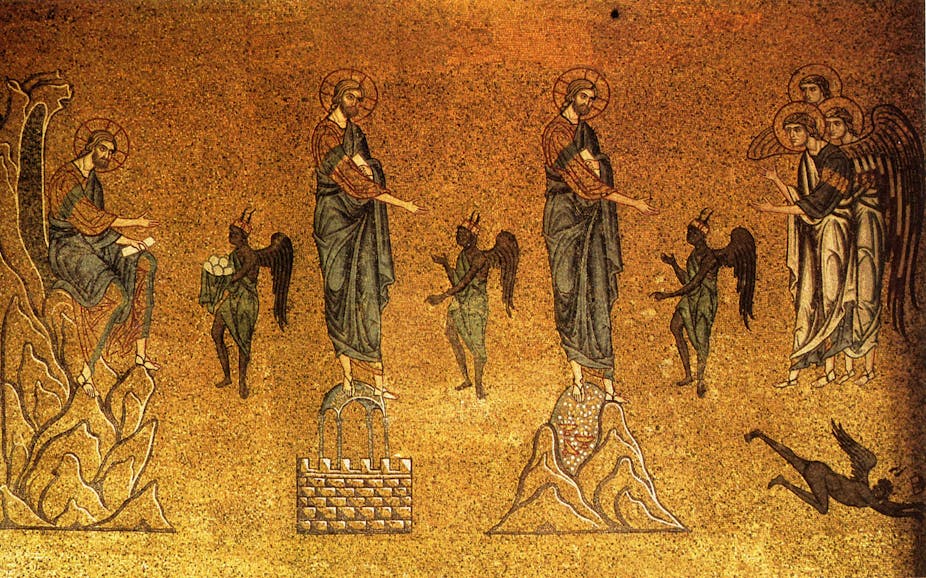
Jesus was led by the Spirit through the wilderness, being tempted there by the devil for forty days. During that time he ate nothing and at the end he was hungry.
During Lent, we join Our Lord in his fast of forty days. I want to speak to you tonight about fasting. We’re asked, as you know, to include in our Lenten observance prayer, fasting, and almsgiving, and of the three I think fasting is probably the one people find most difficult. Difficult, not only to do, but difficult even to understand why we do it. Of course it’s important for us to be able to explain the reasons why we Catholics do the things we do and why we believe the things we believe. “Always be ready to give a reason for the hope that is in you”, as we read in the first letter of Saint Peter. Because even if there are plenty of people today who find our faith baffling, you only have to scratch the surface to discover that most of them are searching for a way to make better sense of their lives. So there’s a great opportunity for us, and a great challenge, to find a way of getting our message across to people who are hungry for the truth. Obviously, the better we understand it ourselves, the better equipped we are to do that. So let’s focus this evening on the ancient practice of fasting, and try to see how it fits into the grand scheme of our faith and our spirituality. Our faith should touch us on every level of our being, and fasting obviously affects us right down there in the gut.
Members of our beloved Order, with its long maritime history fighting the forces of Evil in the form of our fellow men, will have no trouble relating their spiritual lives to the Gospel of last Sunday, the small boat on the Sea of Galilee overcome by waves as Our Lord slept. We live again in such times today, both in the Church, and in our Order.
Many of our readers, especially those who have been to Lourdes or worked in the Spanish Place Soup Kitchen, will know the Reverend Gwilym Evans, former Master of Music of the Grand Priory, and now a Deacon, to be ordained Priest, Deo volente, in June this year. Pray for him.
The video below is the stirring homily on Holy Mother Church and Christian Hope he preached last Sunday at the Masses at the shrine church of St Mary's Warrington – "This boat cannot sink!"
We are invited most particularly at this time to pray for our Holy Father Pope Francis. Readers of this Blog are firmly encouraged to have a Mass said for Him, or ideally a Novena of Masses, and not to omit daily prayers for the person of the Holy Father, in addition to their prayers for His intentions.
This seems most especially fitting as we approach the old feast of the Chair of Saint Peter in Rome (next Tuesday), which intiates the Octave of Prayer for Christian Unity, which closes with the Conversion of Saint Paul.
TU ES PETRUS, et super hanc petram aedificabo ecclesiam meam; et portae inferi non prevalebunt adversus eam; et tibi dabo claves regni coelorum.
V. Oremus pro Pontifice nostro Francisco.
R. Dominus conservet eum, et vivificet eum, et beatum faciat eum in terra, et non tradat eum in animam inimicorum eius.
Oremus. Deus, omnium fidelium pastor et rector, famulum tuum Franciscum, quem pastorem Ecclesiæ tuæ præesse voluisti, propitius respice: da ei, quæsumus, verbo et exemplo, quibus præest, proficere: ut ad vitam, una cum grege sibi credito, perveniat sempiternam. Per Christum, Dominum nostrum. Amen.
THOU ART PETER, and upon this rock I will build my church; and the gates of hell shall not prevail against it. And I will give unto thee the keys of the kingdom of heaven.
V. Let us pray for Francis, our Pope.
R. May the Lord preserve him, and give him life, and make him blessed upon the earth, and deliver him not up to the will of his enemies.
Let us pray. O God, Shepherd and Ruler of all Thy faithful people, look mercifully upon Thy servant Francis, whom Thou hast chosen as shepherd to preside over Thy Church. Grant him, we beseech Thee, that by his word and example, he may edify those over whom he hath charge, so that together with the flock committed to him, he may he attain everlasting life. Through Christ our Lord. Amen.
Last evening, the Vigil of the Epiphany of the Lord, by ancient custom the Church blesses water, the most powerful of the holy water of the Church's year, with powerful exorcisms over the water and the salt, to provided supernatural protection for the faithful against the demons who prowl around to destroy our souls.
A function which belongs to a prelate, the blessing was solemnly celebrated for us by the Abbot of Farnborough, Dom Cuthbert Brogan OSB, at the church of St James Spanish Place, by kind permission of the Rector, who assisted in choir.
Dom Cuthbert spoke beforehand as follows.
I was reminded solemnly in the sacristy that when the order of service says sermon it does not mean sermon, but means instead some short words of instruction. So here we go!...
We celebrate in these days the Epiphany one of the great Theophanies or shewings forth of the God head. So many and so rich are they that the church down the ages has unwoven the various shewings and given them their own feasts or gospels - and so we have the visit of the wise men, the wedding feast at Cana, and the Lord's baptism in the Jordan by John, in Jordane a Joanne - as the antiphon beautifully puts it.
In the baptism all three Persons of the Trinity are revealed - the Father's voice, the spirit as a dove, and Jesus himself goes down in to the waters. But why should he be baptised? He who has no sin. At first John protests, and in a wonderful hymn, Romanus the Melodian, the chief cantor at Hagia Sophia in Constantinople, explains this. John thinks it must be a trick. He knows that in the Old Testament anyone who approached God died on the spot. The psalms tell that they melt like wax who approach God, that the one who tried to save the Ark died on the spot. And so he is naturally reluctant to touch our Lord.
But St Ephrem the Syrian wiring in the fourth century tells us why Jesus went down in to the Jordan. So that he could leave his divine life there. Wherever there is a baptism he says the waters are transubstantiated into the waters of the Jordan and the neophyte, the new Christian, emerges clothed not with Adam's shame but with the restored brightness, the image and likeness of God given him at creation, “quoniam in Jordane lavat Christus ejus crimina.”
The old rituals refer to the ceremonies of this night as being according to the customs of the Oriental Churches. We know how the Orthodox today love to plunge into freezing water to celebrate this feast.
What do we do tonight? With the Church's solemn exorcisms and prayers we bless chalk and salt and water, and we go to our homes armed with these powerful weapons. St John Chrysostom in the fourth century attests to Christians taking holy Water home on this night. And just as the Israelites marked their doors with blood as a sign of salvation so we chalk our doors with the holy cross and the letters CMB - meaning Caspar Melchior and Balthasar - the three wise men - asking also God's blessing for the coming year. CMB also can mean Christus Mansionem Benedicat - may Christ bless this house.
So there you are - now duly instructed, we proceed to the sacred ceremonies.
The ceremony may be watched in the video below. It begins at 1:13:23.
A solemn Requiem Mass was held for our late brother Fra' Matthew Festing, 79th Prince and Grand Master of our Order, at the Church of the Assumption and Saint Gregory, Warwick Street; we are very grateful to Father Elliott-Smith, Rector, for his hospitality. The celebrant and preacher was Father Ronald Creighton-Jobe of the London Oratory, who has probably known Fra' Matthew longer now that most other members of the Order; he was assisted by Fathers Gerard Skinner and Gary Dench. We are grateful to a young member for the transcript of the homily, printed below. The music was provided by the choir of the Assumption, under the direction of Keith Brown.
The Mass may be watched in the video below.
+ In the name of the Father, and of the Son, and of the Holy Spirit. Amen.
Many of you were at Mass when Fra’ Richard [Berkley-Matthews] made his Solemn Vows and it was a very joyful occasion. And in a sense, I want to suggest to you that we are also here for a joyful occasion, praying for the repose of the soul of Fra’ Matthew and now of [his elder brother] Michael. But first we rejoice that Almighty God called him to Himself at the right time. It is always the right time when God calls us. But somehow it was particularly suitable. The last time I saw him, just before he went to Malta, he was surrounded by the young of the Order, and Matthew came alive – he always found the young very touching. He said, “I am going to Malta. After all, I tried to promote as best I could the Professed and now the Solemn Professions have been freed, I am going.” I said, “is that wise”, and he said, “Probably not”.
Well in the end it probably was wise, in God’s sight, because there he was, amongst his own, in that very remarkable church, Matthew just after was taken to hospital, died, and is buried in the crypt of the Grand Masters. And let us not forget that he was the 79th Grand Master.
As we look back on his life, he would be the first who wouldn’t want us to spend the time talking about it. But like many priests, when someone says that, inevitable one does talk about it because it is right and proper in order to encourage us to the virtues that he practised.
I remember Fra’ Matthew when he was made not the first Grand Prior but the restored Grand Prior after all those centuries, and he said to me afterwards, “What on earth do I do as Grand Prior?” I said, “You do your best”, and he did. And then after the funeral of Fra’ Andrew, and we were having a welcome drink in the Plaza Hotel, I said to him, “You do realise, that it is possible that you will be elected Grand Master”. He said, “Don’t be so stupid!”. And he was. And again, he said, “Now what do I do?”. “Do what you have always done: do your best,” and he did. Within his limitations (and we all have limitations), he tried to serve God, to love Him. He had a deep devotion to Our Lady, and he tried to help our Lords the Poor and the Sick.
He was very good with the Poor and the Sick, with sometime rather unusual consequences. I remember him going to visit Our Lords the Poor at the Termini Station in Rome. He didn’t look too well-off himself, and one of the Poor said, “That poor old thing there, they ought to do something for him.” Matthew liked that very much.
The other thing I remember (sorry about the anecdotes), is that when he was first elected, he came to Cortona in Tuscany where I was staying with friends. He had never been there. If you have ever been there, it is all up and down with hills, and he wasn’t best pleased about it (you will all recall a certain… linguistic tendency that Matthew could have). When we arrived at the celebration which was about the importance of the Order in Cortona (there were two Grand Masters) we were together, and our host in Cortona had his jacket and tie on, and Matthew didn’t, of course. When we arrived at the reception, they assumed it wasn’t Matthew who was the Grand Master, but our host. And he liked that too. Because humility has to be genuine, and it has to be heartfelt, and lived with a certain joy. Matthew had it.
I can’t say (and he would certainly not have said) that he always felt joyful in Rome for various reasons. Let’s say, Rome was a little too complicated for him, so he would escape from time to time. His attempts to learn Italian were not vastly successful either, but caused a certain amount of joy and merriment amongst the Italians because unlike the French (we shouldn’t say this), the Italians don’t mind you making a hash of their language. But all the time he did his best in circumstances and in a context in which he was never entirely at home. We know where he was at home: he was at home in Northumberland, and he was also very at home in Lourdes. He loved Our Lady and there he could help the Sick in a very practical way. As you know, he off-loaded them at the station for many years, and he continued to do that when he was Grand Master. Again, the Sick didn’t have the slightest idea who he was. As he got weaker physically, he still insisted on going [to Lourdes]. Again, he overheard someone say, “O look at that poor old thing, why don’t they do something for him.”
Well, God did something for him: He gave him a great possibility to exercise patience and forbearance, under extremely difficult circumstances. And he did it, with obedience and with determination to try to do God’s will. And that’s all that any of us can ask for: to try to do God’s will. And so frankly we don’t have to mourn.
We do mourn his physical presence (and there was a lot of it). We also mourn his capacity for affection: like many Northerners, he didn’t know quite how to express it sometimes, but he was a deeply affectionate man and loved his friends, and depended on their prayers and friendship. And that is why he didn’t always realise the complexities with which he had to deal with in various circumstances, because he tended to think well of people.
We are very grateful to be here tonight to have this opportunity and he would have most of all appreciated our prayers for him, and to be surrounded by (what I am sure is true) a deep sense of affection.
It is sad too that we are mourning Michael, but again: a thoroughly good man. Rather different in temperament to Matthew in some ways, but with that straightforward love of our Blessed Lord and Our Lady which he always felt he had particularly inherited from his mother’s family, the Riddells.
So, dear Matthew, we pray for you. My instinct is that he won’t have very long (whatever that means in terms of eternity) in purgatory, because he suffered. He was not always well-treated. But, in the end, neither was Our Blessed Lord, and we follow the Crucified Saviour who makes sense of pain and sorrow and suffering.
And so we can say with heartfelt devotion: Eternal rest grant to him, O Lord, and let perpetual light shine upon him – may he rest in peace. Amen.
Homily preached by Silvio Cardinal Tomasi C.S. at the Funeral Mass and entombment on Friday 3rd December 2021 in the Conventual Church of Saint John of Jerusalem, now the Co-cathedral in Valletta, of Robert Matthew Festing, Prince and Grand Master of the Sovereign Military Order of Malta from 11 March 2008 to 28 January 2017.
Mr. President, Your Excellency, Lieutenant of Grand Master Fra’ Marco, Excellencies, dear members of Fra’ Matthew’s family, dear confreres, dear friends.
First of all, I would like to express my deep gratitude to our Holy Father Francis who asked me to personally preside over this celebration in his name, and I add my personal greetings and thanks: to the President of the Republic of Malta, George William Vella; and to Archbishop Scicluna for having allowed this celebration and the entombment of Grand Master Festing in the Crypt of the Grand Masters of this glorious cathedral basilica dedicated to our patron saint, Saint John the Baptist.
Fra' Matthew's sepulchre in the centre of the Grand Master's crypt
As a faith Community we are gathered in this beautiful and historical cathedral to say farewell and commend to God the Bailiff Grand Prior, Knight of Justice and former Prince and Grand Master of the Sovereign Military Order of Malta and former Grand Prior of England, Fra’ Matthew Festing. A person of deep Christian convictions, Fra’ Matthew was aware and proud that in his mother’s English recusant family line is included Blessed Sir Adrian Fortescue, Knight of Malta, martyred in 1539. Through the choice of becoming a Knight of Justice, Fra’ Matthew dedicated his life to the mission of the Order, a mission that has remained constant through the centuries: Tuitio Fidei et Obsequium Pauperum, the defence of the Faith and service to the Poor. History doesn’t stay still but it constantly moves forward. Indeed today’s battles are fought by the Order not with the sword but with the more effective weapon of charity toward the Poor and the Sick. The Order is therefore engaged with its Professed, its Members in Obedience, its large number of Knights, its volunteers and Dames, in the vast field of the world in promoting justice, creating peaceful coexistence, aiming at realizing the dream Pope Francis has often placed before our eyes that we are all brothers and sisters, a fundamental message of the Gospel.
Fra’ Matthew Festing, 79th Prince and Grand Master of our Sovereign Military Order of Malta, had been elected in March 2008 and retired in full obedience and with great humility and discretion in 2017.
Fra’ Matthew had as one of his priorities to promote more vocations as Knights of Justice and Providence called him to eternal life when he came to Malta where a solemn profession was celebrated after many years of interruption.
This circumstance sends us a message at this moment when the reform of the life of the Order is underway, and will lead us to an updated Constitution and a Melitensis Code. It is a message that calls us to root ourselves in the religious identity of the Order and to pray that the Lord may send generous vocations to continue the mission of the Order in fidelity to the inspiration of Blessed Gerard, who formed a new religious family of lay religious in the Hospital in Jerusalem for pilgrims, sick people and people without resources, about one thousand years ago.
Fra' Matthew through his obedience and prayer life leaves us a legacy that strengthens the Order and invites us to follow the same path.
The fruitful cooperation of the various categories of persons who together carry on the original charism of the Order is a strong witness of the united spirit and action that moves us on. As we look around this Island, there is plenty of evidence of its Christian tradition, beginning with the refuge provided to the Apostle Paul after his shipwreck. Storms and conflicts have not disappeared and they mark the course of our existence. There is no surprise in this, but mutual love and respect has always to prevail.
Fra’ Matthew contributed his part in pursuing this dream by encouraging the Order around the world.
If the whole Church takes up this missionary impulse, She has to go forth to everyone without exception. But to whom should She go first? When we read the Gospel we find a clear indication: not so much to our friends and wealthy neighbours, but above all the Poor and the Sick, those who are usually despised and overlooked, “those who cannot repay you” (Lk 14:14). There can be no room for doubt or for explanations which weaken so clear a message. Today and always, “the Poor are the privileged recipients of the Gospel”, and the fact that it is freely preached to them is a sign of the Kingdom that Jesus came to establish. We have to state, without mincing words, that there is an inseparable bond between our Faith and the Poor. May we never abandon them.
After nine centuries, the mission of the Order continues to inspire and to advance on the main road of the Church, faithful to her teaching, and to all those who like Fra’ Matthew – and may he rest in peace - tried without fear of their own limits to implement the Gospels’ message. Amen.
Requiescat in pace
Cardinal Tomasi imparts his blessing to the Conventus after Mass.
The Holy Mass for the feast of Blessed Gerard was celebrated by our Chaplain Father Stephen Morrison OPraem, at St James's Church, Spanish Place, by grace of the Rector. Fr Morriosn also preached. The text is given below.
Reverend Fathers, dear Confreres, I wish you a happy founder’s day, a joyful feast of our brother in heaven, Blessed Gerard.
Since the historians tell us that he left this transient life between the years of 1118 and 1121, we celebrated last year the 9thcentenary of Blessed Gerard’s entry into eternal bliss. This year, being the latest date when the same anniversary might reasonably be marked, is no less an occasion of joy. (In fact, this year is also a jubilee for the Norbertine Order too, 900 years since our foundation! So much to celebrate!) Perhaps we can think of tonight, then, as the closing of a jubilee – and, we pray, the beginning of a new chapter in each of our pilgrimages. For we are all pilgrims and patients in a Hospital, the Hospital of St John of Jerusalem; the Holy Father once even referred to the Church as a “Field Hospital for Souls.” Since this is rather a beautiful expression, I shall refrain from the acid retort (tempting though it is) that, if the Church is a hospital, there are several parts of it (some rather prominent) that might qualify as its secure unit for the insane…
But in all seriousness, yes, we are all pilgrims and patients. Blessed Gerard founded an Order, not a hospital; but it was in a hospital that he did so. And he founded it, by God’s inspiration, for us. Before we think of ourselves as running that Hospital, we need to remember that it was – and still is – run for us as well.
We too are pilgrims to the Holy Land, we are all patients in a hospital, we are all poor and sick, in some way. At the beginning of this and every Holy Mass, we have acknowledged our war-wounds, our impoverishment, our persistent complaints of thought, word, deed or omission – our sins. And we try to empty ourselves and “detox” from all worldly cares and cures, in order to be ministered to by the Divine Physician, to whom also we will one day submit ourselves for our final examination, so that, until then, we may receive from “His Holy and Venerable hands” the eternal and supernatural remedy, the medicine of the Blessed Eucharist, the pledge of future glory, a little piece on earth of Him to whom we shall be joined forever in Heaven. For the disease of our sinfulness need not be terminal, though often chronic: we can improve; we can change; the Doctor might look pleased with our progress. After all, He has administered the cure several times.
What Blessed Gerard understood, and left the Church as his particular legacy, is that some of these poor and sick in that Hospital were themselves called to be Servants and Carers of other poor and sick souls, in both natural and supernatural ways, both physically and spiritually; think of the paradox: brothers were called to serve their brothers; the diseased were called to nurse the diseased; the lame were called to carry the lame; was this the blind leading the blind? Bear with me… From a hospital of patients would come the Knights Hospitaller. Some of these men wounded in battle had the divine vocation to be enlisted as soldiers, knights, and defenders of the embattled and shell-shocked faithful of Christ; this is what profession and membership of our Order means. This is what working in and for the Church means. In other words, the asylum was to be run by the inmates. It should not surprise us, then, when the Church of Jesus Christ sometimes resembles (at least to those outside her bounds) a replay of “One flew over the cuckoo’s nest”; for those of us who, like Blessed Gerard, are simultaneously patients and staff in the Field Hospital of the Church, know all too well our own wounds and our own suffering, but we also know the power of His wounds, His suffering, His agony – and we know that His Passion is the medicine for our own, that His Resurrection is the promise of our own, and that His care for the souls entrusted to Him by the Father is also our own task and special care. So we know what our treatment plan is. We know that one day we will leave the Accident and Emergency ward which is the world, and we hope immediately thereafter to ascend to the permanent rest of Paradise forever (with perhaps a little ‘Intensive Care’ in purgatory before we do). But we do not think only of ourselves; our task too, then, is to bring the patients in our care with us: to bring souls to Christ for Him to present them to the Father: holy, clean, and spotless, cared for, nursed, convalesced, and healed. After death, our bodies will lie in wait for His powerful “Rescuss” – when the Morgue will become as busy and as noisy as the wards – at that final day of Resurrection and Reward, when our broken bodies will rise again in a beauty and a glory that we could not possibly have imagined when our life was one of bandages and weeping sores.
Our very presence here, as the Grand Priory of England and the British Association of Blessed Gerard’s Hospital, speaks loudly, nine-hundred years since preceding us into glory, of the power of this metaphor. For it is not merely an image for us – it is a hard reality, a practical endeavour, and a noble effort. The pilgrimage for us is real. The quest for the Holy Places is real. The building and defence of the Kingdom of God outre-mer – that is, beyond the visible boundaries of the known world – is real. Since suffering and poverty are real, our care for Our Lords the poor and the sick is real. The care we know that our own souls require is real. The Faith must be defended, and the poor cared for. Therefore, our need for chivalrous zeal and the highest standards of care is real. Blessed Gerard saw a need, and sought to supply the demand; to say that he saw only a practical need would be to miss the entire point of his life – but to say that he lived in a pious fantasy would also miss the point. Neither was true of him, and neither is (nor should be) true of us. For he was blessed to have had eyes to see and ears to hear; and he not only saw the Church and the world of his own time, but perceived a heavenly goal too, one for all time. He knew that what he did for the least of Christ’s brethren, he did for Christ Himself. Christ presented Blessed Gerard with a Cross, and He presents it to us also. Our Lord does not lie to us, as some doctors do, saying “this won’t hurt…much…” – in fact, He’s honest. He says, this will hurt; how could it not?, since it hurt Him. Yet, “by His wounds we have been healed.” Therefore we perceive reality for what it is, when we glimpse the saving power of the Cross, the nails, and the Crown of Thorns. Blessed Gerard knew the power of that Cross, and we who wear it today thank God for the White Cross of the Order and that first Hospital of St John in Jerusalem.
Today, we remind ourselves of that origin, that first calling, which has allowed so many of our confreres since to follow in Gerard’s venerable footsteps. We too, nine hundred years later, are called to this holy endeavour. We recognise that we are the fortunate ones, poor and sick though we are, to be called to minister to the poor and the sick around us. When the Church, local or universal, starts to look and feel like a chaotic A&E after the pubs close, or if it looks like the lunatics are running the asylum, let us remember what we are offering: a Hospital run for patients by those who are patients themselves. So let us be patient… It is Christ’s Church, not our own. He is in charge, and we can have no better Physician. God diagnosed, and it is He who treats us – and with what tender compassion He does so, and with what wondrous medicine! He himself said, “it is not the healthy who need the doctor, but the sick;” He has come for this purpose, He will see it through, and He will care for Gerard’s Hospital and all within it. The devil said we could not be cured, we were done for, the poison within us was lethal, we were terminally doomed. But our guardian angels asked for a Second Opinion, and they who sang the Gloria when the remedy was born, sang joyfully again as it was first injected into us in Holy Baptism. Do they not sing still, at each absolution? No wonder we make our confessionals soundproof; after each good confession, it is filled with a heavenly chorus that would deafen our poor mortal eardrums. The devil’s gloomy prognosis has been confounded. For the Battle is indeed already won, though it rages on and still requires the service of knights in armour; the cure has already been found, though many still succumb to illness and require treatment; and while some show contempt and may even despise the Doctor, He nonetheless offers the remedy, inviting all yet forcing no one; He pays the price, bandages wounds, and whispers words of peace into anxious hearts. That he did so through Blessed Gerard is what we celebrate today; that He should now wish to do so through us, his Knights and Dames Hospitaller, is what must be our glad motivation tomorrow, and all our tomorrows, for at least the next900 years… For all Time belongs to Him; let us then use the time He has given each of us as wisely as Blessed Gerard did.
For to be wise is to know ourselves to be patients as well as carers. The Tabernacle is our Medicine Cabinet, and the Church has been given its key. As we receive from it tonight a perfect dose whose potency is beyond what our minds can comprehend, may it truly be for us an eternal remedy for body and soul. Let us not hold back, out of shame, from revealing to Him the dangerous infection of our sins, our gaping wounds and their foul stench, since it is in our interests to lay ourselves humbly before Him for healing; what would make others squeamish does not horrify Him. He has already taken up the challenge of our condition. A single tear of his loving anguish, and a single drop of His Precious Blood falling upon us, is able to clean, heal and make us whole. And He provides nourishment to keep us fit and strong: food for the pilgrimage. As we have been fed, so may we feed others; as we have been healed, so may we heal others; and as we have been so generously served, so let us be generous in serving others, at His command.
This coming week sees the Westminster Eucharistic Octave, 11th to 19th September, a week of celebration of our Sacramental Life at the Altar, beginning with a Pontifical Mass with Cardinal Nichols at noon this Saturday, at Corpus Christi Maiden Lane, the Diocesan Shrine of the Blessed Sacrament. During the coming week, Holy Mass in various Catholic rites offered each day at 6.30 pm, with homily, in the same church. Full details are HERE. The Octave follows the International Eucharistic Congress held in Budapest this week.
The week concludes with the London Corpus Christi Procession, which the Order has assisted with over several years, starting at 3.30pm on Sunday 19th September at the Assumption Warwick Street W1B 5LZ, with stations at Farm Street, and the Ukrainian Cathedral Duke Street, at each of which Benediction will be given, and concluding with pontifical Benediction in St James's Spanish Place, and the wonderful Mendelssohn Lauda Sion.
In preparation for the Octave, the Diocese of Westminster has prepared a podcast, linked HERE or click below.
This feast of Saint Pantaleon, which falls tomorrow, upon which the Order commemorates annually a great naval victory over the Turks in 1659, seems a good occasion to publish the somewhat belated report on the Saint John's Day Mass. The observance was instituted by Grand Master Pierre d'Aubusson, the greatest Master of Rhodes.
Saint John's Day was celebrated as a High Mass, with the Chaplain of the Priory, Monsignor John Armitage assisted by Fathers Stephen Morrison OPraem and Gerard Skinner.
Monsignor Armitage's homily is given below.
HOMILY ST JOHN’S DAY 2021
Zechariah, the Father of John the Baptist, doubted the message of Gabriel that his wife Elizabeth would give birth. "I am Gabriel. I stand in the presence of God, and I have been sent to speak to you and to bring you this good news. 20But now, because you did not believe my words, which will be fulfilled in their time, you will become mute, unable to speak, until the day these things occur." Zechariah loses his voice. Contrast the next visit of Gabriel to Our Blessed Lady at the Annunciation, for this was the encounter where Mary found her voice. “Behold the handmaid of the Lord, let it be done to me according to his Word.”
A voice lost and a voice found. Zechariah’s voice will only return when the words of the Angel come true. Marys “yes” was given for she was open in her heart to receive this gift for she had “conceived him in her heart before she conceived him in her womb”.
Mary is troubled by the words of the Angel; Zechariah doubts the words of the Angel. Our Lady’s faith reassures her to put her fears aside, Zechariah’s doubt, silences him, he will not speak again until he sees, the words fulfilled in the birth of his Son John the Baptist. The words of Jesus to Thomas ring true. “Doubt no longer but believe.”
Our Lady and Zechariah, although they respond differently to the Angelic invitation, eventually arrive at the same point. It is a point of prayer and thanksgiving that became the foundation of the Churches daily prayer - Mary's Magnificat and Zechariah’s Benedictus. It doesn’t matter where we start on the journey, our faith and the mercy of God will always bring us to the encounter with the one who calls us friends.
Mary's Son will bring “his mercy on those who fear him from age to age andfill the hungry with good things.” Zechariah and Elizabeth’s son will tell of the one who is to come who has visited his people and redeemed them, thus saving his people from the hands of those who hate us, giving us the mercy that was promised to us by our fathers. Mary is the bearer of the Word incarnate, Elizabeth will be the bearer of the Voice which will proclaim his coming. Mary the Mother of Mercy, Elizabeth the Mother of the prophetic voice who will proclaim our delivery from our enemies so that we might serve him without fear.
These two patrons of our beloved Order, Our Lady and St John the Baptist, both announce the mercy of God, through the forgiveness of our sins, this is the proclamation of the Good News, for he has filled the hungry with good things, and the rich he has sent empty away.
The Hospital in Jerusalem was under the patronage of St John the Baptist. Since the earliest days of our Order his words “He must increase, and I must decrease” has lived in the noble hearts of our brothers and sisters, who like John have stepped aside to make a way for the Lord. Mary’s faith and John’s humility are the very spiritual foundation of our relationship with Jesus. Our vocation as a member of the Order calls us to “step aside” and to give all, to follow Christ so that we may serve “Our Lords the Sick”; we are called to “step aside” from our doubts and fears, that we may be instruments of the Mercy of God; we are called to “step aside” from ambition and greed so that we may share what we have with those who have nothing, we are called to “step aside” from the hardness of heart that restricts the flow of God’s grace and generosity in our life, so that we may become experts in humanity who by our loving service have penetrated the depths of the hearts of the men and women of today, sharing their joys and their hopes, their anguish and their sorrows, thus we defend the Church, by serving the Sick and the poor.
The renewal called for by our Holy Father Pope Francis is a spiritual renewal, that must be rooted in the hearts of every member, or it will not bear fruit. Many fine words might be said and written, but they will fall on barren soil, hardened hearts. “You renew the Church in every age by raising up men and women, outstanding examples of your unchanging love.” These words from the preface of saints must become the heart of our own personal renewal, where we will understand Why we do, what we do. What we do in the service of Our Lords the Sick and Holy Mother Church must be grounded in prayer and truth, and the fruit will be a radical generosity arising from a humble contrite heart the fountain of all nobility. Prayer will change us, the truth of the Word of God and the teaching of the Church will set us free, and radical generosity will bring to life the words of Our Lord, “when you did this to the least of your brothers you did it to me."
We do not seek to renew the Order for the sake of the Order, we seek to embrace the words of Our Lord. “I have come bring you life and life in abundance” and we wish to share this abundance in the service of our brothers and sisters in their need.
The challenges we face today are challenges that all of humanity faces in these difficult times. Governments and humanitarian organisations provide material resilience in the face of need, but man does not live on bread alone, but on every word that comes from the mouth of God. As servants of the Church, we are witnesses to the Spiritual resilience which is the Body of Christ; once again we gather around the Sacrifice of the one who says, “This this is my body and I give it to you.” Let us “step aside” from our fears and anxieties.
Lord Jesus, Thou hast seen fit to enlist me for Thy service among the Knights of St John of Jerusalem. I humbly entreat Thee through the intercession of the most holy Virgin of Philermo, of St John the Baptist, Blessed Gerard and all the Saints, to keep me faithful to the traditions of our Order. Be it mine to practise and defend the Catholic, the Apostolic, the Roman faith against the enemies of religion: be it mine to practise charity towards my neighbours, especially the poor and the sick; Give me the strength I need to carry out this my resolve, forgetful of myself, learning ever from Thy holy Gospel a spirit of deep and generous Christian devotion, striving ever to promote God’s glory, the world’s peace, and all that may benefit the Order of St John of Jerusalem. AMEN
THESE PAGES EXIST TO GIVE REPORTS AND IMAGES OF PAST EVENTS OF THE ORDER, AND TO PROVIDE PUBLICITY FOR FUTURE EVENTS, TO MEMBERS OF THE ORDER OF MALTA AND THE COMPANIONS AND THEIR FRIENDS.






 Posts
Posts


