As Cardinal Mercier said : "When prudence is everywhere, courage is nowhere."                                                                                  From Cardinal Sarah : "In order to avoid hearing God's music, we have chosen to use all the devices of this world. But heaven's instruments will not stop playing just because some people are deaf."                                                                                              Saint John-Paul II wrote: "The fact that one can die for the faith shows that other demands of the faith can also be met."                                                 Cardinal Müller says, “For the real danger to today’s humanity is the greenhouse gases of sin and the global warming of unbelief and the decay of morality when no one knows and teaches the difference between good and evil.”                                                  St Catherine of Siena said, “We've had enough exhortations to be silent. Cry out with a thousand tongues - I see the world is rotten because of silence.”                                                  Chesterton said, “The Christian ideal has not been tried and found wanting. It has been found difficult; and left untried.”                                                Brethren, Wake up!

IN THE SERVICE OF OUR FELLOW MEN - ON THE DEATH OF A QUEEN

Queen Elizabeth II as a girl, by Philip de Lázló

Lord , now lettest thou thy servant depart in peace.
 
An old lady, a very old lady, has died. As you might expect, her children, her grandchildren, her great grandchildren, her friends and relations mourn her. They find consolation no doubt in the old lady's unshakeable Christian faith. Perhaps they remember the words of the preacher in the book of Ecclesiastes we have just heard read whose magnificent poem echoes down the centuries, and find solace after a long life well lived in his words from which none of us can escape: there is a time to die. Thus a beloved person is lost to those around her who loved her, and is mourned, as we all may hope and wish to be mourned.
 
That is all perfectly normal.
 
So what is it that is happening to us and to many, many millions of people not just here in the United Kingdom, but around the world, which makes this old lady's death leave us feeling so profoundly moved and so bereft? Why is it that we feel such genuine and heartfelt grief? This is not normal; this is extraordinary.
 
It is not that the old lady was some titanic writer or scientist, some politician or soldier who had led nations to triumph or glory, some Mandela or Tolstoy or Newton or Napoleon. Not at all. She was an honest, decent, hardworking woman with a sharp sense of humour and a heavenly smile; an iron memory for faces, a fascination with people, a great expertise in bloodstock, an affection for this place which she often visited, and a quiet but profound Christian faith, the rock on which she built her life. Could we find other people, whom perhaps we know and love ourselves in our own families with similar qualities? Yes, we could, though we would be very hard pressed to find someone who was her equal in expertise on breeding race horses.
 
So what is going on? Why is the death of this one old lady, our late Queen Elizabeth II, so profoundly moving? Not just here in Britain, but around the world? Because it is profoundly moving, and if you do not feel it, there is perhaps something a little missing in you.
 
The answer I think is this. Through the genetic lottery of hereditary monarchy she had, not of her choice, laid upon her a task, from which she could not honourably escape, of almost intolerable weight. The task was to inhabit a role - and I use the word borrowed from the theatre deliberately - a role which meant that every day of her long life was constrained and shaped and observed; which meant that she sacrificed virtually all her freedom and voluntarily circumscribed her own individuality; a role which made us all feel that we owned her.
 
What was this role, and who was the ruthless playwright who scripted it?
 
Well, the role was to embody, physically, the values and traditions of the nations of which she was sovereign. And do it forever, for all her life.
 
Who wrote this terrifying script? The answer to that is: look in the mirror. We did, her peoples. We insisted she undertake it, and were often very quick to criticise from the cheap seats if we detected - usually wholly unfairly - any falling off in her performance.
 
Could she have refused the part? Yes, in theory she could, her uncle did, though she regarded such escapism with contempt. Could she have made a mess of it and failed our expectations? Yes indeed she could have done - a good many of her ancestors did make a spectacular mess of it. But she - did not. Aged not much older than you boys, at her twenty first birthday, she looked her future in the eye, accepted it, and pledged her life to fulfilling the role we had laid on her for the rest of her life.
 
Now you may say - "it was just a role - you've said it yourself, Provost - all play-acting processions and stage-set palaces" . But if you do say that you misunderstand in a profound way what it is that makes a nation, a people, a community, a family even, work.
 
Let me tell you one story from my own life to illustrate what I mean. When I was Minister of State in the Foreign Office during and after the fall of the Berlin Wall, I had the honour to receive in my grand office, which overlooked Whitehall and the Cenotaph, the first Foreign Secretary of free, non communist Poland.
 
It was the day of the opening of Parliament. We held our talks, while outside there was the noise of the preparation of the great procession when the monarch, escorted by the Household Cavalry, travels in the royal coach from Buckingham Palace to Parliament. There were bands playing, commands shouted, the clash of arms coming to the Present. It became clear to me that my Polish colleague wanted to watch the parade rather than to talk to me. So we put our papers aside and stood by the window and watched. He turned to me, this hero of anti communist resistance, who had helped free his country and said: "Minister, what we are watching matters. The communists robbed us of our rituals".
 
He was right.
 
He might have quoted Shakespeare; Ulyssein Troilus and Cressida:
 
There is a mystery - with whom relation
Durst not meddle - in the soul of state,
Which hath an operation more divine
Than breath or pen can give expression to.
 
No society or community can survive long without the rituals which embody what Shakespeare calls the state's soul - the ideals and dreams to which that society wishes to aspire, though all societies fail much of the time to achieve them. As another book of the old Testament puts it: "Where there is no vision, the people perish."
 
Some countries choose as Britain does, to have a hereditary constitutional monarch whom we require to embody that vision, that soul of our community, of our nationhood. Without thinking, often, what we are asking, we lay upon an individual human being what is a tremendous duty. We choose the person in an ancient way, by heredity, and require them to undertake the near impossible task of representing the sort of values to which we aspire and then to keep those values themselves safe from what Winston Churchill called the rancour and asperity of party politics - rancour and asperity which are inseparable from democracy but which, unless they are bounded by some sense of shared service to the national community can shake a nation to pieces.
 
So there we have it. This old lady - one of us, one of the ordinary human race - had that burden laid upon her, that extraordinary duty - to represent the very soul of the nation - of all the nations she served - to keep that soul safe and separate from the necessary power struggles beneath - and by becoming the very exemplar of service to give us something to love and to serve, and yes, sometimes something even to die for - and to do all this as a real, living, breathing, person. That is what she accepted all those years ago and having accepted the burden, she carried it all her long life without missing a beat.
 
That is what she did. And I think no one in the thousand years and more of our monarchy, ever did it better. That is why we, and all those millions feel bereft, and why we are right so to feel.
 
Now this strange ancient institution of monarchy provides also the antidote to the feeling of loss that so many feel. It comes, this antidote, much in the same way that it comes in many families. On the day that my own beloved mother died, some years back, another of her great grandchildren was born: life goes on. On the day that the Queen died, King Charles succeeded and in his own powerful and moving words on Friday made clear not only that he well understands the burden that he now carries on our behalf, but accepts it and will to the best of his own ability, carry it as his mother did. So we mourn, but we also celebrate: the story goes on. All the values of service, self-effacement, and duty, often so under-rated in the rat-races for power, money or fame which surround us, find a new quiet champion on whom we place the old burden, and who we look to with hope to carry on the work.
 
So that is why so many millions mourn: it is our way of saying "thank you" and for showing that we understand how well that quietly heroic old lady represented to us and for us all that is best in us. It shows that we know in our hearts that without such a rock of service on which to build our fractious human society so much will be lost. It reminds us that without that vision of duty and shared obligation, the people may indeed perish.
 
Thank you.

We offer the Sermon above, with acknowledgment and gratitude, but without apologies. It was preached by the Provost of Eton College, Lord Waldegrave of North Hill, on 11th September to the boys of that School, the beginning of Term. It sums up the spirit in which all members of the Order should approach their service of our fellow men. Only an accident of history has separated our beloved Order from our equally beloved Monarchy. The Catholics of Great Britain have never allowed that accident to separate them from the service of all that is good in this Realm. Let us pray for Queen Elizabeth. May She rest in peace.

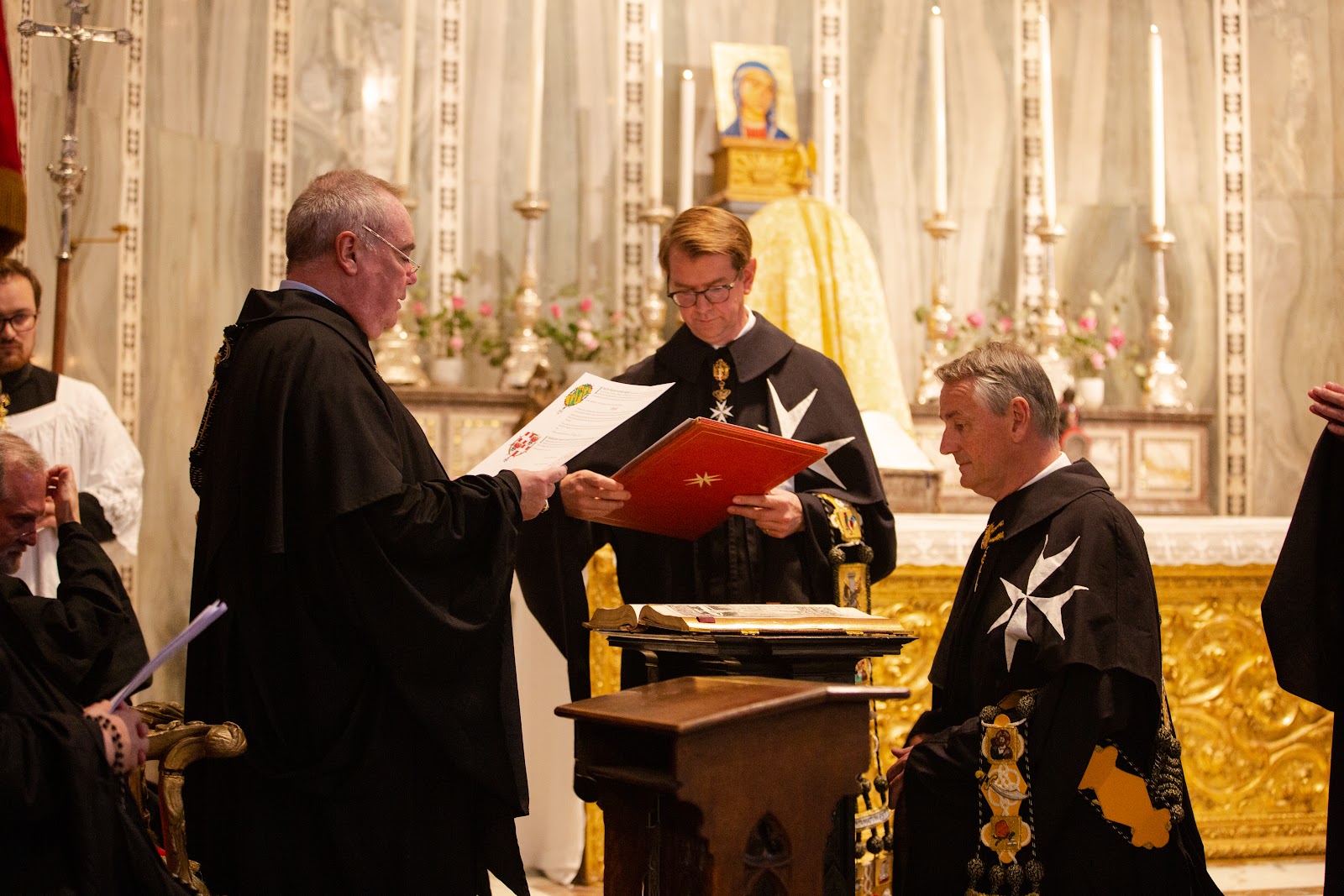
HOMILY FOR THE "VICTORY MASS", AND INSTALLATION OF THE GRAND PRIOR

The sermon preached by Monsignor John Armitage, Chaplain to the Grand Priory of  England, on the occasion of the Installation of Fra' Max Rumney as the 58th Grand Prior of England, by Fra' John Dunlap, Lieutenant to the Grand Master, at the "Victory Mass", The Nativity of the Blessed Virgin Mary, in the Priory's Conventual Chapel of the Assumption and St Gregory Warwick Street, London, on September 8th 2022. Further photographs of this glorious ceremony will follow in a later post.


Brethren, we know that in everything God works for good with those who love him, who are called according to his purpose.” In a world that seeks fulfilment by seeking what I want, the Church is the witness, that the good we encounter in our world, is the result of the God who works for this good through those who love him, for the whole of creation is called according to his purpose. Only love can give our lives meaning and purpose, and our true fulfilment is a consequence of not doing what I want, but seeking, sharing, and doing what we need, building the common good of all humanity.  The Church has its fair share of those of us who do what we want, but our Order has been greatly blessed by those whose lives had been dedicated to building up the body of Christ, living witnesses of what we need, these people we call saints.  

Our founder Blessed Gerard, was known by his contemporaries as “the humblest man in the East, a servant of the poor, devoted to pilgrims, of simple appearance, but shining forth with his noble heart.” In the darkness of 1941 Pope Pius XII in an address to the Order, explained the true meaning of nobility. “In these poor, these orphans these wounded these lepers, lie you own title deeds of nobility, received at Bethlehem from the King of Kings who being rich became poor, that by his poverty you might be rich.”

In every moment in time there is a grace to be found, and the history of the Church shows us that it is in the darkest moments that God’s grace is most profound. “For where sin increased, grace increased all the more,” Romans 5:20 

When Pope Gregory the Great sent St Augustine to evangelise the pagan English, Rome was a dark and dangerous place, the Roman Empire was collapsing, the barbarians were at the gates, plague was rife, yet the successor of Peter sent a frightened monk to the edge of a crumbling empire. Pope Gregory understood the wisdom of the modern saying “Better to light one candle than to curse the darkness.”

Augustine built a monastery, it was the spiritual foundation, lighting the flame of faith for his companions to spread the Good News in a dark and dangerous land. All works of the Gospel must be based on firm spiritual foundations which from time to time must be renewed. 

The Holy Father calls us to a Spiritual Renewal, but such a renewal presupposes a spiritual legacy, this legacy has inspired the men and women of our country to respond to the call of the Gospel and the charism  of our founder from the foundation of the Grand Priory in 1144, through the martyrdom of our brothers, Blessed Adrian Fortescue, David Gunston and Thomas Dingley after the suppression of the Grand Priory in 1540. The blood of these martyrs was the seed that would lead to the restoration of the Order in 1875 with the establishment of the British Association and the restoration of the Grand Priory of England in 1993.

Whatever the darkness humanity faces, whatever the trials and tribulations of the followers of Jesus, Peter and his successors, the rock on which the Church is built, reminds us “that in everything God works for good with those who love him, who are called according to his purpose.” There will be darkness and confusion, from time-to-time we are faced with challenges, but for those of noble heart and humble demeanour, God’s grace enables them to "Listen to what the Spirit is saying to the Church,” not through their own plans or human projects but according to Gods purpose, as he works for the good with those He has chosen. 

The saints and martyrs of our Order were heralds of the Gospel, men and women of noble heart, experts in humanity,  for they were grounded in prayer, and shaped by their love and service of the Sick and the poor. The Preface of Saints tells us that “the Church is renewed in every age by raising up men and women outstanding witnesses of your unchanging love. They inspire us by their heroic lives and help us by their constant prayers to be the living sign of Your saving power.”  

The renewal of our beloved Order will be the consequence of lives that defend the faith by serving the sick and the poor. These heroic lives, founded on fidelity to prayer, will as they have always done, renew the Church and renew our Order. We pray that the renewal will inspire a new spirit of vocational openness, discernment and generosity, to the Professed life, and Obedience and a spirit of loving service that will inspire men and women to join as members or volunteers in the service of those most in need. 

As we stand on the threshold of this new chapter in the ancient tale of Christ’s hospitality, may we, your poor servants, take to heart the words of St Bernard that “the measure of our love will be to love without measure.” 

The BIRTH of Mary, and the YES of Mary brought the light of Christ to shine upon us. This light is experienced only through a human encounter, for the Word became flesh and lived among us. Therefore, the world waits for women and men, who have said yes to God, who are beacons of light to those who live in darkness. 

Today we wish to say Yes, as Mary said yes, to say Yes as Gerard and our martyrs said Yes, to say Yes in the footsteps of the thousands of members of our Order who over the centuries have served the poor and the sick and protected the Church by their example and loving service, always at a cost to themselves, and sometimes at the cost of their very lives! 

Today we commend our dear brother Max to the care and intercession of Our Lady of Philermo, Blessed Gerard, and all the saints and martyrs of our Order and assure him of our prayers, and for Lady Celestia Hales as the new President of BASMOM, may the Lord bless them and strengthen them in the days to come. 

It is a joy to welcome our beloved brother Fra' John Dunlap and we assure him of our prayers and fraternal loyalty at this moment of Grace in the life of our Order.

Each moment in history demands great sacrifices, acts of love and kindness, acts of graciousness and radical generosity to address the darkness that so besets our world. The challenge of renewal within our beloved Order, is about the revitalisation of the personal and generous response in the lives of its members. May the Grand Priory and the British Association, united in our common cause of service to Our Lords the Sick, embrace this moment of grace. 

May Peter, who in the midst of a storm walked on the water and started to sink and was saved by the Lord, strengthen our faith and courage. May Gerard’s humility and nobility of heart inspire us to lives of service and may Mary the one who was “greatly troubled” at what the Lord was asking of her remind us of Gabriel’s words, that the holy spirit will come upon us so there is no need to fear, for nothing is impossible for God. 

At this point Mary's YES and openness to God's will in her life, brought salvation to a fallen world. She “conceived the Lord in her heart before she conceived him in her womb.” In the heart of Mary the Church was born, in the heart of Mary, the Church is sustained, with her words “do whatever he tells you.” The heart of Mary teaches us that all renewal begins in our own hearts. May we conceive Him on our hearts, so that we may bring His love to a fallen world and dedicate ourselves once again to the defence of the Church by our unconditional service of our Lords the Sick. 

Our Lady of Philermo, pray for us.
Saint John the Baptist, pray for us.
Blessed Gerard, pray for us.

INSTALLATION OF THE 58th GRAND PRIOR OF ENGLAND

At a Mass yesterday at the church of the Assumption Warwick Street, Fra' Max Rumney was installed by the Lieutenant to the Grand Master, Fra' John Dunlap, as Grand Prior of England.  A report, and the homily, will follow shortly.

Ad multos annos!

PORTUNCULA INDULGENCE - TODAY!


Today is the day upon which every year we may gain the Portiuncula Indulgence, from the afternoon on the 1st August to sunset on the 2nd. This plenary indulgence may only be applied to the Souls in Purgatory, by the act of visiting a church following Confession and receiving Holy Communion. It is thus one of the greatest Acts of Charity we can perform, to release a soul from Purgatory. Why would one not do this? 

The Indulgence was granted miraculously to Saint Francis on a night of great temptation, in which he is said to have rolled as mortification in a briar-bush which became a bush of sweet thornless roses. Originally it required a visit to the cell where he died, now in the basilica at Portiuncula (see photo above) about a mile from Assisi, but by successive Popes, in their great mercy, has been granted more and more liberally until today any church may be visited to gain this indulgence. (This privilege has been finally established for an indefinite time by a decree of the S. Cong. of Indul., 26 March, 1911 (Acta Apostolicae Sedis, III, 1911, 233-4), and reformed and confirmed by Pope Paul VI in "Indulgentiarum Doctrina" (1967). This Apostolic Constitution established that a Plenary Indulgence may be gained only once a day.)

The obligations are the usual ones of Confession and Holy Communion, ideally on the day, and recitation of the Lord's Prayer and the Creed, and prayer for the Holy Father's intentions, carried out with the will to gain the indulgence, and a detachment from sin. That is all. The indulgence may be gained on each of the two days, thus twice, assisting two souls. Please make the effort to do this wonderful charitable work today! 

For more information see HERE.

MONTHLY RECOLLECTION 1 - FR HEMER ON SAINT JOHN

We are profoundly indebted to our chaplain Fr John Hemer MHM for the biblical learning he offered us this day, at a recollection in the Chapter Room in Golden Square. For those who do not yet know him, Father Hemer is scripture professor at Allen Hall seminary, and regularly offers us insightful food for meditation.  He celebrated the midday Mass in the church of the Assumption, which was followed by lunch in the Priory, and a second talk, Vespers and Benediction. The second talk, on the Good Samaritan, will be published later.

The first Epistle of John.
Here in the year 2020 we all have a sense that we are ‘up against’ the world, as well as being at its service. We understand that there are forces fiercely inimical to religion in general, Christianity in particular and Catholicism most of all. The discipline of apologetics, neglected, even disparaged in the catechetical euphoria that was the 1970’s and 80’s is now on every priest and seminarians ‘to do’ list.
As well as that challenge, for which there are increasingly ample resources, there is also the challenge of division, or at least disagreement within the Church. And that is often the thing which saps us of our energy, and we have, by now, probably all found ourselves alongside people whose understanding of Catholicism is at least somewhat different to our own, and sometimes seems to be a largely different religion. If we study St. Paul, especially 1 Corinthians we see this this already in the Early Church. But the Corinthian divisions seems to be of the cruder, grosser kind, setting up one leader against another, class divisions manifesting themselves during Mass etc. As far as St Paul tells us anyway, the Corinthians don’t seem to be arguing about theological niceties. But this is precisely the problem the letters of John deal with, and also, by the way, the way they behave towards each other. So there are the theological issues:
5 Who is it that overcomes the world but he who believes that Jesus is the Son of God? 6 This is he who came by water and blood, Jesus Christ, not with the water only but with the water and the blood. 7 And the Spirit is the witness, because the Spirit is the truth. 8 There are three witnesses, the Spirit, the water, and the blood; and these three agree. 9 If we receive the testimony of men, the testimony of God is greater; for this is the testimony of God that he has borne witness to his Son. 10 He who believes in the Son of God has the testimony in himself. He who does not believe God has made him a liar, because he has not believed in the testimony that God has borne to his Son. (1John 5:5-10)
And there are the moral issues:
9 He who says he is in the light and hates his brother is in the darkness still.  10 He who loves his brother abides in the light, and in it there is no cause for stumbling. 11 But he who hates his brother is in the darkness and walks in the darkness, and does not know where he is going, because the darkness has blinded his eyes. (1John 2:9-11)
If we think of the church’s traditional motto: Lex orandi lex credendi we could perhaps say John’s teaching here is more lex vivendi lex credendi or lex agendi lex credendi. So the primary issue is orthodoxy, but John makes it very clear that this must go hand in hand with orthopraxy. 

MONTHLY RECOLLECTION 2 - FR HEMER ON THE GOOD SAMARITAN

Here is the second of Fr Hemer's wonderful talks given at the July monthly recollection. The first is HERE.

Joachim v Saandrart 1632. Pinacoteca da Brera, Milan

The Good Samaritan

One of the reasons the parable of the Good Samaritan is so well known is that its meaning is so obvious. The straightforward interpretation one might say superficial that we should always be ready to help people in need is fine, but Jesus is saying a few other things more subtle than that.


The situation is perfectly plausible and the priest and the Levite may seem callous but they are prevented from touching the man for fear of ritual impurity.


Now Jesus doesn’t use this as an occasion to give a diatribe about religious hypocrisy. He understands perfectly well why they can’t do anything.


Only a few years ago, Catholic priests would never speak to anyone when they were carrying the Blessed Sacrament. That may seem rude and those who did not know might take offence, but a good Catholic would usually understand that.


The unfortunate man on the road to Jericho is what we call a victim and the priest and the Levite seem to fail in their reaction to this victim. Anyone who suffers misfortune we call a victim, but our modern use of the word is metaphorical rather than literal.


Search for the word ‘victim’ in an English translation of the bible and you won’t come up with much, in the whole RSV it only occurs twice. But There are two latin words which mean more or less the same thing:  victima and Hostia The word hostia in its various forms occurs 118 in the Latin Vulgate. The word victima 113. They never refer to a misfortunate person. They always refer to a sacrificial victim, an animal. The connection between these two types of victims, the cultic and the social, lies at the heart of the Gospel.


The priest and Levite seem to have no time, no compassion for this unfortunate victim at the side of the road, but their whole lives revolve around the other sort of victims, the more literal sacrificial ones. Because their concern is to be correctly ritually pure so that they can handle sacrificial victims at the altar, they seem to be blind or indifferent to the other sort of victims. That isn’t just a coincidence. A religion which requires literal sacrificial victims – bulls and goats – because it is concerned with purity will inevitably make other victims, the many outcastes whom Jesus worked so hard to rehabilitate, among them of course the Samaritans. 


The trouble with people being ritually pure is the only way they know they are pure is to have some other people who aren’t pure. The parable of the Pharisee and the publican shows that the Pharisee only knows how good he is because he knows or assumes how bad the publican is. He says: God, I thank thee that I am not like other men, extortioners, unjust, adulterers, or even like this tax collector. Much of the work of Jesus is to show that God doesn’t invest in this system of holiness, but rather in one of compassion.


We could almost say that the human race knows of no access to holiness that doesn’t somehow involve victims. There seems to be no way to God that doesn’t somehow have something to do with victims. Either people do it literally by sacrificing animals (or each other) and that nearly always involves a secondary set of victims – those who fall foul of the purity system. Or they have compassion on people who are victims in the other sense of the word, the poor, the downtrodden, the unfortunate, the marginalised. You either make victims or you stand in solidarity with them, but there is no religion without them. The story of Israel’s religion from Moses until 70AD, the final end of sacrifice is in a way the story of how people stopped making one sort of victim and learned to be compassionate to the other sort.


In the parable of the last Judgement in Mt. 25 the king says to the righteous: Come, O blessed of my Father, inherit the kingdom prepared for you from the foundation of the world; for I was hungry and you gave me food, I was thirsty and you gave me drink, I was a stranger and you welcomed me,  (Mt. 25:34-35) In other words the thing that makes them righteous is the way they behave towards victims, and surprisingly for them the kings says whatever you did to victims you did to me.


Which perhaps helps shed more light on the vision of heaven we find in Revelation. In ch. 5 we meet the Lamb who stands for Christ:


I saw a Lamb standing, as though it had been slain, (5:6)

 "Worthy is the Lamb who was slain, to receive power and wealth and wisdom and might and honor and glory and blessing!" (5:12)


But later on in 13:8 he is described as: the Lamb slain from the foundation of the world. Now this foundation of the world doesn’t refer to Genesis 1, there were no living things around to be slain. It refers surely to what begins to happen in Genesis 4, Cain’s murder of Abel and the strange thing we read that Cain built a city and called it after his son Enoch. That’s the foundation of the world, the world that Jesus repeatedly tells us he’s not a part of and warns us against belong to it. Many ancient cities have myths about foundational murders – Rome being the best example. In other words the foundation of the world is not the creation but it’s the putting together the world as we know it, it’s about how you make society hold together and the whole sorry history of the human race has been one of making victims. So often, in so many different ways some people are OK because others are victims. Some are wealthy, not by chance, but because others are poor. Some know they are good because they know others are bad. And if you think I’m exaggerating by calling that the foundation of the world, look what happens to Jesus when he tries to challenge it and change it. People hate Jesus because he challenges their clear cut idea of who is in and who is out, in other words what he does shakes the foundations of their world. So in many ways, making victims and making sure they stay victims is the foundation of the world, the kingdom of this world  


But the victims are also the foundation of the new world which the OT starts to give birth to but which Jesus inaugurates, A world where victims have a voice, where marginalised people are valued. So wherever you stand, whether you belong to the kingdom of this world, or you try to stand in the new world which Jesus is trying to create, victims are central to your world, they are part of the foundation of the world. You could say all the church’s social philanthropic efforts are trying to make a world where victims are not marginal, not forgotten but are central. Think of Lourdes where the most marginal of people stand at the centre of everything.


When we see someone homeless who looks rough, the worse for drink or drugs, part of us feels compassion but part of us also feels it’s a bit their own fault too. The road to Jericho was known to be full of dangerous people and no one with any sense would travel it alone, and perhaps the priest and Levite think to themselves, “well if he’s stupid enough to come this alone, I’ve no sympathy.” In Kenya everyone warns about being in Nairobi after dark and I remember a girl volunteer who went by train, the train arrived early, when it was still dark. She’s been given copious warnings, but ignored them and within a hundred yards of the station was robbed of her luggage, fortunately not harmed in any other way. And although people felt sorry for her, quite a few just shook their heads and said: “well it’s her own fault”.


That’s part of the problem with victims; people think it’s their fault. That’s the issue in the book of Job, his friends for thirty-odd chapters keep insisting that it must be his fault. Just as with a real sacrificial victim, people assume that God approves of the sacrifice, so with metaphorical victims people can assume that God approves or somehow underwrites their suffering, if for no other reason than as a warning to the rest of us. 


And if God underwrites this suffering then we are of course free to ignore the plight of the victim, we leave him to it just as God has.


When someone is cruel to a person or an animal we say they are being inhuman. That’s spot on. To make victims is inhuman, and therein lies the massive mistake the human race made with regard to God. People assumed that he wanted victims. That’s why we needed revelation to tell us he doesn’t. that’s why his Son had to become a victim to show people what’s really going on and to make sure it doesn’t happen again. We don’t need victims, rather we gather round one.


O salutaris hostia – O saving victim,


The human instinct in a crisis is to make some victims, even for some to make themselves victims, but the whole of the Bible is trying to wean us off that. So as the Vicar of Christ his most solemn duty in a situation like this is to resist that sacrificial impulse.


In Mark’s gospel we get the same scene. But here Jesus supplies the answer and then the lawyer says to him: 

"You are right, Teacher; you have truly said that he is one, and there is no other but he; and to love him with all the heart, and with all the understanding, and with all the strength, and to love one's neighbor as oneself, is much more than all whole burnt offerings and sacrifices."

  And when Jesus saw that he answered wisely, he said to him, "You are not far from the kingdom of God." 


This perhaps makes it a bit clearer the the issue behind the parable is the question of sacrifice and victims. The parable is in many ways a midrash on that, and the repudiation of sacrifice is made more clearly the point the simple meaning of the parable is obvious but profound, just as Jesus answer to the lawyers question is simple but profound. But the simple meaning remains a profound one, it’s something that helps us to be truly, deeply human.


SERMON FOR THE 6th BLESSED DAVID GUNSON PILGRIMAGE


We are, as previously noted, extremely grateful to Father Gary Dench, of Brentwood Cathedral, for celebrating Holy Mass and preaching this year's annual Sermon for this Pilgrimage, the sixth consecutive year.

A good number of Pilgrims attended at the church of Our Lady of la Salette, Bermondsey, with several then walking along the Old Kent Road to the site of the Martyrdom at St Thomas Waterings, for the customary prayers. We were joined, by happy circumstance, by Father Gwilym Evans FSSP, an old friend of the Order ordained in Bavaria a month ago, who served the Mass and gave First Blessings afterwards.  The evening concluded with an informal supper in the Borough. 

Here then is the text of Fr Dench's sermon, which places our beloved Martyr in the wider context of the numerous other martyrs who came from the Venerable English College to serve the Faith in these shores.

Just off the Piazza Farnese is a road called the Via di Monserrato. In 1362, two rosary sellers set up a small establishment offering hospitality to English pilgrims. Apparently there had long been a problem with foreign visitors being over-charged by locals (dare I say that say that some things have not changed in 650 years) and this was an attempt to provide decent accommodation at a fair price for the English pilgrim.


Like much of the work of Providence throughout history, it is those things with humble beginnings which God tends and nurtures, and allows to flourish. By the sixteenth century, with English Reformation in full swing, the site was considered large enough to house a community of young men who would be trained, formed, and ordained as priests to be sent back to the English mission. They were sent back to their homeland in order that the dying embers of faith in our land could be fanned and tended. The Venerable English College was founded in 1579 for that very purpose and still it stands, a community which has withstood Reformation, Enlightenment, Revolution and war. 


High above in the top level of the College Church, dedicated to the Holy Trinity and St Thomas of Canterbury is the history of the British Isles portrayed in a series of images. But this is no ordinary history of our islands. These images tell the story of our faith and all that it has suffered through the centuries. 

FEAST OF BLESSED DAVID GUNSON, MARTYR IN SOUTHWARK

Today is the Feast of our third Martyr in the scourge of Henry VIII. Blessed David Gunson (Gonson, or Gunston) was this day dragged from the Kings Bench Gaol in the Borough, along the start of the Pilgrim Way to Canterbury, to be hanged, drawn and quartered at Saint Thomas Waterings, for his defence of the Pope's supremacy. Two years earlier his friends Adrian Fortescue and Thomas Dingley has suffered likewise at Tower Hill. May they pray for us, and for all who persecute the Church in our own day. May their example enlighten those engaged in the reforms of our beloved Order.

Holy Mass will be celebrated for the Order at the Church of Our Lady of La Salette, Bermondsey, (14 Melior Street, SE1 3QP), at 6pm this evening (Tuesday 12th July), followed by a silent walk to the site of the Martyrdom. The preacher and celebrant will be Fr Gary Dench of Brentwood Cathedral.

Blessed David Gunson, pray for us.

HOMILY FOR BLESSED ADRIAN FORTESCUE FOR THE 50th JUBILEE OF HIS PATRONAGE

We are deeply indebted to our Chaplain Fr Stephen Morrison, O Praem, for this exposition on the devotion to Blessed Adrain Fortescue, which forms a sequel to last year's sermon on this holy feast, which may be read HERE.

This year Father Stephen was himself celebrant of the Mass, at the Assumption Warwick Street, assisted in very monastic 'half-High Mass' by Fr Gerard Skinner, and glorious choir. The Order's rarely seen 'Fort Augustus' vestments were worn. Veneration of the Relic followed the Mass, which was itself followed by a reception in the Grand Priory Library.

Dear Fathers, Dear Confreres, Dear Faithful,

We celebrate the feast of the patron of the Grand Priory of England, fifty years after he was first chosen as such, with grateful hearts. We are grateful for so many graces received through his intercession, and for the inspiration his witness has given over the years to so many who would take up the Cross of the Order of Malta, calling on him to pray – as we have done countless times – that we may “forget ourselves and love God more.” The line which strikes me most in our prayer to Bd Adrian, however, and upon which I wish to speak this evening, is the last phrase: “Pray also that like you I may risk all for Christ and His Holy Catholic Church.”

Risk all. 

THE SHIELD OF TRUTH

Reading for 8th July from "Mementoes of the Martyrs", Burns and Oates 1961, which every anglophone Catholic gentleman should have by his bed or board.

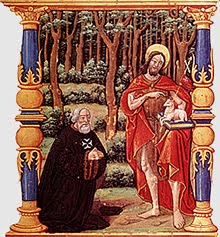
ADRIAN FORTESCUE (fort escu - strong shield) was born of an old Devon family in 1476. He served in the French campaign of 1513 with the young King Henry VIII, and became attached to Henry's court. He served again in France in 1523, and assisted at the coronation of Anne Boleyn, his first cousin, for the pope had not yet declared Katherine's marriage valid. But the oath of supremacy in 1535 opened his eyes to Henry's pretensions. Adrian had always been true to his faith (he was a knight of St John of Jerusalem and a Dominican tertiary), and early in 1539 he was sent to the Tower. He was then attainted by Parliament, and on July 9 of the same year beheaded on Tower Hill. The knights of his order have always revered him as a martyr, and his picture is in the church of St John at Valletta in Malta, with the martyr's palm.

Blessed Adrian, pray for us

FRA' FREDRIK CRICHTON STUART RIP

Today is the Anniversary of the late 56th Grand Prior of England, Fra' Fredrik Crichton Stuart. Of your charity pray for the repose of his beautiful soul, and invoke his intercession for the future reforms of our beloved Order. The Rosary pictured is the one he held when he died.

Anima eius
et animae omnium fidelium defunctorum 
per misericordiam Dei 
requiescant in pace.


THREE REQUIEM MASSES

Over then last few weeks the Order has celebrated Requiem Masses for some of our late brethren. Father Michael Lang, of the London Oratory, celebrated a Mass in the Chapter Room at Golden Square for the rose of the souls of Desmond Seward, Knight of Grace and Devotion in Obedience, and Herbert Coutts, Magistral Grace in Obedience, on Monday 22nd May. On Tuesday 2nd June, in die obitus, Father John Hemer MHM offered Mass for the repose of the soul of Sir George Bowyer, benefactor and founder of our Conventual Church in London and founder of the British Association.


On Saturday 28th May many members of the Order gathered at Goring-on-Thames for Mass in the parish church of our late Chaplain Mgr Antony Conlon, the first visit we have been able to make collectively following Covid, the celebrant being his successor, Father Kenneth Macnab, who generously gave the meditations. Following a suitably convivial lunch in the new parish hall complete in Fr Antony's memory, we processed to his grave for Absolutions supra tumulum.

REQUIEM AETERNAM DONA EIS DOMINE:
ET LUX PERPETUA LUCEAT EIS.
REQUIESCANT IN PACE.


LOURDES PILGRIMAGE TALKS

The Lourdes Pilgrimage is under weigh, Deo gratias, after two year's hiatus, and each day one of the Chaplains is giving a spiritual meditation which will be available here. These talks last about half an hour, the first two can be streamed below, with the text of the second talk provided at the end of this post.

Our Lady of Lourdes, pray for us
Our Lady of Philermo, pray for us


Talk 2 : St. Joseph the Worker

Order of Malta Lourdes Pilgrimage

1 May 2022


Some of you are aware that my last parish was Hatfield. The Salisburys were always very gracious: he as Chancellor of the University of Hertfordshire, where I was chaplain; she as a parishioner. It troubled me that many of the international students had never even heard of Hatfield House and had certainly never visited the place. I determined to rectify that, but felt some students might have been discouraged by the entry fee. So, I asked Lady Salisbury was there any chance of a discount? ‘Absolutely not,’ she replied. ‘You must all come for free, and I will show you round myself.’ She kept her word.


The Salisburys were not always so tolerant of Catholics. A century earlier they were distinctly unimpressed when a member of the family, Algernon Cecil, became a papist. To compound the crime, the new convert grew a beard. Hugh Cecil challenged his cousin:

‘Algernon, why have you grown that absurd beard.’

Algernon defended himself: ‘Our Lord had a beard.’ 

Hugh was having none of it: ‘But Our Lord was not a gentleman.’


We have to face facts.

BLESSED KARL OF THE HOUSE OF AUSTRIA

Today is the anniversary of the death, the heavenly birthday, of Charles I of Austria, the last Emperor, King of Hungary, and Blessed of our Order. Today is also the feast day of Blessed Nuno Alvarez Pereira, Prior of our Order.

He was beatified by Pope Saint John Paul II on 3rd October 2004. Pray for the continuation of his cause of sainthood, and for his intercession for our world today.

Blessed Karl, pray for us
Blessed Nuno Alvarez, pray for us

OUR LENTEN FAST

We are indebted to Monsignor Philip Whitmore, former Rector of the Venerable English College, for the Lenten Recollection he preached to the Order last Tuesday, in the presence of the Procurator of the Priory, Fra' Max Rumney, of the President, Chancellor and Vice-President of the British Association, and many knights and dames, in the Lady Chapel of St James's Spanish Place, by grace of the Rector.

For the benefit of those members of the Order unable to be present, the text is given below. We extend our prayers and commiserations to the two members of the British Association who had intended to make the Promise of Obedience that evening, but were unable due to having Covid. May they soon be fully recovered and pursue their religious conviction

The evening concluded with Sung Compline of the Little Office, for which we are grateful to Fr Stephen Morrison, OPraem, for his melifluous services as Hebdomadarius. 

We would ask for the prayers, as a matter of obligation, of every member of our beloved Order tomorrow, the Feast of Saint Joseph, on which day senior members of our Order, including our Procurator, will be meeting the Holy Father to further discuss the ongoing reforms of the Order.

FASTING IN LENT 

Monsignor Philip Whitmore

As we heard in the Gospel on the first Sunday of Lent, 


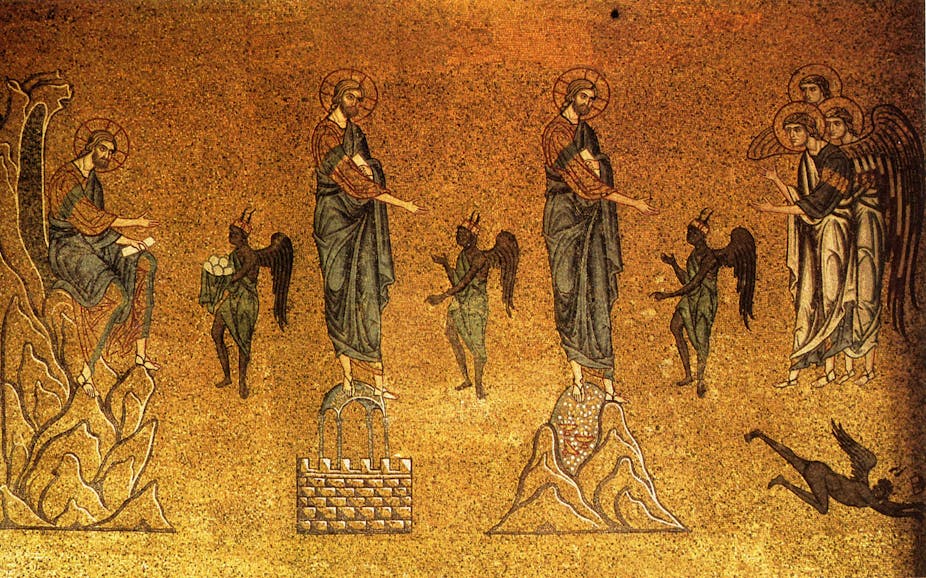
Jesus was led by the Spirit through the wilderness, being tempted there by the devil for forty days.  During that time he ate nothing and at the end he was hungry.  


During Lent, we join Our Lord in his fast of forty days.  I want to speak to you tonight about fasting. We’re asked, as you know, to include in our Lenten observance prayer, fasting, and almsgiving, and of the three I think fasting is probably the one people find most difficult.  Difficult, not only to do, but difficult even to understand why we do it.  Of course it’s important for us to be able to explain the reasons why we Catholics do the things we do and why we believe the things we believe.  “Always be ready to give a reason for the hope that is in you”, as we read in the first letter of Saint Peter.  Because even if there are plenty of people today who find our faith baffling, you only have to scratch the surface to discover that most of them are searching for a way to make better sense of their lives.  So there’s a great opportunity for us, and a great challenge, to find a way of getting our message across to people who are hungry for the truth.  Obviously, the better we understand it ourselves, the better equipped we are to do that.  So let’s focus this evening on the ancient practice of fasting, and try to see how it fits into the grand scheme of our faith and our spirituality.  Our faith should touch us on every level of our being, and fasting obviously affects us right down there in the gut.

A SHIP TOSSED BY WAVES


Members of our beloved Order, with its long maritime history fighting the forces of Evil in the form of our fellow men, will have no trouble relating their spiritual lives to the Gospel of last Sunday, the small boat on the Sea of Galilee overcome by waves as Our Lord slept. We live again in such times today, both in the Church, and in our Order.

Many of our readers, especially those who have been to Lourdes or worked in the Spanish Place Soup Kitchen, will know the Reverend Gwilym Evans, former Master of Music of the Grand Priory, and now a Deacon, to be ordained Priest, Deo volente, in June this year. Pray for him.

The video below is the stirring homily on Holy Mother Church and Christian Hope he preached last Sunday at the Masses at the shrine church of St Mary's Warrington – "This boat cannot sink!"

PRAYERS FOR THE HOLY FATHER


We are invited most particularly at this time to pray for our Holy Father Pope Francis. Readers of this Blog are firmly encouraged to have a Mass said for Him, or ideally a Novena of Masses, and not to omit daily prayers for the person of the Holy Father, in addition to their prayers for His intentions.

This seems most especially fitting as we approach the old feast of the Chair of Saint Peter in Rome (next Tuesday), which intiates the Octave of Prayer for Christian Unity, which closes with the Conversion of Saint Paul.

TU ES PETRUS,
 et super hanc petram aedificabo ecclesiam meam;
 et portae inferi non prevalebunt adversus eam; 
et tibi dabo claves regni coelorum.

V. Oremus pro Pontifice nostro Francisco.

R. Dominus conservet eum, et vivificet eum, et beatum faciat eum in terra, et non tradat eum in animam inimicorum eius.

Oremus. Deus, omnium fidelium pastor et rector, famulum tuum Franciscum, quem pastorem Ecclesiæ tuæ præesse voluisti, propitius respice: da ei, quæsumus, verbo et exemplo, quibus præest, proficere: ut ad vitam, una cum grege sibi credito, perveniat sempiternam. Per Christum, Dominum nostrum. Amen.

THOU ART PETER, and upon this rock I will build my church;
 and the gates of hell shall not prevail against it. And I will give unto thee the keys of the kingdom of heaven.

V. Let us pray for Francis, our Pope.

R. May the Lord preserve him, and give him life, and make him blessed upon the earth, and deliver him not up to the will of his enemies.

Let us pray. O God, Shepherd and Ruler of all Thy faithful people, look mercifully upon Thy servant Francis, whom Thou hast chosen as shepherd to preside over Thy Church. Grant him, we beseech Thee, that by his word and example, he may edify those over whom he hath charge, so that together with the flock committed to him, he may he attain everlasting life. Through Christ our Lord. Amen.

BLESSING OF THE EPIPHANY WATER

Last evening, the Vigil of the Epiphany of the Lord, by ancient custom the Church blesses water, the most powerful of the holy water of the Church's year, with powerful exorcisms over the water and the salt, to provided supernatural protection for the faithful against the demons who prowl around to destroy our souls.

A function which belongs to a prelate, the blessing was solemnly celebrated for us by the Abbot of Farnborough, Dom Cuthbert Brogan OSB, at the church of St James Spanish Place, by kind permission of the Rector, who assisted in choir.

Dom Cuthbert spoke beforehand as follows.

I was reminded solemnly in the sacristy that when the order of service says sermon it does not mean sermon, but means instead some short words of instruction. So here we go!...


We celebrate in these days the Epiphany one of the great Theophanies or shewings forth of the God head. So many and so rich are they that the church down the ages has unwoven the various shewings and given them their own feasts or gospels - and so we have the visit of the wise men, the wedding feast at Cana, and the Lord's baptism in the Jordan by John, in Jordane a Joanne - as the antiphon beautifully puts it.


In the baptism all three Persons of the Trinity are revealed - the Father's voice, the spirit as a dove, and Jesus himself goes down in to the waters. But why should he be baptised? He who has no sin. At first John protests, and in a wonderful hymn, Romanus the Melodian, the chief cantor at Hagia Sophia in Constantinople, explains this. John thinks it must be a trick. He knows that in the Old Testament anyone who approached God died on the spot. The psalms tell that they melt like wax who approach God, that the one who tried to save the Ark died on the spot. And so he is naturally reluctant to touch our Lord.


But St Ephrem the Syrian wiring in the fourth century tells us why Jesus went down in to the Jordan. So that he could leave his divine life there. Wherever there is a baptism he says the waters are transubstantiated into the waters of the Jordan and the neophyte, the new Christian, emerges clothed not with Adam's shame but with the restored brightness, the image and likeness of God given him at creation, “quoniam in Jordane lavat Christus ejus crimina.


The old rituals refer to the ceremonies of this night as being according to the customs of the Oriental Churches. We know how the Orthodox today love to plunge into freezing water to celebrate this feast.


What do we do tonight? With the Church's solemn exorcisms and prayers we bless chalk and salt and water, and we go to our homes armed with these powerful weapons. St John Chrysostom in the fourth century attests to Christians taking holy Water home on this night. And just as the Israelites marked their doors with blood as a sign of salvation so we chalk our doors with the holy cross and the letters CMB - meaning Caspar Melchior and Balthasar - the three wise men - asking also God's blessing for the coming year. CMB also can mean Christus Mansionem Benedicat - may Christ bless this house.

So there you are - now duly instructed, we proceed to the sacred ceremonies.

The ceremony may be watched in the video below. It begins at 1:13:23.