As Cardinal Mercier said : "When prudence is everywhere, courage is nowhere."                                                                                  From Cardinal Sarah : "In order to avoid hearing God's music, we have chosen to use all the devices of this world. But heaven's instruments will not stop playing just because some people are deaf."                                                                                              Saint John-Paul II wrote: "The fact that one can die for the faith shows that other demands of the faith can also be met."                                                 Cardinal Müller says, “For the real danger to today’s humanity is the greenhouse gases of sin and the global warming of unbelief and the decay of morality when no one knows and teaches the difference between good and evil.”                                                  St Catherine of Siena said, “We've had enough exhortations to be silent. Cry out with a thousand tongues - I see the world is rotten because of silence.”                                                  Chesterton said, “The Christian ideal has not been tried and found wanting. It has been found difficult; and left untried.”                                                Brethren, Wake up!

WARDOUR - FR MONTGOMERY'S SECOND PAPER


The first paper in this two-part meditation is given HERE.  We are grateful to Fr Edmund Montgomery for his insights into our Faith, an to the Faith of the Martyrs in this land.

In the Name of the Father and of the Son and of the Holy Spirit. Amen.

In our First Conference we heard how the true understanding of martyrdom is to ‘bear witness’ and we explored both martyrdom in this sense in Scripture, in tradition, and in our lives, too.

A witness in Court, as we know, is required to affirm: ‘I swear by almighty God, that the evidence I shall give will be the truth, the whole truth, and nothing but the truth.’ They are on oath before God that their testimony is true.

To be a martyr is to be a witness. To be a witness is to be obliged to tell the truth. So that our lives may tell the truth, we must live lives of integrity: faithful to the Lord’s commands, the teaching of His Church, and the obligations we have taken on as members of the Order. It all has to be, as it were, a seamless garment: we claim to be Catholics, good, then we must show that by the conduct of our lives, otherwise our witness testimony will be seen to be unreliable; we claim to be members of the Order, good, then we must show that by the conduct of our lives, otherwise our witness testimony will be seen to be unreliable.

But we also witness to each other. St Paul put it like this, ‘Therefore, since we are surrounded by such a great cloud of witnesses, let us throw off everything that hinders and the sin that so easily entangles. And let us run with perseverance the race marked out for us, fixing our eyes on Jesus, the pioneer and perfecter of faith. For the joy set before him he endured the cross, scorning its shame, and sat down at the right hand of the throne of God. Consider him who endured such opposition from sinners, so that you will not grow weary and lose heart.’11 St Paul literally writes, ‘Therefore, since we are surrounded by such a great cloud of martyrs...’

Our testimony, our witness to each other than encourage or discourage each other. To be absent from Mass, to not support our parish priests, to be never amongst those who volunteer that can be a real counter-sign to our witness as Catholics; to be absence from Order events, to not support our confreres, to not be involved in the works of the Order unless it fits with our social lives or plans for recreation that can be a real counter-sign to our witness as members of the Order.

St John, writing in the last book of the Bible, Revelation, sees a vision of heaven, ‘After this I looked, and there before me was a great multitude that no one could count, from every nation, tribe, people, and language, standing before the throne and before the Lamb. They were wearing white robes and were holding palm branches in their hands.’12 The multitude in heaven, that is – everyone in heaven – are dressed in white and holding palm branches. The palm branch, as you know from Christian iconography and symbology is the attribute of the martyr. St John foresees that everyone in heaven is a martyr. We get to heaven if we bear witness. The testimony of our lives is written by our deeds and our testimony bears witness to what we truly believe is important, our real priorities, where we consider our true energies should be directed. Please God these all align with our duties as Catholics and our obligations in marriage and family life, religious profession, ordination, and to the Order.

Let me share with you an episode from Penal Times here in England of a case so famous and so instructive in the Law it became almost a maxim of law in citing precedent. A number of Catholics attended a clandestine Mass, offered in secret as the Mass and priesthood were both outlawed under Elizabeth Tudor.

Nevertheless, these faithful Catholics, huddled around a makeshift Altar, took the risk – took their lives in their hands – by seeking out the Mass in a time when to attend would mean imprisonment for the laity and certain death for the priest. However, this Mass was a trap. The priest sent to ‘say’ the ‘Mass’ was, in fact, an agent of the Crown, and as the ‘Mass’ began, so the guards fell on the gathering, arresting all present. At their trial, the Catholics were defended by an excellent lawyer, Edmund Plowden, who challenged the basis on which they were arraigned.

Plowden admitted that it was contrary to the law to assist at Mass and to do so carried grave penalties. Yet, argued Plowden, how could there be a Mass? The so-called ‘priest’ was an agent of the Crown, there was no priest, and if no priest, no Mass, and if no Mass, no crime. The brilliant argument won the acquittal of the accused. And the legal principle, challenging the basis of a charge, has passed into legal parlance as ‘The case is altered, quoth Plowden’!

The bravery of those Catholics who ventured out to attend Mass, mindful of the grave penalties attached to breaking the Penal Laws, gave witness  they were true martyrs. They need not shed blood to be shown to be so, rather the courage of their witness is the authentic understanding of martyrdom.

Let us put ourselves ‘on trial’ by way of an Examination of Conscience: if the charges read that we were both Catholics and members of the Order of Malta, to convict us, there would need to be evidence ‘beyond a reasonable doubt’. What would acquit us? A ‘reasonable doubt’ that we are authentically living and daily striving to be good Catholics and good confreres of the Order. It can be a helpful way to consider our responsibilities as baptised persons and our particular state in life as well as the obligations attached to belonging to the Order, too.

But let me offer a word of encouragement to you also. I have been deliberately challenging in my choice of topic and the message I wanted to share with you today: that true martyrdom lies in bearing witness and that our lives – and our deaths – must testify to what we believe. We must take seriously our obligations and our responsibilities to God and to each other because we can be a source of encouragement of discouragement to each other by whether our example is edifying or otherwise.

It is certain that by the faithfulness to God and your lives of prayer you have been, and will continue to be, the witnesses or martyrs that the Lord desires us to be. The courage that the martyrs showed in the last moment as they were lead to the scaffold was only possible because they had already lived heroic lives and so, in the end, their death was a consequence of how they had lived. Their martyrdom began not with the first foot on the ladder to the scaffold but by their daily decision to love God above all things and to love their neighbour as they loved themselves. The true path to martyrdom is a desire to put to death all those parts of your heart and mine that cannot be offered to God or that God cannot bless. In this, the martyrs are not so different to you and me. The daily struggle of martyrdom and the aspiration that our lives give testimony and true witness that we live what we believe requires that we are willing to accept a form of martyrdom that requires us to seek authenticity and integrity in our lives as Catholics and as members of the Order.

From the perspective of Eternity, we will see on the Last Day at the General Judgment the consequences of both sin and grace, the impact that each of our lives and our choices for God or otherwise have had on the lives of others, on the course of human history, on the unfolding of God’s Divine Will and the effect of our witness and the testimony of our lives. I am confident that, through God’s grace, Divine Providence will both help us to strive for the good and given we all fall short, that God’s Providence will correct what we have omitted, undone, or deliberate chose to do, contrary to His Will.

But let us not forget that we have deep and serious obligations to God and to each other. We must renew these commitments and ask for God’s grace every day to carry them out. But more than this, we must decide, choose, to fulfil them. When this is a struggle, or requires effort, or makes us need to change our plans or make sacrifices, then let us see in this our own small martyrdom, and overcome these struggles with something of the same courage by which our forebears lived and ultimately, died for the faith.

Let’s commit ourselves to be authentic martyrs, true witnesses bearing testimony to what we believe by the manner of our lives, asking the prayers here of Ss Peter and Paul and the martyrs whose relics are only feet away from us, Ss Primus and Secundus, as we conclude:

Our Father – Hail Mary – Glory Be

In the Name of the Father and of the Son and of the Holy Spirit. Amen.


11 Heb 12:1-3
12 Rev 7:9

WARDOUR RECOLLECTION - REPORT AND FIRST PAPER


Last Saturday saw the annual recollection at Wardour Castle, attended as ever by an unusually large number of members of the Order and friends, this day is always a great success. We are deeply grateful to Lord Talbot of Malahide for his kind welcome, and to Fra' Richard Berkley-Matthews for his generosity at lunch in his beautiful garden in Tisbury. Fra' Richard extends his thanks to the team of volunteers who make this day possible.

Saturday was the Feast of Our Lady of Walsingham in the English Calendar, and Holy Mass, sung in English, was celebrated accordingly. The chapel’s statue of Our Lady of Walsingham, donated by a Dame of the Order, was on the Sanctuary.


We are also greatly indebted to our chaplain, Fr Edmund Montgomery, for his two wonderful papers, and for driving five hours from his busy parish in Ellesmere Port.

We give below the text of the morning paper. The afternoon paper will be published separately.


In the Name of the Father and of the Son and of the Holy Spirit. Amen.

I would like to add my own words of welcome to those gathered for this Day of Recollection here in this special place at Wardour Castle, soaked in the history of our Catholic faith, and a period of intense persecution and the sacrifice of so many martyrs. By the Tabernacle here we have flanking each side as though heraldic supporters the two Princes of the Apostles, Peter and Paul, martyrs of Rome, and beneath the Altar two martyrs, known to God, but whose names are unknown, adopted as ‘Primus’ and ‘Secundus’ by those who built this Chapel.

Let’s begin our Day of Recollection well by seeking the intercession of our Lady of Philermo, St John the Baptist, Ss Peter and Paul, the martyrs enshrined in the Altar here, Blessed Adrian Fortescue, Blessed Gerard, and all the saints and blessed of our Order:

Our Father – Hail Mary – Glory Be

When I asked Fra’ Richard what I might speak on today, he suggested that given the history of Wardour and the magnificent Chapel, I consider speaking about our Catholic past and the ‘Faith of our Fathers, living still, in spite of dungeon, fire, and sword’. The whole period of what we might call ‘Recusancy’ or ‘Penal Times’ we know well through our schooling, our reading, knowing the history of our country and of our Order. I want to embrace that invitation and broaden it slightly to understand what our forebears endured and what the sacrifice of their lives means for us, five centuries later.

PHOTO REPORT ON THE VICTORY MASS AND INSTALLATION OF THE GRAND PRIOR

(Click any photograph to enlarge)

Now that the funeral of her late Majesty Queen Elizabeth is past, and may we continue to pray for her soul, we are happy to offer the report upon the Victory Mass, held the day the late Queen died, Thursday 8th of September. Holy Mass of the Nativity of the Blessed Virgin Mary, called in the Order "Our Lady of Philermo", was celebrated at 11.30 am at the Church of the Assumption and Saint Gregory, Warwick Street, used as a Conventual Chapel of the Order.

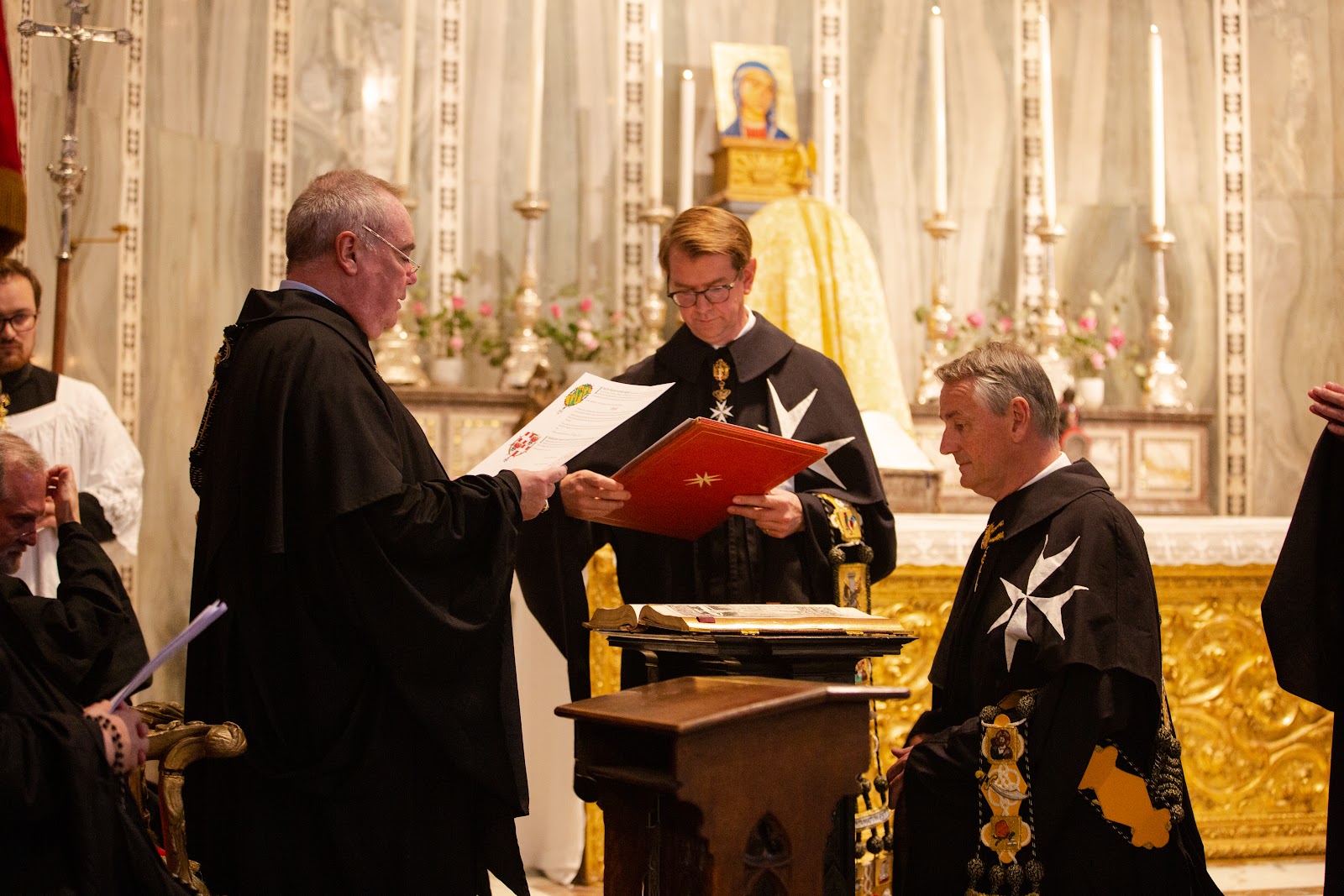
Mass was celebrated in the gracious presence of the Lieutenant of the Grand Master, His Excellency Fra’ John Dunlap, who during Mass installed HE Fra’ Max Rumney as the 58th Grand Prior of England. The Lieutenant was attended upon by Fra’ Duncan Gallie and Fra’ John Eidinow, now a member of Sovereign Council.

During the Gospel the Lieutenant held a sword in honour of the victory at the Siege of Malta, following a custom on this Feast in the Conventual Church in Valetta, on which day the Master held the sword of Grand Master de la Valette at the throne.

The Investiture, in the usual way, took place after the singing of the Gospel. The supporters to the new Grand Prior were Grand Prior emeritus Fra' Ian Scott, and Fra’ Julian Chadwick. Following the new Prior being led by the hand by the Lieutenant to his throne, members of the Grand Priory, knights in Justice and in Obedience, came forward to make the customary homage of Obedience. 

Holy Mass was offered by our Chaplain Fr Richard Biggerstaff, assisted by Fr Stephen Morrison OPraem and Fr Edmund Montgomery. The homily was preached by the Chaplain of the Grand Priory, Monsignor John Armitage, who is also Chaplain to BASMOM; the text was published HERE last week.

Mass was attended by the President of the British Association, HE Lady Celestria Hales, and two former Presidents, Peregrine Bertie and Richard Fitzalan Howard, and the Chancellor and officers of BASMOM.

The Grand Priory was delighted to welcome members of the Diplomatic Corps; the Apostolic Nuncio was represented by Mgr Ervin Lengyel, Counsellor. Also among the guests were Knights of St Gregory, members of the Order of the Holy Sepulchre and the Constantinian Order of St George; the Venerable Order of St John was represented by the Chancellor, Dr Gillian Willmore.

The music was performed by the 'Ensemble Pro Victoria', under the direction of Toby Ward, Master of Music of the Grand Priory, who was also organist. The Mass setting was Missa pro victoria a 9 by Tomas Luis de Victoria and the Offertory Decantabat populus by Orlando di Lassus. At Holy Communion were sung Ego flos campi and O salutaris hostia by Guerrero. During the homage they sang Job tonso capita by Clemens non Papa.

A Reception was held after Mass in the Grand Priory's Chapter Room and Library and in the Chalonner Hall, by gracious permission of the Rector, Fr Mark Elliott-Smith.

The Lieutenant was very pleased to be able to meet many people involved in the life and work of the Order in Britain, and in the evening attended the Companions' Soup Kitchen in St James's Spanish Place. The Order in England is very honoured to have been able to welcome him. During the evening the death of the Queen was announced, and the Rector, Monsignor Philip Whitmore, led members of the Order and our guests in silent prayer for the repose of her soul. May she rest in peace.

Our Lady of Philermo, pray for us
Saint John the Baptist, pray for us
Blessed Gerard, pray for us
Blessed Adrian Fortescue, pray for us


Lady Celestria with her Chancellor and the past Presidents
The Sword of State in procession
Entry of the new Grand Prior with his predecessor
Before the Oath
The singing of the Gospel, the Genealogy of Christ
The Lieutenant holds a sword during the Gospel,
in honour of the Victory of the Siege of Malta
... and returns it
Swearing the Oath, with hands on the Missal
Signing the Oath
The new Grand Prior on his throne
The Homage

Monsignor Armitage's sermon
Censing the Lieutenant at the Offertory 


Singing of the Inviolata at the end of Mass,
following the custom of Conventual Masses in Valetta
HE the Lieutenant with the President of BASMOM
in the Chapter Room
The Grand Prior at work in the evening
The Lieutenant with Mgr Whitmore and
Paul Letman, Chairman of the Companions
Teatime

IN THE SERVICE OF OUR FELLOW MEN - ON THE DEATH OF A QUEEN

Queen Elizabeth II as a girl, by Philip de Lázló

Lord , now lettest thou thy servant depart in peace.
 
An old lady, a very old lady, has died. As you might expect, her children, her grandchildren, her great grandchildren, her friends and relations mourn her. They find consolation no doubt in the old lady's unshakeable Christian faith. Perhaps they remember the words of the preacher in the book of Ecclesiastes we have just heard read whose magnificent poem echoes down the centuries, and find solace after a long life well lived in his words from which none of us can escape: there is a time to die. Thus a beloved person is lost to those around her who loved her, and is mourned, as we all may hope and wish to be mourned.
 
That is all perfectly normal.
 
So what is it that is happening to us and to many, many millions of people not just here in the United Kingdom, but around the world, which makes this old lady's death leave us feeling so profoundly moved and so bereft? Why is it that we feel such genuine and heartfelt grief? This is not normal; this is extraordinary.
 
It is not that the old lady was some titanic writer or scientist, some politician or soldier who had led nations to triumph or glory, some Mandela or Tolstoy or Newton or Napoleon. Not at all. She was an honest, decent, hardworking woman with a sharp sense of humour and a heavenly smile; an iron memory for faces, a fascination with people, a great expertise in bloodstock, an affection for this place which she often visited, and a quiet but profound Christian faith, the rock on which she built her life. Could we find other people, whom perhaps we know and love ourselves in our own families with similar qualities? Yes, we could, though we would be very hard pressed to find someone who was her equal in expertise on breeding race horses.
 
So what is going on? Why is the death of this one old lady, our late Queen Elizabeth II, so profoundly moving? Not just here in Britain, but around the world? Because it is profoundly moving, and if you do not feel it, there is perhaps something a little missing in you.
 
The answer I think is this. Through the genetic lottery of hereditary monarchy she had, not of her choice, laid upon her a task, from which she could not honourably escape, of almost intolerable weight. The task was to inhabit a role - and I use the word borrowed from the theatre deliberately - a role which meant that every day of her long life was constrained and shaped and observed; which meant that she sacrificed virtually all her freedom and voluntarily circumscribed her own individuality; a role which made us all feel that we owned her.
 
What was this role, and who was the ruthless playwright who scripted it?
 
Well, the role was to embody, physically, the values and traditions of the nations of which she was sovereign. And do it forever, for all her life.
 
Who wrote this terrifying script? The answer to that is: look in the mirror. We did, her peoples. We insisted she undertake it, and were often very quick to criticise from the cheap seats if we detected - usually wholly unfairly - any falling off in her performance.
 
Could she have refused the part? Yes, in theory she could, her uncle did, though she regarded such escapism with contempt. Could she have made a mess of it and failed our expectations? Yes indeed she could have done - a good many of her ancestors did make a spectacular mess of it. But she - did not. Aged not much older than you boys, at her twenty first birthday, she looked her future in the eye, accepted it, and pledged her life to fulfilling the role we had laid on her for the rest of her life.
 
Now you may say - "it was just a role - you've said it yourself, Provost - all play-acting processions and stage-set palaces" . But if you do say that you misunderstand in a profound way what it is that makes a nation, a people, a community, a family even, work.
 
Let me tell you one story from my own life to illustrate what I mean. When I was Minister of State in the Foreign Office during and after the fall of the Berlin Wall, I had the honour to receive in my grand office, which overlooked Whitehall and the Cenotaph, the first Foreign Secretary of free, non communist Poland.
 
It was the day of the opening of Parliament. We held our talks, while outside there was the noise of the preparation of the great procession when the monarch, escorted by the Household Cavalry, travels in the royal coach from Buckingham Palace to Parliament. There were bands playing, commands shouted, the clash of arms coming to the Present. It became clear to me that my Polish colleague wanted to watch the parade rather than to talk to me. So we put our papers aside and stood by the window and watched. He turned to me, this hero of anti communist resistance, who had helped free his country and said: "Minister, what we are watching matters. The communists robbed us of our rituals".
 
He was right.
 
He might have quoted Shakespeare; Ulyssein Troilus and Cressida:
 
There is a mystery - with whom relation
Durst not meddle - in the soul of state,
Which hath an operation more divine
Than breath or pen can give expression to.
 
No society or community can survive long without the rituals which embody what Shakespeare calls the state's soul - the ideals and dreams to which that society wishes to aspire, though all societies fail much of the time to achieve them. As another book of the old Testament puts it: "Where there is no vision, the people perish."
 
Some countries choose as Britain does, to have a hereditary constitutional monarch whom we require to embody that vision, that soul of our community, of our nationhood. Without thinking, often, what we are asking, we lay upon an individual human being what is a tremendous duty. We choose the person in an ancient way, by heredity, and require them to undertake the near impossible task of representing the sort of values to which we aspire and then to keep those values themselves safe from what Winston Churchill called the rancour and asperity of party politics - rancour and asperity which are inseparable from democracy but which, unless they are bounded by some sense of shared service to the national community can shake a nation to pieces.
 
So there we have it. This old lady - one of us, one of the ordinary human race - had that burden laid upon her, that extraordinary duty - to represent the very soul of the nation - of all the nations she served - to keep that soul safe and separate from the necessary power struggles beneath - and by becoming the very exemplar of service to give us something to love and to serve, and yes, sometimes something even to die for - and to do all this as a real, living, breathing, person. That is what she accepted all those years ago and having accepted the burden, she carried it all her long life without missing a beat.
 
That is what she did. And I think no one in the thousand years and more of our monarchy, ever did it better. That is why we, and all those millions feel bereft, and why we are right so to feel.
 
Now this strange ancient institution of monarchy provides also the antidote to the feeling of loss that so many feel. It comes, this antidote, much in the same way that it comes in many families. On the day that my own beloved mother died, some years back, another of her great grandchildren was born: life goes on. On the day that the Queen died, King Charles succeeded and in his own powerful and moving words on Friday made clear not only that he well understands the burden that he now carries on our behalf, but accepts it and will to the best of his own ability, carry it as his mother did. So we mourn, but we also celebrate: the story goes on. All the values of service, self-effacement, and duty, often so under-rated in the rat-races for power, money or fame which surround us, find a new quiet champion on whom we place the old burden, and who we look to with hope to carry on the work.
 
So that is why so many millions mourn: it is our way of saying "thank you" and for showing that we understand how well that quietly heroic old lady represented to us and for us all that is best in us. It shows that we know in our hearts that without such a rock of service on which to build our fractious human society so much will be lost. It reminds us that without that vision of duty and shared obligation, the people may indeed perish.
 
Thank you.

We offer the Sermon above, with acknowledgment and gratitude, but without apologies. It was preached by the Provost of Eton College, Lord Waldegrave of North Hill, on 11th September to the boys of that School, the beginning of Term. It sums up the spirit in which all members of the Order should approach their service of our fellow men. Only an accident of history has separated our beloved Order from our equally beloved Monarchy. The Catholics of Great Britain have never allowed that accident to separate them from the service of all that is good in this Realm. Let us pray for Queen Elizabeth. May She rest in peace.

HOMILY FOR THE "VICTORY MASS", AND INSTALLATION OF THE GRAND PRIOR

The sermon preached by Monsignor John Armitage, Chaplain to the Grand Priory of  England, on the occasion of the Installation of Fra' Max Rumney as the 58th Grand Prior of England, by Fra' John Dunlap, Lieutenant to the Grand Master, at the "Victory Mass", The Nativity of the Blessed Virgin Mary, in the Priory's Conventual Chapel of the Assumption and St Gregory Warwick Street, London, on September 8th 2022. Further photographs of this glorious ceremony will follow in a later post.


Brethren, we know that in everything God works for good with those who love him, who are called according to his purpose.” In a world that seeks fulfilment by seeking what I want, the Church is the witness, that the good we encounter in our world, is the result of the God who works for this good through those who love him, for the whole of creation is called according to his purpose. Only love can give our lives meaning and purpose, and our true fulfilment is a consequence of not doing what I want, but seeking, sharing, and doing what we need, building the common good of all humanity.  The Church has its fair share of those of us who do what we want, but our Order has been greatly blessed by those whose lives had been dedicated to building up the body of Christ, living witnesses of what we need, these people we call saints.  

Our founder Blessed Gerard, was known by his contemporaries as “the humblest man in the East, a servant of the poor, devoted to pilgrims, of simple appearance, but shining forth with his noble heart.” In the darkness of 1941 Pope Pius XII in an address to the Order, explained the true meaning of nobility. “In these poor, these orphans these wounded these lepers, lie you own title deeds of nobility, received at Bethlehem from the King of Kings who being rich became poor, that by his poverty you might be rich.”

In every moment in time there is a grace to be found, and the history of the Church shows us that it is in the darkest moments that God’s grace is most profound. “For where sin increased, grace increased all the more,” Romans 5:20 

When Pope Gregory the Great sent St Augustine to evangelise the pagan English, Rome was a dark and dangerous place, the Roman Empire was collapsing, the barbarians were at the gates, plague was rife, yet the successor of Peter sent a frightened monk to the edge of a crumbling empire. Pope Gregory understood the wisdom of the modern saying “Better to light one candle than to curse the darkness.”

Augustine built a monastery, it was the spiritual foundation, lighting the flame of faith for his companions to spread the Good News in a dark and dangerous land. All works of the Gospel must be based on firm spiritual foundations which from time to time must be renewed. 

The Holy Father calls us to a Spiritual Renewal, but such a renewal presupposes a spiritual legacy, this legacy has inspired the men and women of our country to respond to the call of the Gospel and the charism  of our founder from the foundation of the Grand Priory in 1144, through the martyrdom of our brothers, Blessed Adrian Fortescue, David Gunston and Thomas Dingley after the suppression of the Grand Priory in 1540. The blood of these martyrs was the seed that would lead to the restoration of the Order in 1875 with the establishment of the British Association and the restoration of the Grand Priory of England in 1993.

Whatever the darkness humanity faces, whatever the trials and tribulations of the followers of Jesus, Peter and his successors, the rock on which the Church is built, reminds us “that in everything God works for good with those who love him, who are called according to his purpose.” There will be darkness and confusion, from time-to-time we are faced with challenges, but for those of noble heart and humble demeanour, God’s grace enables them to "Listen to what the Spirit is saying to the Church,” not through their own plans or human projects but according to Gods purpose, as he works for the good with those He has chosen. 

The saints and martyrs of our Order were heralds of the Gospel, men and women of noble heart, experts in humanity,  for they were grounded in prayer, and shaped by their love and service of the Sick and the poor. The Preface of Saints tells us that “the Church is renewed in every age by raising up men and women outstanding witnesses of your unchanging love. They inspire us by their heroic lives and help us by their constant prayers to be the living sign of Your saving power.”  

The renewal of our beloved Order will be the consequence of lives that defend the faith by serving the sick and the poor. These heroic lives, founded on fidelity to prayer, will as they have always done, renew the Church and renew our Order. We pray that the renewal will inspire a new spirit of vocational openness, discernment and generosity, to the Professed life, and Obedience and a spirit of loving service that will inspire men and women to join as members or volunteers in the service of those most in need. 

As we stand on the threshold of this new chapter in the ancient tale of Christ’s hospitality, may we, your poor servants, take to heart the words of St Bernard that “the measure of our love will be to love without measure.” 

The BIRTH of Mary, and the YES of Mary brought the light of Christ to shine upon us. This light is experienced only through a human encounter, for the Word became flesh and lived among us. Therefore, the world waits for women and men, who have said yes to God, who are beacons of light to those who live in darkness. 

Today we wish to say Yes, as Mary said yes, to say Yes as Gerard and our martyrs said Yes, to say Yes in the footsteps of the thousands of members of our Order who over the centuries have served the poor and the sick and protected the Church by their example and loving service, always at a cost to themselves, and sometimes at the cost of their very lives! 

Today we commend our dear brother Max to the care and intercession of Our Lady of Philermo, Blessed Gerard, and all the saints and martyrs of our Order and assure him of our prayers, and for Lady Celestia Hales as the new President of BASMOM, may the Lord bless them and strengthen them in the days to come. 

It is a joy to welcome our beloved brother Fra' John Dunlap and we assure him of our prayers and fraternal loyalty at this moment of Grace in the life of our Order.

Each moment in history demands great sacrifices, acts of love and kindness, acts of graciousness and radical generosity to address the darkness that so besets our world. The challenge of renewal within our beloved Order, is about the revitalisation of the personal and generous response in the lives of its members. May the Grand Priory and the British Association, united in our common cause of service to Our Lords the Sick, embrace this moment of grace. 

May Peter, who in the midst of a storm walked on the water and started to sink and was saved by the Lord, strengthen our faith and courage. May Gerard’s humility and nobility of heart inspire us to lives of service and may Mary the one who was “greatly troubled” at what the Lord was asking of her remind us of Gabriel’s words, that the holy spirit will come upon us so there is no need to fear, for nothing is impossible for God. 

At this point Mary's YES and openness to God's will in her life, brought salvation to a fallen world. She “conceived the Lord in her heart before she conceived him in her womb.” In the heart of Mary the Church was born, in the heart of Mary, the Church is sustained, with her words “do whatever he tells you.” The heart of Mary teaches us that all renewal begins in our own hearts. May we conceive Him on our hearts, so that we may bring His love to a fallen world and dedicate ourselves once again to the defence of the Church by our unconditional service of our Lords the Sick. 

Our Lady of Philermo, pray for us.
Saint John the Baptist, pray for us.
Blessed Gerard, pray for us.

INSTALLATION OF THE 58th GRAND PRIOR OF ENGLAND

At a Mass yesterday at the church of the Assumption Warwick Street, Fra' Max Rumney was installed by the Lieutenant to the Grand Master, Fra' John Dunlap, as Grand Prior of England.  A report, and the homily, will follow shortly.

Ad multos annos!

PORTUNCULA INDULGENCE - TODAY!


Today is the day upon which every year we may gain the Portiuncula Indulgence, from the afternoon on the 1st August to sunset on the 2nd. This plenary indulgence may only be applied to the Souls in Purgatory, by the act of visiting a church following Confession and receiving Holy Communion. It is thus one of the greatest Acts of Charity we can perform, to release a soul from Purgatory. Why would one not do this? 

The Indulgence was granted miraculously to Saint Francis on a night of great temptation, in which he is said to have rolled as mortification in a briar-bush which became a bush of sweet thornless roses. Originally it required a visit to the cell where he died, now in the basilica at Portiuncula (see photo above) about a mile from Assisi, but by successive Popes, in their great mercy, has been granted more and more liberally until today any church may be visited to gain this indulgence. (This privilege has been finally established for an indefinite time by a decree of the S. Cong. of Indul., 26 March, 1911 (Acta Apostolicae Sedis, III, 1911, 233-4), and reformed and confirmed by Pope Paul VI in "Indulgentiarum Doctrina" (1967). This Apostolic Constitution established that a Plenary Indulgence may be gained only once a day.)

The obligations are the usual ones of Confession and Holy Communion, ideally on the day, and recitation of the Lord's Prayer and the Creed, and prayer for the Holy Father's intentions, carried out with the will to gain the indulgence, and a detachment from sin. That is all. The indulgence may be gained on each of the two days, thus twice, assisting two souls. Please make the effort to do this wonderful charitable work today! 

For more information see HERE.

MONTHLY RECOLLECTION 1 - FR HEMER ON SAINT JOHN

We are profoundly indebted to our chaplain Fr John Hemer MHM for the biblical learning he offered us this day, at a recollection in the Chapter Room in Golden Square. For those who do not yet know him, Father Hemer is scripture professor at Allen Hall seminary, and regularly offers us insightful food for meditation.  He celebrated the midday Mass in the church of the Assumption, which was followed by lunch in the Priory, and a second talk, Vespers and Benediction. The second talk, on the Good Samaritan, will be published later.

The first Epistle of John.
Here in the year 2020 we all have a sense that we are ‘up against’ the world, as well as being at its service. We understand that there are forces fiercely inimical to religion in general, Christianity in particular and Catholicism most of all. The discipline of apologetics, neglected, even disparaged in the catechetical euphoria that was the 1970’s and 80’s is now on every priest and seminarians ‘to do’ list.
As well as that challenge, for which there are increasingly ample resources, there is also the challenge of division, or at least disagreement within the Church. And that is often the thing which saps us of our energy, and we have, by now, probably all found ourselves alongside people whose understanding of Catholicism is at least somewhat different to our own, and sometimes seems to be a largely different religion. If we study St. Paul, especially 1 Corinthians we see this this already in the Early Church. But the Corinthian divisions seems to be of the cruder, grosser kind, setting up one leader against another, class divisions manifesting themselves during Mass etc. As far as St Paul tells us anyway, the Corinthians don’t seem to be arguing about theological niceties. But this is precisely the problem the letters of John deal with, and also, by the way, the way they behave towards each other. So there are the theological issues:
5 Who is it that overcomes the world but he who believes that Jesus is the Son of God? 6 This is he who came by water and blood, Jesus Christ, not with the water only but with the water and the blood. 7 And the Spirit is the witness, because the Spirit is the truth. 8 There are three witnesses, the Spirit, the water, and the blood; and these three agree. 9 If we receive the testimony of men, the testimony of God is greater; for this is the testimony of God that he has borne witness to his Son. 10 He who believes in the Son of God has the testimony in himself. He who does not believe God has made him a liar, because he has not believed in the testimony that God has borne to his Son. (1John 5:5-10)
And there are the moral issues:
9 He who says he is in the light and hates his brother is in the darkness still.  10 He who loves his brother abides in the light, and in it there is no cause for stumbling. 11 But he who hates his brother is in the darkness and walks in the darkness, and does not know where he is going, because the darkness has blinded his eyes. (1John 2:9-11)
If we think of the church’s traditional motto: Lex orandi lex credendi we could perhaps say John’s teaching here is more lex vivendi lex credendi or lex agendi lex credendi. So the primary issue is orthodoxy, but John makes it very clear that this must go hand in hand with orthopraxy. 

MONTHLY RECOLLECTION 2 - FR HEMER ON THE GOOD SAMARITAN

Here is the second of Fr Hemer's wonderful talks given at the July monthly recollection. The first is HERE.

Joachim v Saandrart 1632. Pinacoteca da Brera, Milan

The Good Samaritan

One of the reasons the parable of the Good Samaritan is so well known is that its meaning is so obvious. The straightforward interpretation one might say superficial that we should always be ready to help people in need is fine, but Jesus is saying a few other things more subtle than that.


The situation is perfectly plausible and the priest and the Levite may seem callous but they are prevented from touching the man for fear of ritual impurity.


Now Jesus doesn’t use this as an occasion to give a diatribe about religious hypocrisy. He understands perfectly well why they can’t do anything.


Only a few years ago, Catholic priests would never speak to anyone when they were carrying the Blessed Sacrament. That may seem rude and those who did not know might take offence, but a good Catholic would usually understand that.


The unfortunate man on the road to Jericho is what we call a victim and the priest and the Levite seem to fail in their reaction to this victim. Anyone who suffers misfortune we call a victim, but our modern use of the word is metaphorical rather than literal.


Search for the word ‘victim’ in an English translation of the bible and you won’t come up with much, in the whole RSV it only occurs twice. But There are two latin words which mean more or less the same thing:  victima and Hostia The word hostia in its various forms occurs 118 in the Latin Vulgate. The word victima 113. They never refer to a misfortunate person. They always refer to a sacrificial victim, an animal. The connection between these two types of victims, the cultic and the social, lies at the heart of the Gospel.


The priest and Levite seem to have no time, no compassion for this unfortunate victim at the side of the road, but their whole lives revolve around the other sort of victims, the more literal sacrificial ones. Because their concern is to be correctly ritually pure so that they can handle sacrificial victims at the altar, they seem to be blind or indifferent to the other sort of victims. That isn’t just a coincidence. A religion which requires literal sacrificial victims – bulls and goats – because it is concerned with purity will inevitably make other victims, the many outcastes whom Jesus worked so hard to rehabilitate, among them of course the Samaritans. 


The trouble with people being ritually pure is the only way they know they are pure is to have some other people who aren’t pure. The parable of the Pharisee and the publican shows that the Pharisee only knows how good he is because he knows or assumes how bad the publican is. He says: God, I thank thee that I am not like other men, extortioners, unjust, adulterers, or even like this tax collector. Much of the work of Jesus is to show that God doesn’t invest in this system of holiness, but rather in one of compassion.


We could almost say that the human race knows of no access to holiness that doesn’t somehow involve victims. There seems to be no way to God that doesn’t somehow have something to do with victims. Either people do it literally by sacrificing animals (or each other) and that nearly always involves a secondary set of victims – those who fall foul of the purity system. Or they have compassion on people who are victims in the other sense of the word, the poor, the downtrodden, the unfortunate, the marginalised. You either make victims or you stand in solidarity with them, but there is no religion without them. The story of Israel’s religion from Moses until 70AD, the final end of sacrifice is in a way the story of how people stopped making one sort of victim and learned to be compassionate to the other sort.


In the parable of the last Judgement in Mt. 25 the king says to the righteous: Come, O blessed of my Father, inherit the kingdom prepared for you from the foundation of the world; for I was hungry and you gave me food, I was thirsty and you gave me drink, I was a stranger and you welcomed me,  (Mt. 25:34-35) In other words the thing that makes them righteous is the way they behave towards victims, and surprisingly for them the kings says whatever you did to victims you did to me.


Which perhaps helps shed more light on the vision of heaven we find in Revelation. In ch. 5 we meet the Lamb who stands for Christ:


I saw a Lamb standing, as though it had been slain, (5:6)

 "Worthy is the Lamb who was slain, to receive power and wealth and wisdom and might and honor and glory and blessing!" (5:12)


But later on in 13:8 he is described as: the Lamb slain from the foundation of the world. Now this foundation of the world doesn’t refer to Genesis 1, there were no living things around to be slain. It refers surely to what begins to happen in Genesis 4, Cain’s murder of Abel and the strange thing we read that Cain built a city and called it after his son Enoch. That’s the foundation of the world, the world that Jesus repeatedly tells us he’s not a part of and warns us against belong to it. Many ancient cities have myths about foundational murders – Rome being the best example. In other words the foundation of the world is not the creation but it’s the putting together the world as we know it, it’s about how you make society hold together and the whole sorry history of the human race has been one of making victims. So often, in so many different ways some people are OK because others are victims. Some are wealthy, not by chance, but because others are poor. Some know they are good because they know others are bad. And if you think I’m exaggerating by calling that the foundation of the world, look what happens to Jesus when he tries to challenge it and change it. People hate Jesus because he challenges their clear cut idea of who is in and who is out, in other words what he does shakes the foundations of their world. So in many ways, making victims and making sure they stay victims is the foundation of the world, the kingdom of this world  


But the victims are also the foundation of the new world which the OT starts to give birth to but which Jesus inaugurates, A world where victims have a voice, where marginalised people are valued. So wherever you stand, whether you belong to the kingdom of this world, or you try to stand in the new world which Jesus is trying to create, victims are central to your world, they are part of the foundation of the world. You could say all the church’s social philanthropic efforts are trying to make a world where victims are not marginal, not forgotten but are central. Think of Lourdes where the most marginal of people stand at the centre of everything.


When we see someone homeless who looks rough, the worse for drink or drugs, part of us feels compassion but part of us also feels it’s a bit their own fault too. The road to Jericho was known to be full of dangerous people and no one with any sense would travel it alone, and perhaps the priest and Levite think to themselves, “well if he’s stupid enough to come this alone, I’ve no sympathy.” In Kenya everyone warns about being in Nairobi after dark and I remember a girl volunteer who went by train, the train arrived early, when it was still dark. She’s been given copious warnings, but ignored them and within a hundred yards of the station was robbed of her luggage, fortunately not harmed in any other way. And although people felt sorry for her, quite a few just shook their heads and said: “well it’s her own fault”.


That’s part of the problem with victims; people think it’s their fault. That’s the issue in the book of Job, his friends for thirty-odd chapters keep insisting that it must be his fault. Just as with a real sacrificial victim, people assume that God approves of the sacrifice, so with metaphorical victims people can assume that God approves or somehow underwrites their suffering, if for no other reason than as a warning to the rest of us. 


And if God underwrites this suffering then we are of course free to ignore the plight of the victim, we leave him to it just as God has.


When someone is cruel to a person or an animal we say they are being inhuman. That’s spot on. To make victims is inhuman, and therein lies the massive mistake the human race made with regard to God. People assumed that he wanted victims. That’s why we needed revelation to tell us he doesn’t. that’s why his Son had to become a victim to show people what’s really going on and to make sure it doesn’t happen again. We don’t need victims, rather we gather round one.


O salutaris hostia – O saving victim,


The human instinct in a crisis is to make some victims, even for some to make themselves victims, but the whole of the Bible is trying to wean us off that. So as the Vicar of Christ his most solemn duty in a situation like this is to resist that sacrificial impulse.


In Mark’s gospel we get the same scene. But here Jesus supplies the answer and then the lawyer says to him: 

"You are right, Teacher; you have truly said that he is one, and there is no other but he; and to love him with all the heart, and with all the understanding, and with all the strength, and to love one's neighbor as oneself, is much more than all whole burnt offerings and sacrifices."

  And when Jesus saw that he answered wisely, he said to him, "You are not far from the kingdom of God." 


This perhaps makes it a bit clearer the the issue behind the parable is the question of sacrifice and victims. The parable is in many ways a midrash on that, and the repudiation of sacrifice is made more clearly the point the simple meaning of the parable is obvious but profound, just as Jesus answer to the lawyers question is simple but profound. But the simple meaning remains a profound one, it’s something that helps us to be truly, deeply human.